

Your Garage Concrete Floor Is Dirtier Than It Looks — Here’s What to Do About It
The best way to clean a garage concrete floor in a commercial setting is a multi-step process that goes well beyond a quick sweep and rinse. Here’s the short answer for property managers who need it fast:
Quick Answer: Best Way to Clean a Commercial Garage Concrete Floor
- Clear the area — remove all vehicles and loose debris
- Dry sweep or vacuum — remove grit before any wet cleaning
- Pre-treat stains — apply an alkaline degreaser to oil and grease spots; use a rust remover for rust stains
- Scrub and dwell — let the cleaning solution soak for 5–10 minutes without drying
- Hot-water pressure wash — use 1,500–2,000 PSI to extract contaminants from porous concrete
- Reclaim wastewater — capture runoff to comply with EPA stormwater regulations
- Dry completely — squeegee and air-dry before reopening the area
Concrete looks tough — and it is. But it behaves more like a dense sponge than a solid rock. Because it is porous, a commercial parking garage floor absorbs everything: motor oil, hydraulic fluid, rust from metal equipment, road salt, and tire rubber. Under heavy vehicle traffic, those contaminants don’t just sit on the surface — they sink deep into the slab. Left untreated, they create slip hazards, degrade the concrete over time, and make your property look neglected.
That’s a real problem for property managers in greater Los Angeles, where curb appeal, tenant safety, and stormwater compliance all demand a clean, well-maintained floor.
I’m Jana Hanson, and I’ve led Klean Sweep’s exterior maintenance operations across the Los Angeles area since 2012, building on over 55 years of commercial cleaning expertise my father Norm Basmajian established. Knowing the best way to clean a garage concrete floor in high-traffic commercial environments is something our team applies every day across parking structures, industrial sites, and managed properties throughout Southern California. Let’s walk through exactly how it’s done right.
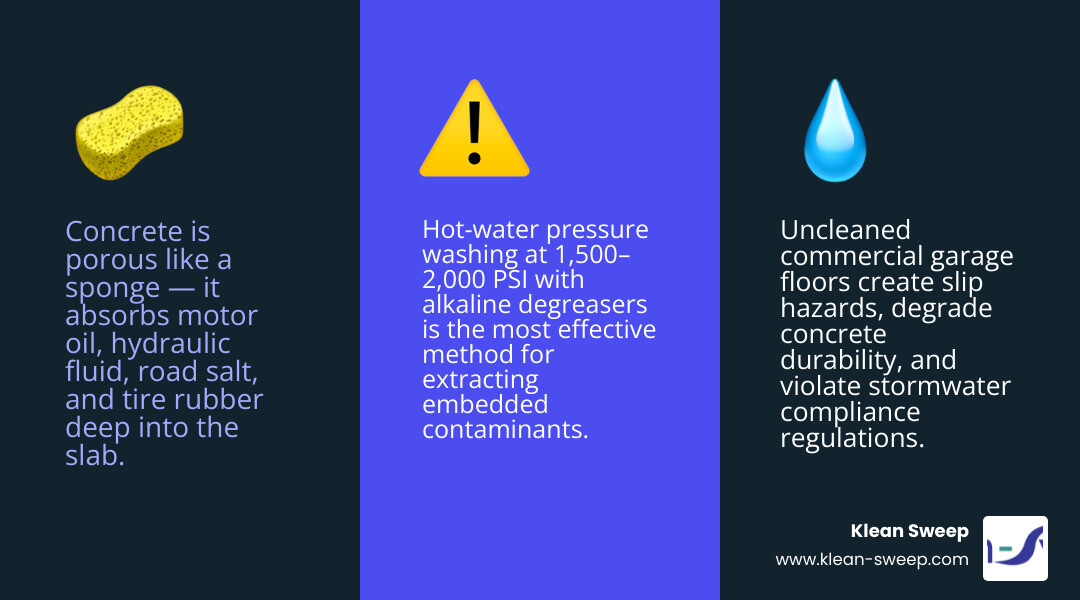
Best way to clean garage concrete floor terms made easy:
Why Professional Pressure Washing is the Best Way to Clean Garage Concrete Floor Surfaces
When it comes to high-traffic commercial parking structures in cities like Pasadena CA or Beverly Hills CA, a standard cold-water garden hose or a light-duty pressure washer simply won’t cut it. The best way to clean a garage concrete floor that experiences heavy daily traffic involves high-performance, commercial-grade hot-water pressure washing.
Hot-water pressure washing operates on the same principle as washing greasy dishes: heat breaks down the molecular bonds of oils and grease. While cold water merely pushes oil around on the surface, hot water (often heated up to 200°F) melts solidified grease, allowing it to be lifted and extracted from the concrete’s porous structure.
To achieve a deep clean without damaging the masonry, we typically set our pressure washers between 1,500 and 2,500 PSI. Going above 3,000 PSI on standard concrete can permanently etch, scar, or degrade the surface, especially if the wand is held too close. To prevent this, professional crews use rotating surface cleaners that distribute the pressure evenly and prevent the “striping” marks left by manual wands.
For a deeper dive into how this works, you can read our Beginners Guide to Pressure Washing or check out our guide on how to Stop the Grime with a Power Washed Concrete Floor.
Water Reclamation and EPA Regulations
In Southern California, environmental compliance is not optional. Under the Federal Clean Water Act and local municipal codes in Torrance CA and Carson CA, discharging soapy, oil-laden runoff into the storm drain system is illegal and carries severe financial penalties. Storm drains lead directly to our oceans without treatment, meaning any oil, heavy metals, or chemical degreasers washed off a parking garage floor would pollute local marine habitats.
Professional concrete cleaning requires a closed-loop water reclamation system. As the hot-water pressure washer cleans the concrete, a powerful vacuum system immediately captures the dirty wash water. This water is then pumped into a filtration tank on our service trucks, separating the hydrocarbons and debris so the treated water can be discharged safely into the sanitary sewer system.
For a comprehensive breakdown of standard commercial pressure washing setups, you can also consult How to Pressure Wash Your Garage Floor and Driveway: Complete Guide (2026).
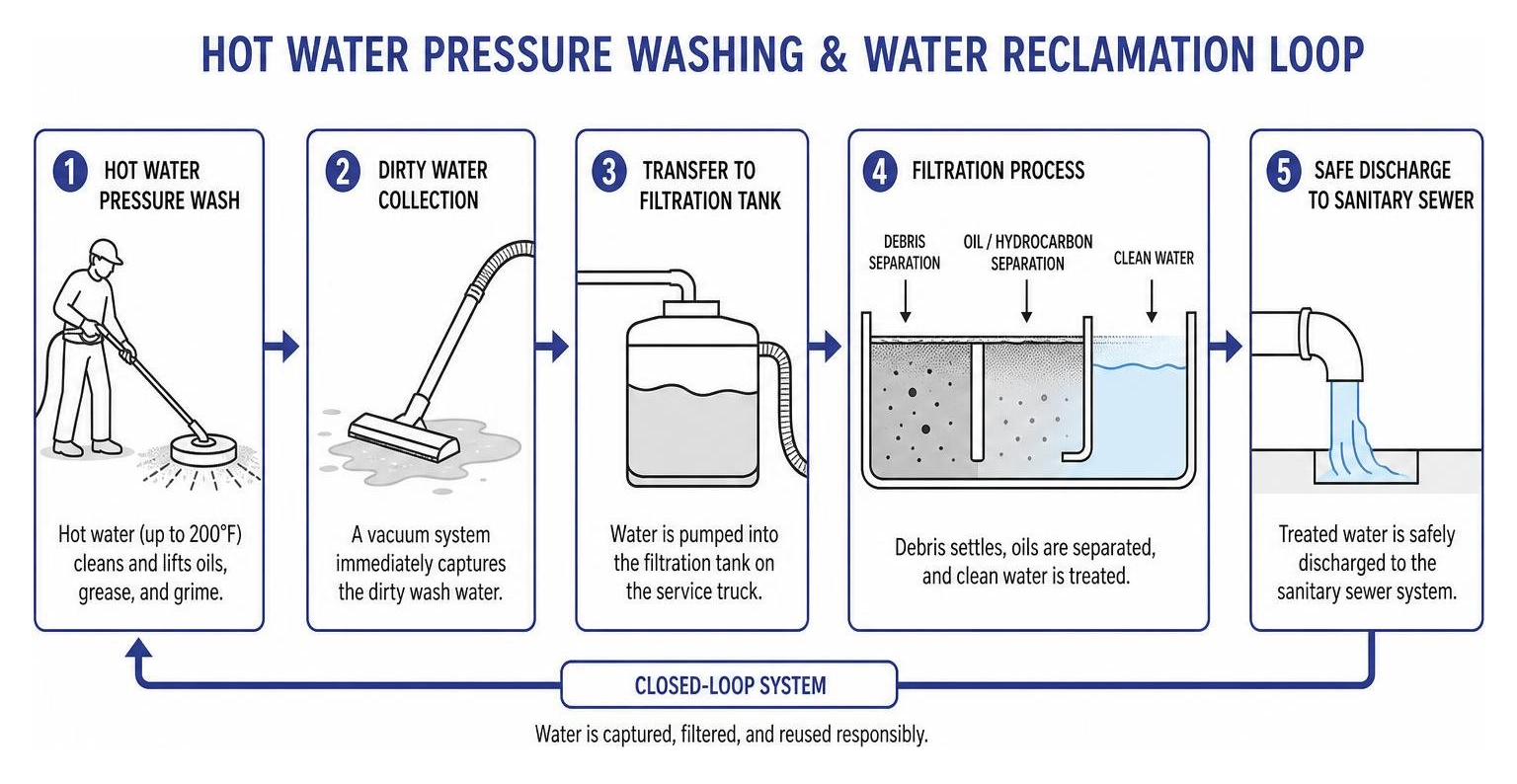
Step-by-Step Commercial Concrete Cleaning Process
Cleaning a commercial garage concrete floor requires a systematic approach to ensure both efficiency and safety. The table below outlines the primary methods used during a commercial concrete cleaning project, highlighting their specific roles.
| Method | Best Used For | Equipment Used | Expected Outcome |
|---|---|---|---|
| Dry Sweeping & Vacuuming | Removing loose dirt, dust, and abrasive grit before wet cleaning. | Industrial ride-on sweepers, HEPA shop vacuums. | Prevents dust from turning to mud; protects concrete from abrasion. |
| Mechanical Scrubbing | Agitating heavy grime and pulling up surface oil. | Walk-behind auto scrubbers with nylon grit brushes. | Deeply cleans the surface profile; prepares concrete for pressure washing. |
| Hot-Water Pressure Washing | Deep extraction of embedded oils, tire marks, and heavy stains. | Hot-water pressure washers (1,500–2,500 PSI) with surface cleaners. | Restores original concrete color; extracts deep-set contaminants. |
To execute this process correctly, our teams follow a strict step-by-step workflow:
- Pre-Sweep: We utilize heavy-duty sweepers to clear the deck. Skipping this step is a major mistake; if you apply water to dry concrete dust, it forms a thick slurry that settles right back into the concrete’s pores.
- Spot Treatment: We target heavy oil drips, rust spots, and tire marks with specialized chemical agents.
- Agitation: We use mechanical scrubbers to work the cleaning solutions deep into the slab.
- Rinse and Reclaim: We pressure wash the entire surface, vacuuming up the water as we go.
- Detail Mopping: In tight corners, around electrical boxes, or near elevator lobbies where heavy machinery cannot reach, we perform manual detail work. For more on the tools used for these tight spaces, see our review of the 7 Best Mops for Concrete Floors That Actually Work.
To learn more about how we utilize heavy-duty mechanical scrubbers to maintain large commercial properties, read about our specialized Concrete Floor Scrubbing services.
The Best Way to Clean Garage Concrete Floor Oil Stains
Motor oil, transmission fluid, and diesel leaks are the most common contaminants in commercial parking structures. Because unsealed concrete is porous, these petroleum-based fluids quickly penetrate deep into the slab.
The best way to clean a garage concrete floor with oil stains is to use an industrial-grade alkaline degreaser. Alkaline cleaners work through saponification, a chemical process that converts fats and oils into soap, making them water-soluble and easy to wash away.
For fresh spills, we apply an absorbent material like granular clay absorbent or sawdust and leave it to absorb the bulk of the liquid. Once swept up, we apply the alkaline degreaser directly to the stain. The key to successful oil extraction is dwell time. The cleaner must sit on the stain for 5 to 10 minutes to break down the embedded oils, but it must not be allowed to dry on the surface. If it dries, the emulsified oil will settle back into the pores. After the dwell time, we scrub the area with a stiff-bristle brush and rinse with hot-water pressure washing.
For older, deeply set-in oil stains, we often use a poultice method. We mix an absorbent powder (like diatomaceous earth) with a strong solvent or degreaser to form a thick paste. We spread this paste over the stain, cover it with plastic wrap, and let it sit for 24 hours. As the solvent breaks down the oil, the absorbent powder draws the fluid out of the concrete through capillary action.
Discover how regular oil extraction preserves your property in our guide on Concrete Floor Cleaning for Long-Lasting Durability.
Removing Rust Stains and Efflorescence from Commercial Concrete
Rust stains are another common headache in commercial garages. They typically form when wet metal tools, structural steel, or older vehicles sit on unsealed concrete. Unlike oil, which is a surface-penetrating liquid, rust is an iron oxide stain that chemically bonds with the concrete.
To dissolve rust, you must use an acidic cleaner. However, strong acids like muriatic acid must be used with extreme caution. Muriatic acid is highly corrosive; it dissolves Portland cement (the chemical binder that holds concrete together) and pulls calcium hydroxide to the surface. When the water evaporates, this calcium leaves behind a white, powdery crystalline deposit known as efflorescence.
Instead of harsh muriatic acid, we recommend using safer, targeted acid solutions like phosphoric, oxalic, or citric acid. These acids dissolve the iron oxide without degrading the underlying concrete matrix.
To treat rust:
- Clean the area of any grease or oil first (acids cannot penetrate an oily film).
- Apply the rust remover and let it dwell for 10 to 15 minutes.
- Scrub with a stiff nylon brush (never use a wire brush, as metal bristles can break off, rust, and create new stains).
- Rinse thoroughly and neutralize the area with an alkaline solution (such as baking soda and water) to stop the acid reaction.
For more professional tips on keeping your concrete surfaces pristine, read about The Secret to a Rust Free Concrete Floor or explore our list of the Top Rated Rust Removers for Your Concrete Surfaces.
Preparing Commercial Garage Floors for Epoxy or Coatings
Applying a protective epoxy or polyaspartic coating is an excellent way to protect commercial concrete from future staining and chemical damage. However, an epoxy coating is only as good as the surface preparation beneath it. The number one cause of epoxy coating failure is poor surface cleaning and profiling. If the epoxy cannot form a mechanical bond with the concrete, it will peel and blister under the weight and heat of vehicle tires.

Before applying any coating, the concrete must undergo rigorous testing and profiling:
- The Moisture Test: Sub-slab moisture is a major threat to epoxy. If moisture vapor rises through the concrete slab, it will build up pressure under the impermeable epoxy coating, causing it to delaminate. To test for this, we tape a 2-foot by 2-foot plastic sheet completely to the floor for 24 to 48 hours. If condensation forms on the underside of the plastic or the concrete beneath it is dark and damp, a vapor barrier must be applied before coating.
- The Sealer Test: We pour water onto the concrete. If the water beads up, a sealer is present and must be mechanically removed. If the water absorbs quickly, the concrete is unsealed and ready for profiling.
- Surface Profiling: To ensure the epoxy bonds, the concrete surface must be roughened to a texture similar to 80-grit sandpaper. This is achieved either through mechanical grinding (using a diamond-grinding machine) or acid etching.
For a deeper look at preparing commercial concrete for coatings, you can read the step-by-step process outlined in How To Clean Garage Floor For Epoxy.
The Best Way to Clean Garage Concrete Floor Areas Before Coating
The best way to clean a garage concrete floor before applying an epoxy coating involves a meticulous process of degreasing, profiling, neutralizing, and drying.
First, any existing grease, paint, or laitance (a weak, milky layer of cement dust on the surface of new concrete) must be completely removed. We apply a heavy-duty concrete degreaser, scrub the floor mechanically, and perform a thorough hot-water rinse.
Next, we profile the concrete. While acid etching with phosphoric acid is a common alternative method, commercial projects in Southern California cities like Brea CA and Pasadena CA almost always utilize mechanical diamond grinding. Grinding is highly controllable, does not introduce large amounts of water into the slab, and completely removes laitance and old coatings.
If acid etching is used, the floor must be neutralized afterward. We apply an alkaline neutralizing agent (like baking soda or ammonia diluted in water) to ensure the concrete’s pH returns to a neutral 7.0. If the concrete remains too acidic, it will interfere with the chemical curing process of the epoxy.
Finally, the floor must dry completely. We recommend a minimum drying time of 24 to 48 hours (72 hours is ideal in humid conditions) before applying any primer or base coat.
Learn more about managing concrete chemistry in The pH Neutral Guide Keeping Your Concrete Floors from Having a Meltdown.
Frequently Asked Questions About Commercial Concrete Cleaning
Managing commercial parking garages and exterior concrete structures comes with unique challenges. Below are some of the most common questions we receive from property managers across the greater Los Angeles area.
How often should commercial concrete garage floors be deep cleaned?
We recommend a thorough, professional deep cleaning at least 1 to 2 times per year, typically in the spring and fall. Regular deep cleaning prevents the buildup of dangerous slip-and-fall hazards (like slick oil spots), protects the concrete from chemical degradation, and maintains a clean, professional appearance for tenants and visitors. Properties with exceptionally high vehicle turnover may require quarterly cleanings to keep up with oil drips and tire marks.
Can you pressure wash epoxy-coated or sealed commercial garage floors?
Yes, but you must use a completely different approach than you would on bare concrete. High-pressure streams (above 1,500 PSI) can force water under the edges of an epoxy coating, causing it to peel. For epoxy-coated or sealed floors, we use low-pressure washing (under 1,000 PSI) combined with soft microfiber mops and pH-neutral cleaners. Avoid any harsh acids, solvents, or citrus-based cleaners, as they will permanently dull and erode the glossy topcoat.
Why is wastewater reclamation important when cleaning commercial parking garages?
Wastewater reclamation is required by law under the EPA’s Clean Water Act. When cleaning a commercial parking structure, the runoff water contains heavy metals, motor oils, and chemical cleaners. If this water is allowed to flow into storm drains, it pollutes local Southern California waterways and beaches. Utilizing a professional service with a certified water reclamation system ensures your property remains compliant with local environmental laws and avoids costly municipal fines.
Conclusion
Keeping your commercial parking structure or industrial facility clean is essential for protecting your concrete investment, ensuring tenant safety, and staying compliant with strict Southern California environmental laws. Whether you are dealing with decades of stubborn oil stains, rust, or preparing a large deck for a fresh epoxy coating, doing it right requires commercial-grade equipment and specialized expertise.
At Klean Sweep, we have provided eco-friendly exterior maintenance services across the greater Los Angeles area since 1969. Headquartered in Torrance CA, our family-owned business utilizes state-of-the-art hot-water pressure washing and water reclamation equipment to serve commercial properties in Beverly Hills, Carson, Pasadena, Brea, and beyond.
Ready to restore your commercial concrete surfaces? Schedule Professional Concrete Floor Cleaning Services with Klean Sweep today.