

Why Choosing the Right Mop for Concrete Floors Makes a Bigger Difference Than You Think
The best mops for concrete floors are:
| Rank | Mop | Best For |
|---|---|---|
| 1 | Large Microfiber Flat Mop (Pro Grade) | Commercial & warehouse spaces |
| 2 | The Mop Bucket Concrete Dust Mop | Dry dust removal on rough concrete |
| 3 | O-Cedar ProMist MAX | Residential concrete floors |
| 4 | Rejuvenate Click n Clean | Multi-surface, light commercial use |
| 5 | Rubbermaid Commercial Products | High-traffic industrial floors |
| 6 | Mopit Mid Cordless Floor Scrubber | Large-area heavy-duty scrubbing |
| 7 | Zep Industrial Cleaning System | Grease and grime in commercial settings |
Concrete floors are tough — but they’re also surprisingly easy to clean wrong. They’re porous, uneven, and they hold onto dust, grease, and grime in ways that smooth tile or hardwood simply don’t. A standard cotton mop often just pushes dirt around. The wrong cleaning solution can leave residue or even damage a sealed surface.
For property managers overseeing parking structures, warehouses, or industrial facilities in the Los Angeles area, getting this right isn’t just about appearances — it’s about safety, compliance, and protecting a significant investment.
I’m Jana Hanson, and I’ve spent years growing Klean Sweep into one of LA’s largest exterior maintenance companies, giving me hands-on experience with every type of mop for concrete floors across commercial and industrial properties. In the sections below, I’ll break down exactly what works — and what doesn’t.
Choosing the Right Mop for Concrete Floors
When you walk into a warehouse in Torrance or a commercial garage in Los Angeles, the first thing you notice is the scale of the concrete. You can’t tackle that kind of square footage with just any tool. Choosing the right mop for concrete floors requires understanding the relationship between the mop material and the concrete’s texture.
Concrete is naturally porous. Even when polished, it has microscopic pits that trap dust. Traditional cotton string mops often struggle here; they become heavy when wet, and the fibers can snag on rougher patches, leaving behind lint.

Microfiber vs. Cotton: The Heavyweight Battle
In the professional cleaning world, microfiber has almost entirely replaced cotton. Why? Because microfiber is an engineered fiber that is split to be thinner than a human hair. This allows it to reach into those tiny concrete pores.
Statistics show that microfiber can hold up to seven times its weight in water. This high absorbency is critical for concrete because it allows you to pick up the dirty slurry rather than just spreading it around. Furthermore, microfiber is incredibly durable—it can be laundered hundreds of times without losing its “grabby” quality, whereas cotton begins to fray and lose its effectiveness much sooner.
Comparing Mop Systems
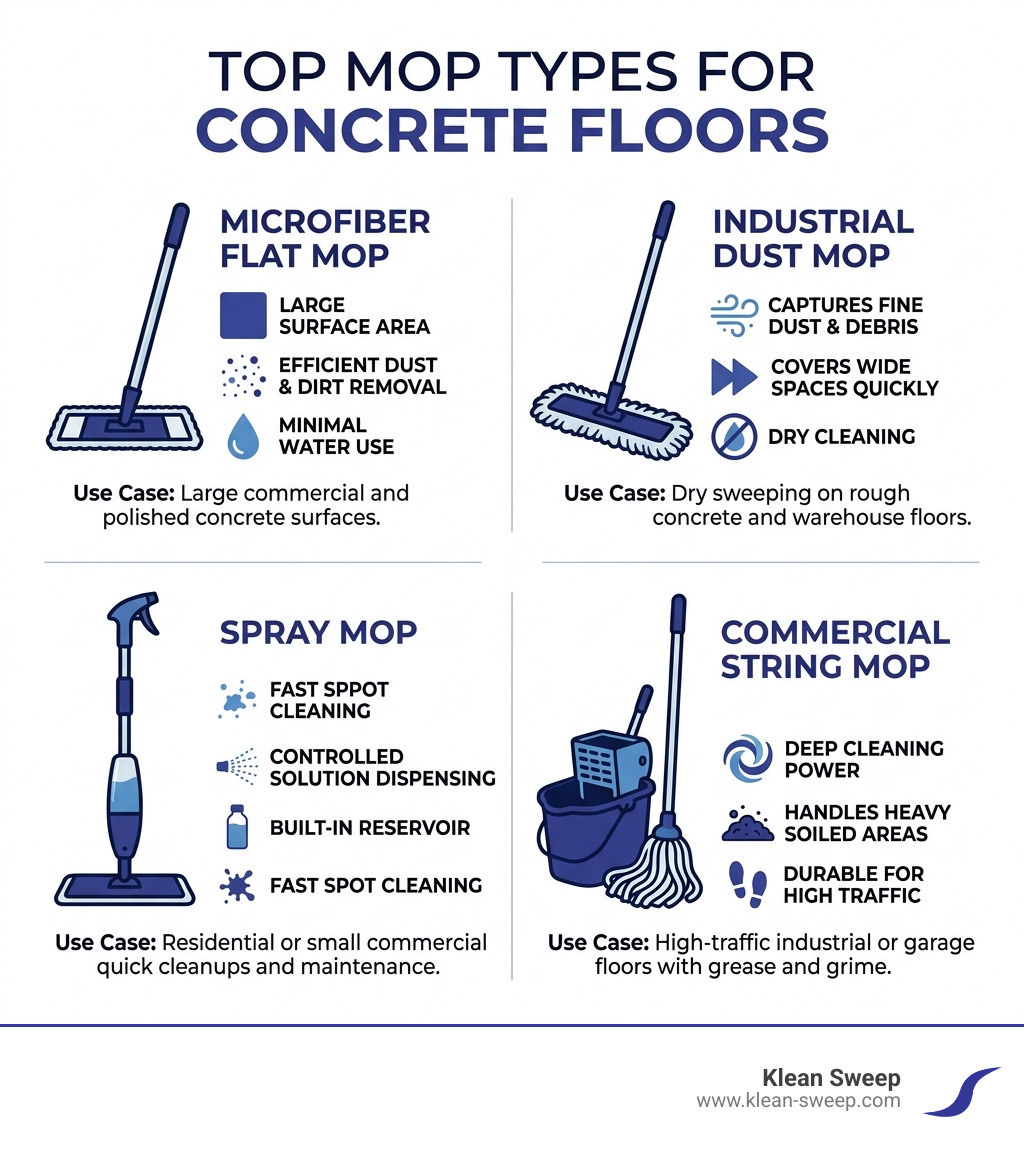
| Feature | Microfiber Flat Mop | Traditional String Mop | Industrial Dust Mop |
|---|---|---|---|
| Primary Use | Wet/Damp Mopping | Heavy Soil Removal | Dry Debris/Dusting |
| Maneuverability | High (Swivel Heads) | Low | Moderate |
| Ergonomics | Lightweight/Adjustable | Heavy when wet | Large/Awkward |
| Drying Time | Fast | Slow | N/A |
For those managing large spaces, swivel head maneuverability is a game changer. It allows the user to navigate around pallet racks, machinery, and corners without lifting the mop. Additionally, look for telescoping handles that can be adjusted to chin height, which reduces back strain during long shifts.
Best Microfiber Mop for Concrete Floors
Microfiber technology is the gold standard for a reason. Beyond its absorbency, it creates a mechanical bond with dust and allergens. When used on concrete, it provides a lint-free finish that is essential if you plan on applying a sealer or if you simply want that high-gloss polished look to shine. For more insights, check out our guide on Concrete Floor Cleaning for Long-Lasting Durability.
Key Features to Look For
- Synthetic Backing: Avoid mops with natural fiber backings that can rot. Synthetic backings dry faster and resist bacteria.
- Infinity Twist Yarn: This is a specific manufacturing style where the yarn won’t fray or unravel, even when used on high-friction surfaces like broom-finished concrete.
- Date Coding: Professional mops often feature date codes so you can track the lifespan of the product and ensure you aren’t using an “expired” mop that has lost its efficacy.
- Head Width: For residential use, 15-18 inches is fine. For industrial spaces in Southern California, you’ll want 24 to 36 inches to maximize coverage.
Top 7 Mop Recommendations for Concrete Surfaces
Whether you are maintaining a trendy retail space in Downtown LA or a massive distribution center in Torrance, these are the tools we recommend for the job.

1. Large Microfiber Flat Mop (Professional Grade)
This is the workhorse of the industry. These mops feature wide 18″ to 36″ frames and heavy-duty hardware that can withstand the daily grind of commercial use. The key to efficiency here is the “swapping pads” technique. Instead of rinsing a dirty mop in a bucket of increasingly filthy water, you simply pull off the dirty microfiber pad, toss it in a laundry bin, and slap on a fresh, clean one. This ensures you are always cleaning with a sterile surface.
2. The Mop Bucket Concrete Dust Mop
Specifically designed for the unique challenges of concrete, this mop features a 36-inch frame and Infinity Twist yarn. It’s pre-laundered, meaning it’s ready to trap dust the moment it arrives. The date-coding feature is excellent for property managers who need to keep strict maintenance logs. It’s particularly effective on rougher concrete where standard mops might get torn to shreds.
3. O-Cedar ProMist MAX
For smaller residential garages or light-duty office spaces, the O-Cedar ProMist MAX is a top-rated choice. It features a dual-sided pad that allows you to flip the head and keep cleaning without stopping. Its spray trigger means you don’t need a bucket, making it highly portable for quick spills on sealed concrete.
4. Rejuvenate Click n Clean
With a 4.4-star rating, this system is praised for its versatility. It includes a refillable bottle, allowing you to use specialized concrete degreasers. The mechanical scrubbing power provided by its sturdy frame helps lift stubborn scuff marks that a lighter mop might miss.
5. Rubbermaid Commercial Products
Rubbermaid is a staple in the industrial sector for a reason: durability. Their steel handles and high-impact plastic frames are designed for high-traffic endurance. If you have a team of janitorial staff who are tough on equipment, this is the brand that will survive the year. You can find a variety of these Wet Mops for Professional Use through industrial distributors.
6. Mopit Mid Cordless Floor Scrubber
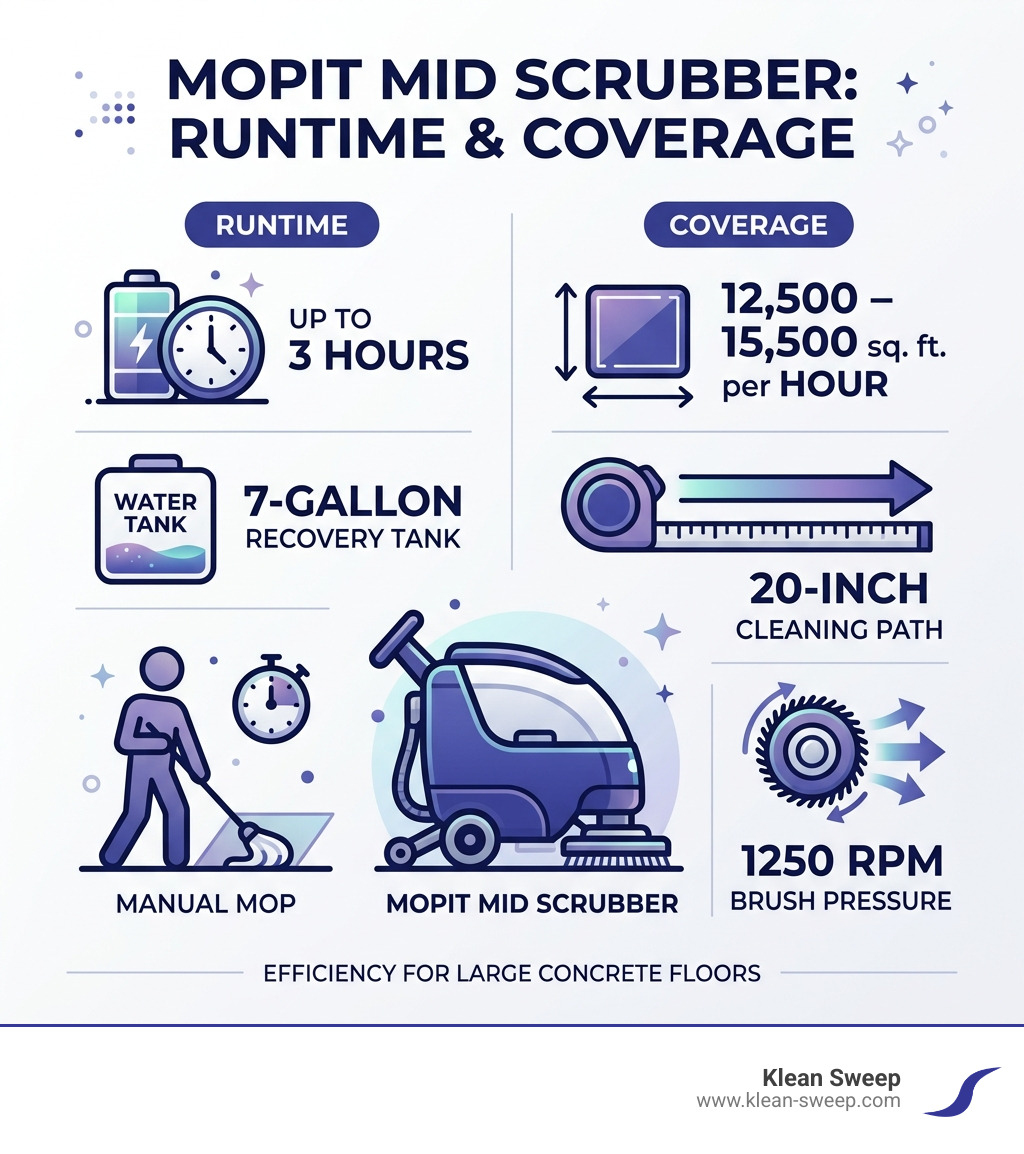
When manual mopping isn’t enough, you step up to the Mopit Mid Industrial Scrubber. This isn’t just a mop; it’s a cordless walk-behind machine that scrubs and vacuums in one pass. It features a 16-inch brush spinning at 1250 RPM and can cover up to 15,500 sq. ft. per charge. With a zero turning radius, it’s perfect for the tight aisles of a Southern California warehouse.
7. Zep Industrial Cleaning System
Zep offers more than just chemicals; their application systems are designed for heavy-duty grease removal. Using the Zep Extra Industrial Concrete Cleaner in combination with a high-grade microfiber mop allows you to break down industrial oils and carbon soot quickly. It’s a fast-acting formula that makes manual mopping significantly more effective.
How to Mop Concrete Floors Like a Professional
Mopping isn’t just about moving water around; it’s about technique. To get professional results, follow these steps:
Step 1: Dust Mopping (The Preparation)
Never start wet mopping without a thorough dry dust mop first. If you skip this, you’re just making “concrete mud.” Use a large dry microfiber pad and work in a figure-8 pattern. This keeps the leading edge of the mop always moving forward, trapping debris rather than pushing it aside. Shake out the pad frequently or swap it for a clean one as it becomes saturated with dust.
Step 2: Wet Mopping (The Technique)
Once the floor is clear of loose debris, it’s time for the wet phase.
- Dampen, Don’t Soak: Microfiber works best when it is damp, not dripping.
- Work Backward: Always move toward your exit so you don’t step on the clean, wet floor.
- The Figure-8 Pattern: Just like with the dust mop, use the figure-8 stroke. This ensures you cover every square inch of the porous surface.
- Swap Pads: For a typical 2,000 sq. ft. area, you should use at least 3-4 fresh pads to ensure you aren’t just redepositing dirt.
For businesses that need a deeper level of care, our team at Klean Sweep offers specialized Concrete Floor Cleaning in Torrance, CA to handle the heavy lifting.
Industrial Solutions for Heavy-Duty Concrete Cleaning
In large-scale industrial environments like factories or airport terminals, manual mopping has its limits. This is where the Mopit Mid and specialized chemicals come into play.
Manual Mopping vs. Machine Scrubbing
While a mop for concrete floors is great for daily maintenance, a walk-behind scrubber like the Mopit Mid offers several advantages:
- Speed: A machine cleans roughly 12,500–15,500 sq. ft. per hour, a feat impossible for a person with a mop.
- Water Recovery: Machines use a vacuum system to suck up dirty water immediately. The Mopit Mid, for example, has a 7-gallon recovery tank, ensuring the floor is dry and safe to walk on within seconds.
- Pressure: The 1250 RPM brush provides mechanical agitation that a human arm simply cannot replicate, which is vital for removing ground-in grease.
The Power of the Right Cleaner
For heavy grease, we recommend Zep Heavy-Duty Concrete and Masonry Floor Cleaner. These low-foam formulas are specifically designed for both manual mopping and automatic scrubbers. They can be diluted up to 1oz per gallon, making them highly economical for large Southern California facilities.
Frequently Asked Questions about Mops for Concrete Floors
Can I use a microfiber mop to apply concrete sealer?
This is a common debate in the professional community. While some pros prefer specialized applicators, a clean, lint-free microfiber flat mop can be used to apply sealers effectively. The key is to use a fresh pad and ensure an even, thin coat. However, once the pad is used for sealer, it should generally be considered disposable, as the resins can be difficult to wash out completely.
How do I maintain and launder my mop for concrete floors?
To extend the life of your microfiber:
- Launder regularly: Don’t let dirt sit in the fibers.
- Avoid Fabric Softener: This is the “golden rule.” Softeners coat the fibers and ruin the mop’s ability to “grab” dust and absorb water.
- Use Date Coding: Track when you put a mop into service. Most professional pads are good for about 100-500 washes depending on the surface roughness.
What safety precautions should I take when mopping concrete?
- Ventilation: When using industrial degreasers like Zep Extra Fast Acting Degreaser, always ensure proper airflow.
- Composition Floors: Be careful—many industrial concrete cleaners are too harsh for “composition” floors (like linoleum or vinyl). Only use them on the concrete and masonry they were designed for.
- Slip Prevention: Always put up “Wet Floor” signs. Concrete can be incredibly slick when wet, especially if there is a layer of soap or grease involved.
Conclusion
Finding the right mop for concrete floors doesn’t have to be a chore. Whether you opt for a high-tech microfiber flat mop or an industrial-grade Mopit Mid scrubber, the goal is the same: a clean, safe, and professional-looking environment.
At Klean Sweep, we’ve been a family-owned staple in the Southern California community since 1969. We pride ourselves on using state-of-the-art equipment and environmentally friendly practices to keep Los Angeles and Torrance looking their best. If your concrete floors have reached a point where a simple mop isn’t cutting it, we’re here to help.
Contact us for expert concrete floor cleaning services and let us put our decades of experience to work for your property.