

Why Power Washing Your Concrete Floor Is Worth It
Power wash concrete floor surfaces the right way and you can strip away years of grime, oil stains, and mildew in a single afternoon — no professional crew required.
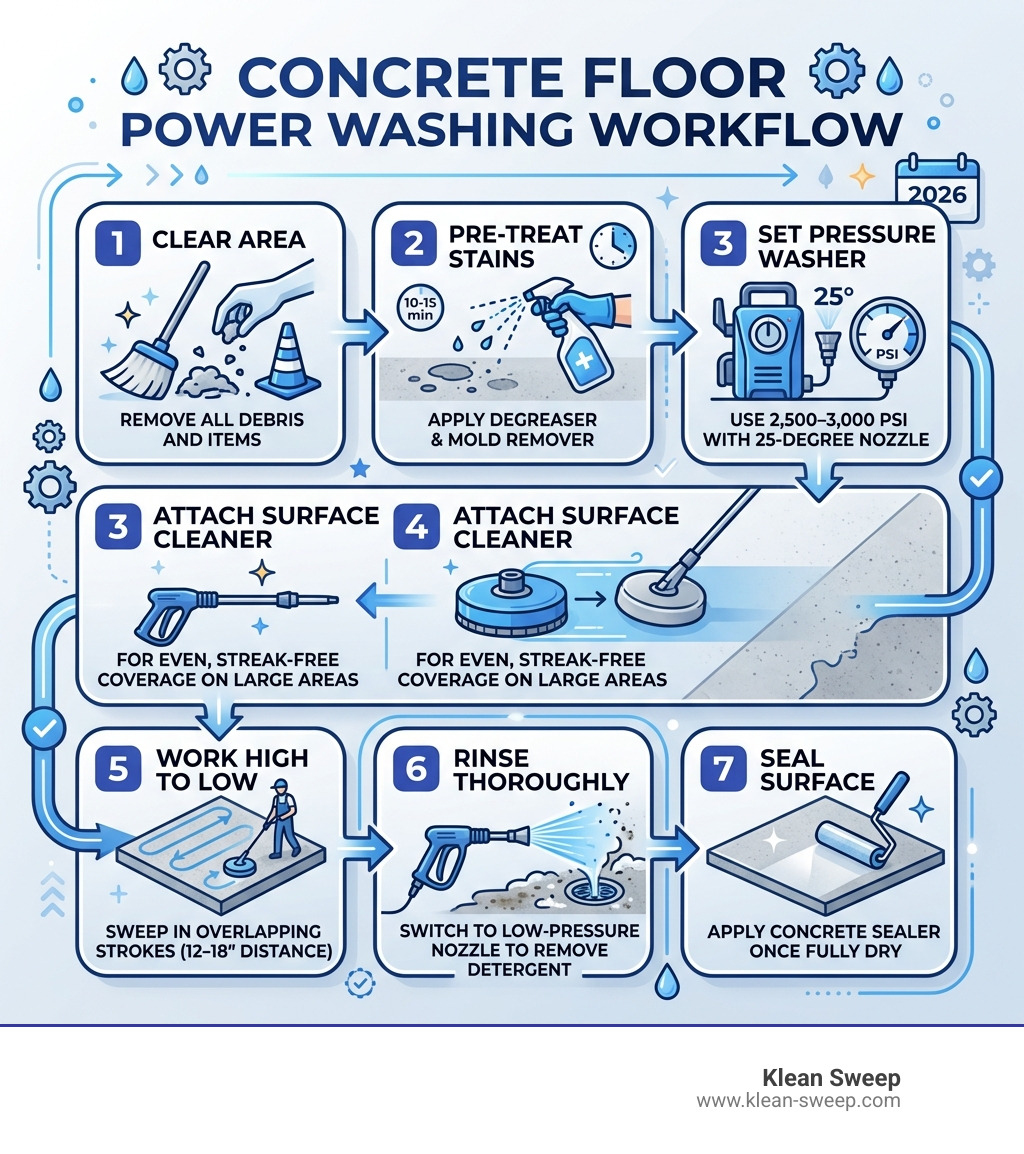
Here’s the quick answer on how to power wash a concrete floor:
- Clear the area — remove debris, vehicles, and loose items
- Pre-treat stains — apply degreaser or mold remover and let it dwell 10–15 minutes
- Set your pressure washer — use 2,500–3,000 PSI with a 25-degree nozzle
- Attach a surface cleaner — for even, streak-free coverage on large flat areas
- Work high to low — sweep in overlapping strokes, keeping the nozzle 12–18 inches from the surface
- Rinse thoroughly — switch to a low-pressure nozzle to remove all detergent
- Seal the surface — once fully dry, apply a concrete sealer to protect against future staining
Concrete looks tough. But it’s actually porous — meaning dirt, oil, and moisture sink right in over time. Left untreated, that buildup doesn’t just look bad. It can weaken the surface, accelerate cracking, and create slip hazards on commercial and industrial properties.
For LA property managers especially, spring 2026 is an ideal time to schedule a deep clean. Wet winter months leave behind algae, runoff residue, and embedded grime that routine sweeping simply can’t touch.
I’m Jana Hanson, and I’ve spent over a decade running Klean Sweep — one of the largest exterior maintenance companies in the Los Angeles area — helping commercial and industrial clients power wash concrete floor surfaces back to their best. In the guide below, I’ll walk you through exactly how to do this right, from equipment selection to post-clean sealing.
Essential Equipment to Power Wash Concrete Floor
To achieve professional-grade results, you need more than just a garden hose and a prayer. The right equipment determines whether you’ll be finished in two hours or still scrubbing by sunset.
When you prepare to power wash concrete floor areas, you generally have two choices for the machine itself: gas-powered or electric. In our professional experience at Klean Sweep, gas-powered units are the gold standard for concrete. While electric washers are quiet and great for washing a car or patio furniture, they often top out at 2,000 PSI. For stubborn driveway oil or embedded Los Angeles smog, you really need the “oomph” that only gas or Steam Cleaning and Pressure Washing in Torrance, CA can provide.
One of the most important upgrades you can make is moving from a standard wand to a surface cleaner attachment. These circular devices house a spinning bar with two or more nozzles, providing a uniform clean that a manual wand simply cannot match.
Comparison: Stainless Steel vs. Plastic Surface Cleaners
| Feature | Stainless Steel Surface Cleaner | Plastic Surface Cleaner |
|---|---|---|
| Durability | High; resists rust and impact damage | Moderate; prone to cracking over time |
| Weight | Heavier (helps keep it on the ground) | Lightweight (can “hover” or flip at high PSI) |
| Price | $250 – $600+ | $60 – $150 |
| Best For | Commercial use / Large driveways | Occasional residential use |
| Heat Rating | Often handles hot water | Usually restricted to cold water |
For those following a How to Clean Concrete with a Pressure Washer guide, the “Cleaning Power” (CP) of your machine is calculated by multiplying PSI (Pressure) by GPM (Flow). A higher GPM is often more important than high PSI because it’s the volume of water that actually flushes the dirt away.
The Best PSI to Power Wash Concrete Floor
If you use too little pressure, you’re just giving the dirt a bath. If you use too much, you can actually “etch” the concrete, leaving permanent swirl marks or exposing the aggregate underneath.
- 3,000 PSI: This is the “sweet spot” for most residential and commercial concrete cleaning. It is powerful enough to lift tire marks and mildew without damaging the structural integrity of the slab.
- 4 GPM (Gallons Per Minute): This flow rate is what the pros use. It allows you to move faster and ensures that the grime you’ve loosened is actually pushed off the surface rather than just settling back down.
- Residential Settings: If you are using a smaller unit around 2,000 to 2,500 PSI, you will likely need to move slower and use more detergent to compensate for the lower power.
- Commercial Grade: For heavy industrial floors in Torrance or large parking structures in LA, we often utilize units reaching 4,000 PSI, but these require expert handling to avoid surface “scarring.”
Surface Cleaner Attachments vs. Standard Nozzles
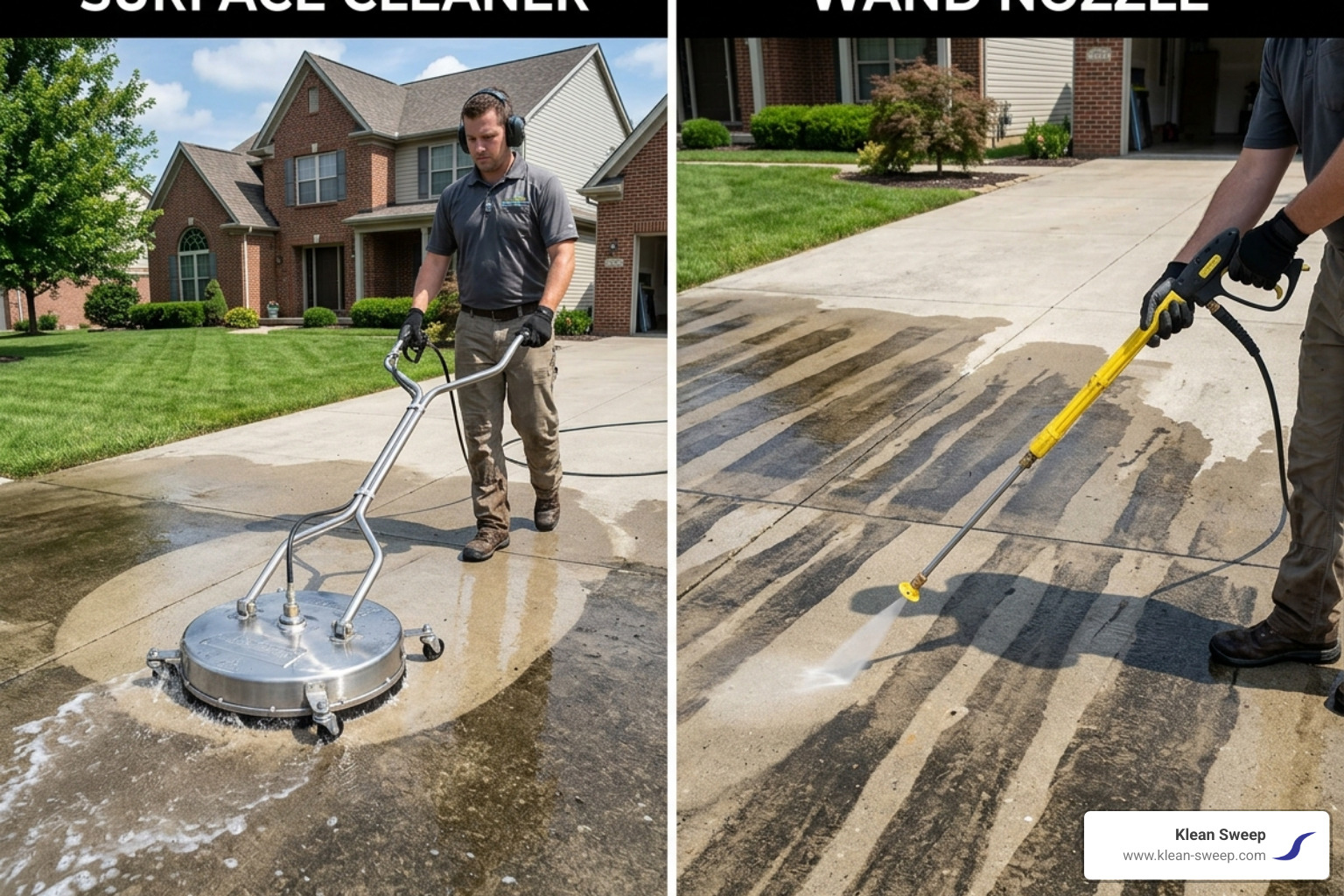
If you have ever seen a driveway that looks like it has “tiger stripes,” that is the result of using a standard nozzle and an inconsistent hand. A surface cleaner attachment is the cure for this.
These attachments feature a rotating bar that spins at high speeds just an inch or two above the concrete. This ensures even coverage across the entire path of the cleaner. Not only does this prevent streaks, but it also offers incredible time efficiency. A 20-inch diameter surface cleaner can clean a driveway up to four times faster than a standard wand. It’s the difference between “mowing the lawn” and “painting a fence with a toothbrush.”
Preparation and Safety Protocols
Before you pull the starter cord, you need to prep the “battlefield.” High-pressure water is no joke—it can cut through skin, boots, and even solid wood if mishandled.
First, clear all debris. Use a leaf blower or a stiff-bristled broom to remove loose rocks and dirt. If these get caught under a surface cleaner, they act like shrapnel, potentially damaging the spinning nozzles or the concrete itself.
Next, you must protect your surroundings. In Southern California, our landscaping is precious. High-pressure water and detergents can easily shred delicate leaves or alter the pH of your soil. Cover nearby plants with plastic tarps and use painter’s tape to cover any outdoor electrical outlets or low-hanging vents.
For Concrete Floor Cleaning for Long-Lasting Durability, safety gear is non-negotiable:
- Safety Goggles: Water and debris will bounce back at you.
- Closed-Toe Shoes: Preferably waterproof boots. Never, ever power wash in flip-flops.
- Ear Protection: Gas-powered units are loud and can cause hearing damage over long sessions.
- Long Pants: Protects your legs from flying grit.
Pre-Treating Stubborn Stains
Concrete is like a giant sponge. Oil from a leaky car or mold from a damp corner doesn’t just sit on top; it dives deep into the pores. This is where “dwell time” becomes your best friend.
- Oil Degreasers: Apply a specialized concrete degreaser to oil spots. Use a stiff brush to scrub it in, then let it sit (or “dwell”) for 10–15 minutes. Do not let it dry! Mist it with a little water if it starts to evaporate.
- Mold and Mildew: A solution of bleach and water (usually 1:3 ratio) or a dedicated antimicrobial cleaner works best here. Again, allow at least 10 minutes for the chemicals to break down the organic matter.
- Rust Removal: Rust often requires an acid-based cleaner. Be extremely careful with these, as they can discolor the concrete if left too long.

The Professional Process to Power Wash Concrete Floor
Once the prep is done, it’s time to wash. The goal is a uniform, bright finish that makes the concrete look brand new.
At Klean Sweep, we always follow the high-to-low rule. Start at the highest point of the driveway or floor (usually near the garage door or the back of the building) and work your way toward the street or the drains. This ensures that dirty water isn’t flowing over areas you’ve already cleaned.
When using a surface cleaner, use overlapping strokes. Move the unit slowly and steadily, like you are vacuuming a rug. If you move too fast, you’ll leave “swirlies.” If you move too slow, you’re wasting water.
According to Effective Techniques for Power Washing Concrete Surfaces, maintaining a consistent distance is the secret to a professional look. If you switch to a wand for corners, keep the tip exactly 12 inches from the surface at all times.
Step-by-Step: How to Power Wash Concrete Floor
- Clear the Area: Move the cars, the trash cans, and the kids’ toys.
- Apply Detergent: Use a low-pressure “soap nozzle” (usually the black one) to apply your cleaning solution to the entire area. Let it dwell for 15 minutes.
- Surface Cleaning: Connect your surface cleaner and begin your overlapping passes. Work in sections of about 10×10 feet.
- Detail Rinsing: Switch back to a 25-degree nozzle (green) to clean the edges, corners, and joints where the surface cleaner couldn’t reach.
- Final Flush: Use a high-volume rinse to push all the dirty suds and silt off the concrete.
- Drying Time: Concrete needs at least 24 hours to dry completely before you apply any sealer.
Post-Cleaning Care and Sealing
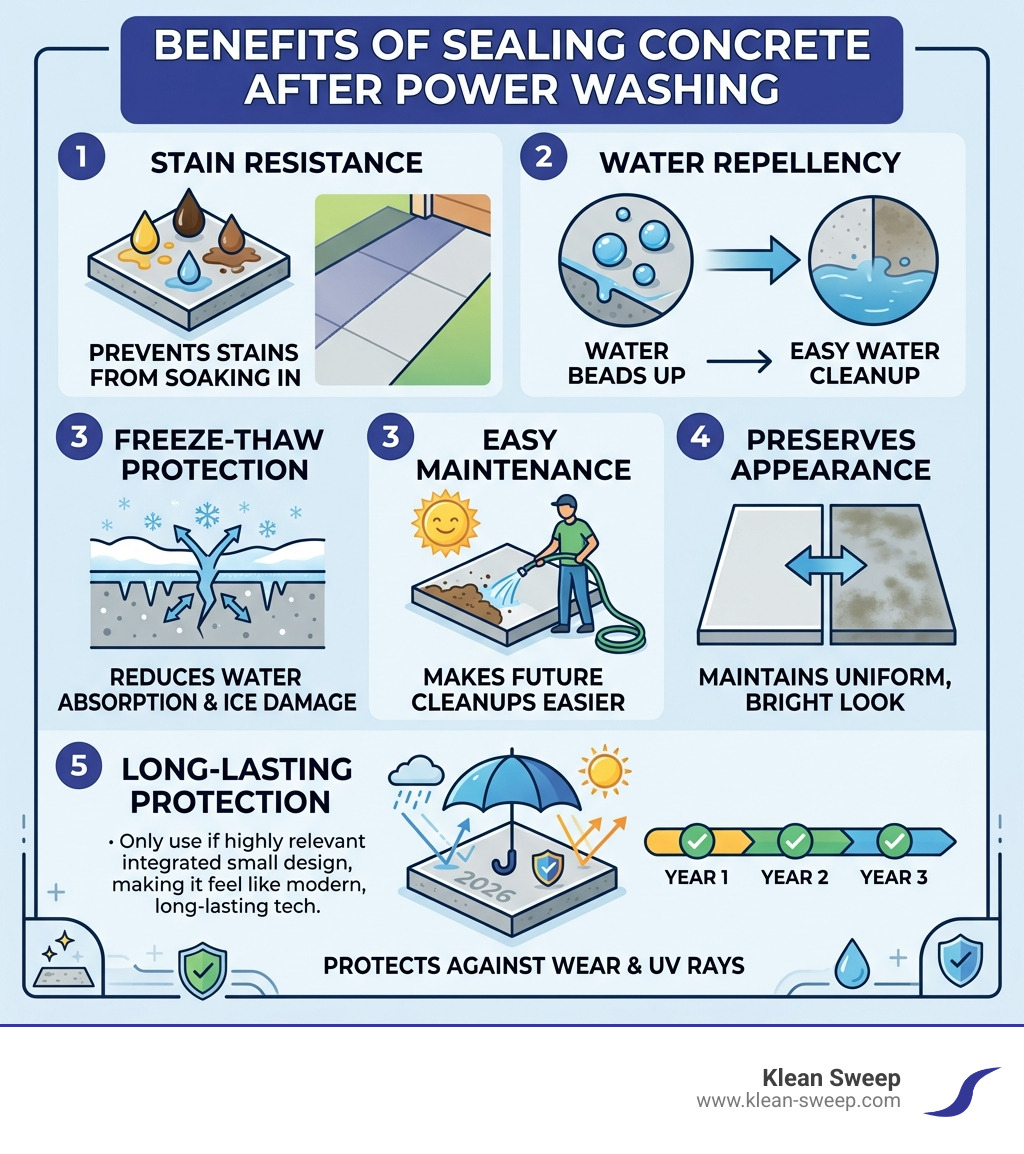
Now that your floor is pristine, you want to keep it that way. Because power washing opens up the pores of the concrete, it is actually more vulnerable to stains immediately after cleaning.
Pore protection is achieved through sealing. A high-quality silane/siloxane sealer acts as a water repellent, causing liquids to “bead up” on the surface rather than soaking in. This makes future cleanups as easy as using a garden hose.
We recommend annual maintenance for high-traffic areas in Los Angeles. A quick “soft wash” once a year can prevent the need for heavy-duty power washing later. Also, take this time for a crack inspection. If you see new cracks, fill them with a concrete caulk to prevent water from getting underneath the slab, which can lead to shifting and expensive repairs.
Frequently Asked Questions about Concrete Cleaning
What is the best size for a surface cleaner attachment?
For most residential gas pressure washers (2,500–3,200 PSI), a 14-inch to 16-inch surface cleaner is ideal. If you go too large (like a 24-inch) with a small machine, the pressure is distributed too thinly and the bar won’t spin fast enough to clean. Professional 4 GPM machines can easily handle 20-inch to 30-inch cleaners.
Can power washing damage my concrete floor?
Yes. Using a 0-degree nozzle (the red one) or holding a high-pressure wand too close can “etch” the surface, essentially carving lines into the stone. Always start with a wider nozzle (25 or 40 degrees) and keep it at least 12 inches away. If the concrete is very old or “spalling” (flaking off), stick to lower pressure and more chemical cleaning.
How often should I power wash my driveway or garage?
In the Southern California climate, once a year is usually sufficient to maintain curb appeal and prevent the buildup of slick algae or oil. However, if you have heavy tree cover or a fleet of vehicles, you might find that a bi-annual clean keeps the property looking its best.
Conclusion
A clean concrete floor does more than just look good—it preserves your investment and ensures safety for everyone walking on your property. While the DIY route is a great Saturday project for many, achieving that “like-new” glow on large commercial or industrial scales often requires professional-grade power.
Since 1969, Klean Sweep has been a family-owned staple in the Torrance and Los Angeles area. We combine decades of expertise with state-of-the-art equipment to handle the toughest grime California can throw at us. Whether you need a simple driveway refresh or a massive parking structure overhaul, we are here to help.
Ready to see the difference professional Concrete Floor Cleaning in Torrance, CA can make? Contact us today for an environmentally friendly deep clean that stops the grime in its tracks.