

Your Polished Concrete Floors Deserveled Better Than a Dirty Mop
Polished concrete floor cleaning is one of the most important — and most misunderstood — parts of owning this type of flooring.
Here’s the quick answer for busy property managers:
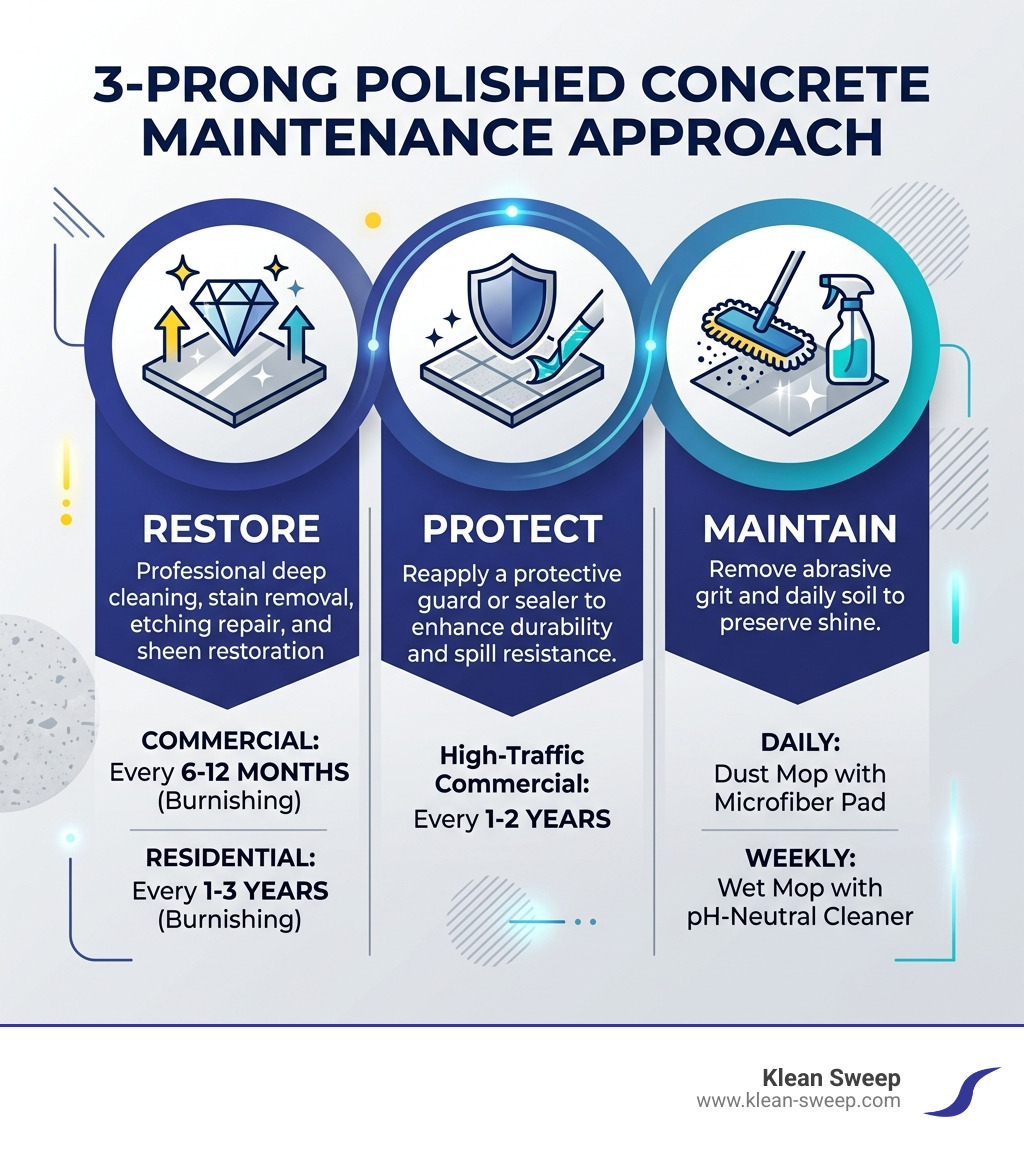
- Dust mop daily with a microfiber pad to remove abrasive grit
- Wet mop weekly using a pH-neutral cleaner (never vinegar, bleach, or ammonia)
- Clean spills immediately — acidic liquids like soft drinks or fruit juice can etch the surface fast
- Burnish every 6–12 months (commercial) or every 1–3 years (residential) to restore shine
- Reapply floor guard every 1–2 years in high-traffic commercial settings
- Call a professional for deep stains, etching, or when the sheen won’t come back
There’s a common misconception that polished concrete needs no maintenance. That’s simply not true. Dirt and grit act like sandpaper on a polished surface — left unchecked, they grind down the finish day by day. The good news? With the right products and a simple routine, a well-maintained polished concrete floor can look great for 20 to 30 years or more.
This guide focuses on the cleaners and tools that actually work — without damaging the surface you’ve invested in.
I’m Jana Hanson, and I’ve led Klean Sweep’s growth across the greater Los Angeles area since taking over our family business in 2012 — building on over 55 years of hands-on experience in commercial and industrial floor maintenance, including polished concrete floor cleaning. That field experience shapes everything in this guide, so you can trust it’s grounded in what actually works on real floors, not just theory.
The Science of Polished Concrete Floor Cleaning
To understand why certain cleaners work while others destroy your floor, we have to look at what polished concrete actually is. It isn’t just a shiny coating or a wax; it’s a mechanical transformation of the concrete itself. Through a process of grinding with diamond-embedded segments and the application of chemical densifiers, the concrete becomes incredibly dense and reflective.
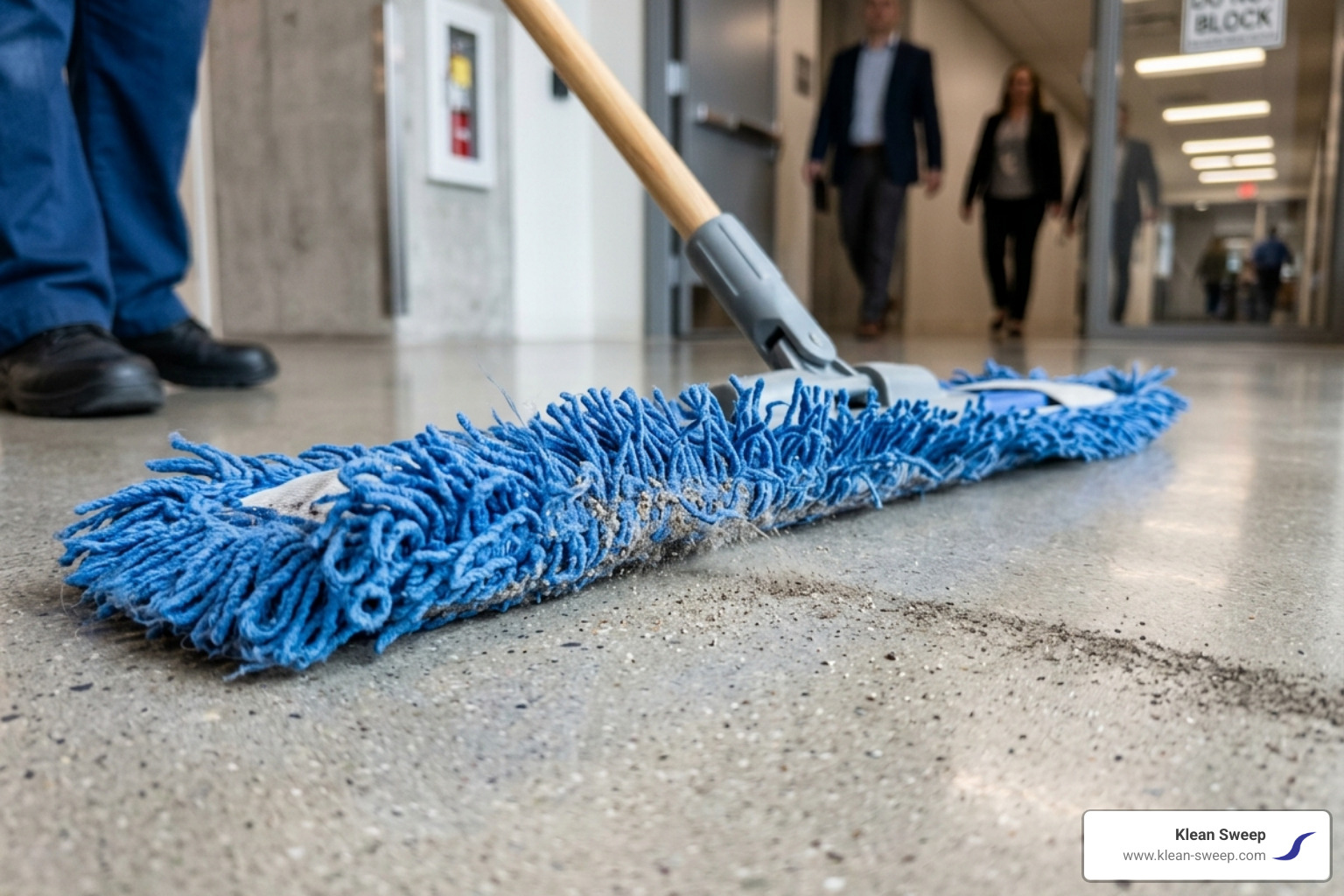
However, even though it’s “hard as a rock,” it’s still susceptible to abrasion. Think of fine dust and grit as microscopic sandpaper. Every time someone walks across a dusty floor, they are essentially sanding away the shine. This is why Concrete Floor Cleaning for Long-Lasting Durability begins with dry removal of debris before any liquid touches the surface.
Modern polished concrete floor cleaning often utilizes nano-silica technology. These tiny particles are designed to fill the microscopic voids in the concrete surface, effectively “healing” small scratches and maintaining the surface hardness. When you use a cleaner infused with these silicas, you aren’t just removing dirt; you’re reinforcing the floor’s defensive line.
The most critical scientific factor, however, is pH-neutrality. Concrete is naturally alkaline. If you use an acidic cleaner, it triggers a chemical reaction that eats away at the calcium carbonate in the concrete, a process known as etching. This leaves the floor looking dull, cloudy, and “dead.” For a deep dive into the technical side of upkeep, check out this guide on How to Clean Polished Concrete Floors + Maintenance Tips – Concrete Network.
Safe Polished Concrete Floor Cleaning Products
When shopping for cleaners in Torrance or Los Angeles, look for “pH-neutral” on the label. These concentrates are designed to suspend dirt particles so they can be easily wiped or vacuumed away without leaving a film or attacking the concrete’s structure.
Many of the best modern options are plant-based and eco-friendly, which is a priority for us here at Klean Sweep. These non-filming agents ensure that after the floor dries, there is no sticky residue left behind to attract more dust.
| Cleaner Type | Effect on Polished Concrete | Recommended? |
|---|---|---|
| pH-Neutral Concentrate | Lifts dirt safely; maintains shine. | Yes |
| Nano-Silica Cleaners | Cleans and hardens the surface simultaneously. | Yes |
| Vinegar / Lemon Juice | Acidic; etches the surface and kills the gloss. | No |
| Bleach / Ammonia | High pH; can cause discoloration and salt deposits. | No |
| Pine/Oil-Based Cleaners | Leaves a dulling, slippery film that attracts dirt. | No |
If you are managing a large facility and aren’t sure which chemical is right for your specific slab, our team provides expert Concrete Floor Cleaning in Torrance, CA to help you set up a safe, effective chemical rotation.
What to Avoid: Surface Killers
It’s tempting to grab whatever is under the kitchen sink or in the janitor’s closet, but some “common” cleaners are absolute surface killers for polished concrete.
- Vinegar and Citrus: These are acids. They will “eat” the shine off your floor faster than you can say “spring cleaning.”
- Bleach and Ammonia: These are too harsh and can cause the concrete to “bloom” with white salt deposits.
- Steam Mops: While great for tile, the intense heat and moisture of a steam mop can force water into the micro-pores of the concrete, potentially causing the sealer to delaminate or the concrete to spall.
- High-Pressure Washers: Indoors, these can force water into expansion joints and cause long-term structural moisture issues.
- Abrasive Pads: Never use black or brown stripping pads on a polished surface. You should stick to soft white or beige pads, or diamond-impregnated maintenance pads.
Maintenance Schedules: Residential vs. Commercial Needs
Frequency is the “secret sauce” of floor care. A warehouse in Los Angeles with 24/7 forklift traffic has vastly different needs than a modern home in Torrance.
One often overlooked benefit of a strict cleaning schedule is indoor air quality. Polished concrete doesn’t harbor dust mites or dander like carpet does, but it can collect fine particulates. Regular cleaning keeps these allergens out of the air. For a comprehensive look at professional-grade schedules, refer to How to Maintain Polished Concrete Floors: The Complete Guide.
Commercial Polished Concrete Floor Cleaning Frequency
In a commercial environment, maintenance isn’t just about looks; it’s about the bottom line. For example, did you know that replacing a set of forklift wheels or bearings can cost around $1,000? This is an expense that adds up quickly when floors are left dirty, as the grit on the floor migrates into the machinery’s moving parts.
- Daily: Dust mop the entire surface. In high-traffic retail or warehouses, this might need to happen multiple times a day.
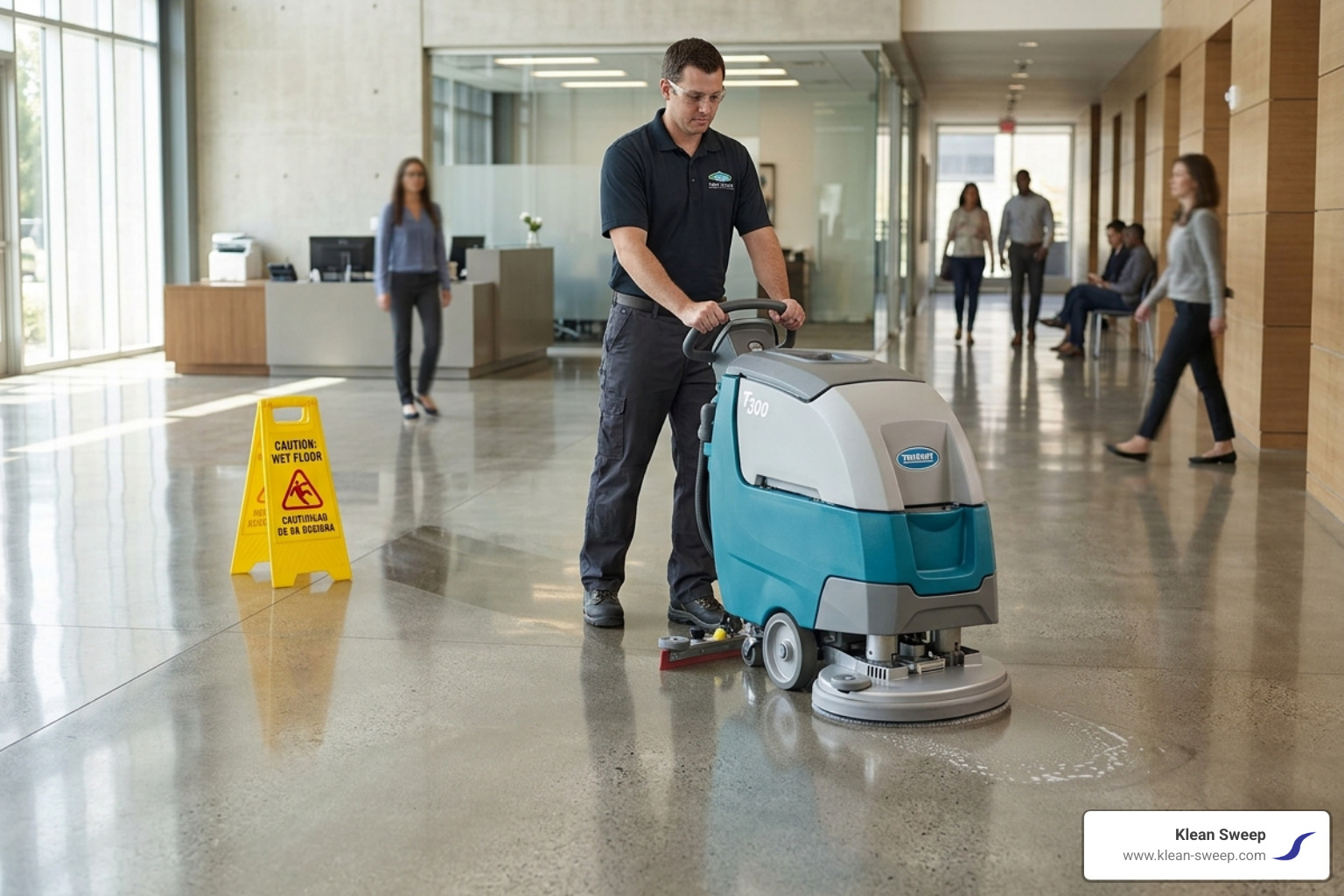
- 2-3x Weekly: Use an automatic scrubber with a pH-neutral solution. This deep-cleans the “traffic lanes” where dirt accumulates most.
- Monthly/Quarterly: Burnish the floor to pop the shine back and “tighten” the surface.
- Annually: Assess the floor for “guard” reapplication. In very high-traffic areas, a new coat of stain protector may be needed every 12 months.
For more industrial-specific advice, Tips for Polished Concrete Floor Maintenance offers great insights into managing large-scale facilities.
Residential Upkeep and Longevity
In a home, the “grit load” is much lower, but the desire for a “mirror finish” is often higher.
- Sweep 2-3 times weekly: Use a microfiber dust mop. Avoid traditional brooms with stiff bristles that can leave micro-scratches.
- Weekly damp mop: Use a microfiber mop and plain water or a very diluted neutral cleaner.
- Entryway Protection: This is your best defense. 80% of the dirt that enters a home comes in on shoes. Use high-quality walk-off mats at every door.
- Furniture Care: Always put felt pads on the legs of chairs and tables. Dragging a metal chair leg across polished concrete is a recipe for a permanent gouge.
With this level of care, a residential floor often won’t need professional restoration for 5 to 10 years.
Advanced Restoration: Burnishing and Guard Reapplication
Eventually, even the best-cleaned floor will lose a bit of its luster. This is where “burnishing” comes in. A high-speed burnisher (spinning at 1,500 to 2,500 RPM) uses friction heat to essentially re-melt and realign the surface molecules of the floor’s protective guard.
This process restores that “wet-look” shine without the need for messy waxes or coatings. It’s a mechanical way to “pop” the gloss back to life.
Along with burnishing, you’ll eventually need to reapply a penetrating guard. Unlike a topical sealer that sits on top like a piece of plastic, a guard penetrates the surface. In commercial settings, this is typically done every 1 to 2 years. In a home, you might get 3 to 5 years out of a single application. This proactive care is what allows a floor to reach that 20 to 30-year lifespan. You can find a great step-by-step on the How to Clean a Polished Concrete Floor Daily (Proper Routine) to see how the pros do it.
Troubleshooting Stains and Common Maintenance Mistakes
Accidents happen. Whether it’s an oil leak from a forklift in a Los Angeles warehouse or a spilled glass of wine in a Torrance living room, the key is speed.
- Oil and Grease: Do not wipe! Wiping spreads the oil into the pores. Instead, blot it with an absorbent cloth. For stubborn oil, use a “poultice” (a paste made of baking soda and water or a specialized oil-absorber). Let it sit overnight to draw the oil out of the concrete.
- Acidic Spills (Juice, Soda, Vinegar): Neutralize these immediately with a mixture of baking soda and water to stop the chemical reaction that causes etching.
- Tire Marks: These “rubber burns” can be tough. Use an alkaline degreaser and a soft-bristle brush to lift the rubber without scratching the concrete.
- Dwell Time: A common mistake is spraying cleaner and immediately mopping it up. Give the cleaner 2–3 minutes of “dwell time” to actually break down the grime before you lift it away.
- Over-Wetting: Never leave standing water on your polished concrete. Even though it’s dense, prolonged exposure to puddles can lead to staining or “efflorescence” (white salty powder rising to the surface).
Frequently Asked Questions about Polished Concrete
How often should I burnish my floors to restore shine?
Commercial high-traffic areas benefit from burnishing every 6-12 months, while residential floors typically only require it every 1-3 years to maintain their reflective clarity. If you notice “traffic lanes” appearing where the floor looks duller than the edges, it’s time to burnish.
Can I use a steam mop on polished concrete?
No, you should avoid steam mops as the intense heat and moisture can force water into micro-cracks or control joints, potentially damaging the densifiers and sealers. Stick to a damp microfiber mop and a pH-neutral cleaner for the safest results.
What is the best way to handle an oil spill?
Blot the spill immediately with an absorbent cloth—never wipe, as this spreads the oil. Apply a pH-neutral degreaser or a baking-soda poultice to draw out deep-seated residue. If the oil has sat overnight, you may need a professional-grade degreaser to fully lift the “shadow” left behind.
Conclusion
Polished concrete is an investment in durability and style, but it isn’t “set it and forget it” flooring. By sticking to a simple routine of daily dusting and weekly neutral cleaning, you can keep your space looking spectacular for decades.
At Klean Sweep, we’ve been family-owned since 1969, and we’ve seen every type of floor disaster imaginable. We use state-of-the-art equipment and eco-friendly methods to ensure your Southern California property stays in peak condition. Whether you need a one-time deep clean or a regular maintenance contract in Torrance or the greater Los Angeles area, we’re here to help.
Don’t let your floors stay dull. Contact us for Professional Concrete Floor Cleaning in Torrance and let us bring the shine back to your business or home.