

Why Parking Lot Sweeping for Hospitals Matters
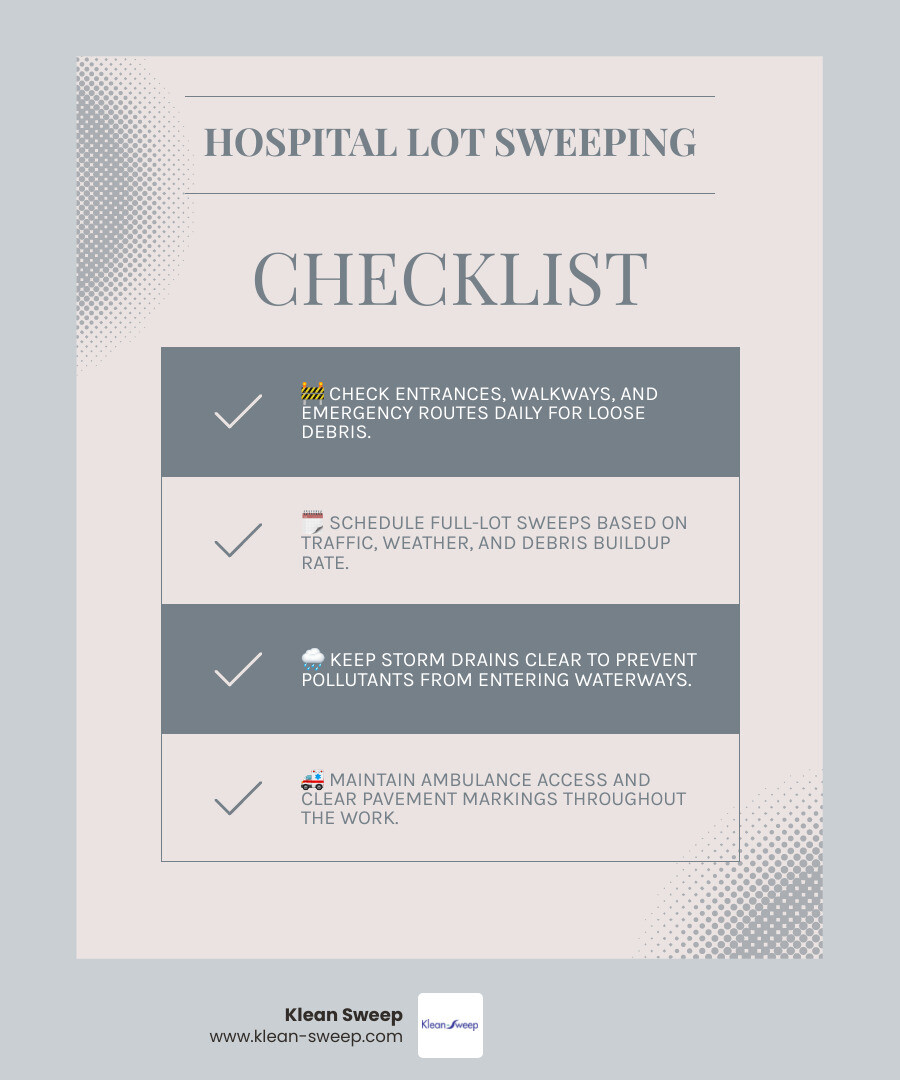
Parking lot sweeping for hospitals starts with a site-specific plan. Check entrances, walkways, and emergency routes daily for loose debris. Schedule full-lot sweeps based on traffic, weather, and how quickly debris builds up. Keep storm drains clear, control dust near patient areas, and maintain ambulance access throughout the work.
This routine helps reduce slip and trip hazards, keeps pavement markings visible, and removes pollutants before rain carries them into storm drains. A clean arrival area also helps patients and visitors feel confident in the facility’s care.
I’m Jana Hanson, and I’ve led Klean Sweep, our family-owned exterior maintenance company in the greater Los Angeles area, since 2012. My experience overseeing commercial sweeping informs this guide to parking lot sweeping for hospitals.
Simple parking lot sweeping for hospitals glossary:
Why Parking Lot Sweeping for Hospitals Is Critical for Safety and Sanitation
Maintaining a medical facility requires a focus on cleanliness that extends well past the front lobby doors. The hospital exterior functions as the initial checkpoint for risk management, infection prevention, and traffic coordination. Every day, medical centers in busy hubs like Los Angeles, Torrance, and Pasadena welcome hundreds of arriving patients, visitors, and staff members. When lots gather loose gravel, discarded trash, or fluid leaks, these materials immediately threaten the safety of arriving visitors and the operational rhythm of emergency response teams.
Understanding essential commercial sweeping techniques helps healthcare administrators protect their physical assets while safeguarding everyone who steps onto the property. Pavement is an investment, but abrasive grit left on asphalt acts like sandpaper under vehicle tires, grinding down the protective sealcoat and creating cracks. By systematically removing this abrasive grit before it grinds down asphalt binders, medical centers prevent early deterioration, eliminate surface trip hazards, and maintain unrestricted transit corridors for life-saving transport.
Infection Control Standards in Parking Lot Sweeping for Hospitals
Infection control protocols are central to healthcare operations, but many teams overlook how exterior grounds impact interior sterile environments. When visitors and medical personnel step out of their vehicles, their shoes gather whatever sits on the asphalt: fine silica dust, automotive soot, biological waste, and discarded litter. Without routine exterior maintenance, this particulate matter transfers directly across thresholds and onto interior floors, compromising clean zones and increasing the burden on custodial teams.
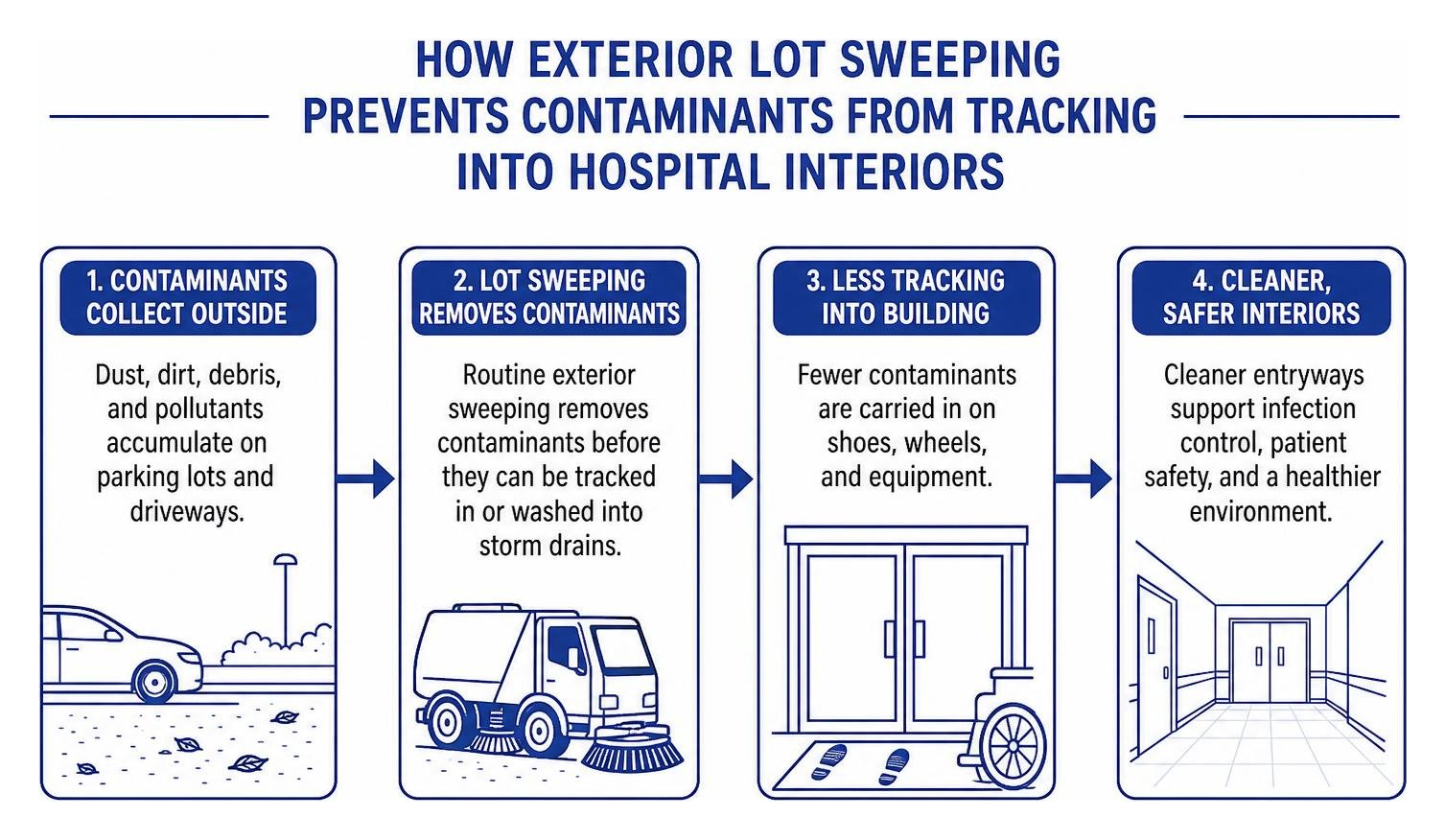
Airborne particulates also threaten vulnerable patient populations. Routine sweeping suppresses and eliminates fine allergens and respiratory irritants before HVAC intake systems pull them into clinical buildings. Furthermore, organic matter like food waste and wet landscape debris attracts disease vectors, including rodents, birds, and insects. Implementing structured steps for preventing parking lot debris accumulation prevents pest nesting near exterior doors and keeps fine contaminants from entering surgical corridors, intensive care units, and patient rooms.
Slip Hazard Mitigation and Emergency Route Accessibility
Hospitals accommodate individuals with physical vulnerabilities, mobility limitations, and urgent medical needs. A loose patch of sand, a slick layer of wet leaves, or a stray patch of motor oil can cause a devastating slip-and-fall accident. For a patient using crutches or a wheelchair, an uneven or debris-strewn surface turns a routine walk from the car into a safety hazard.
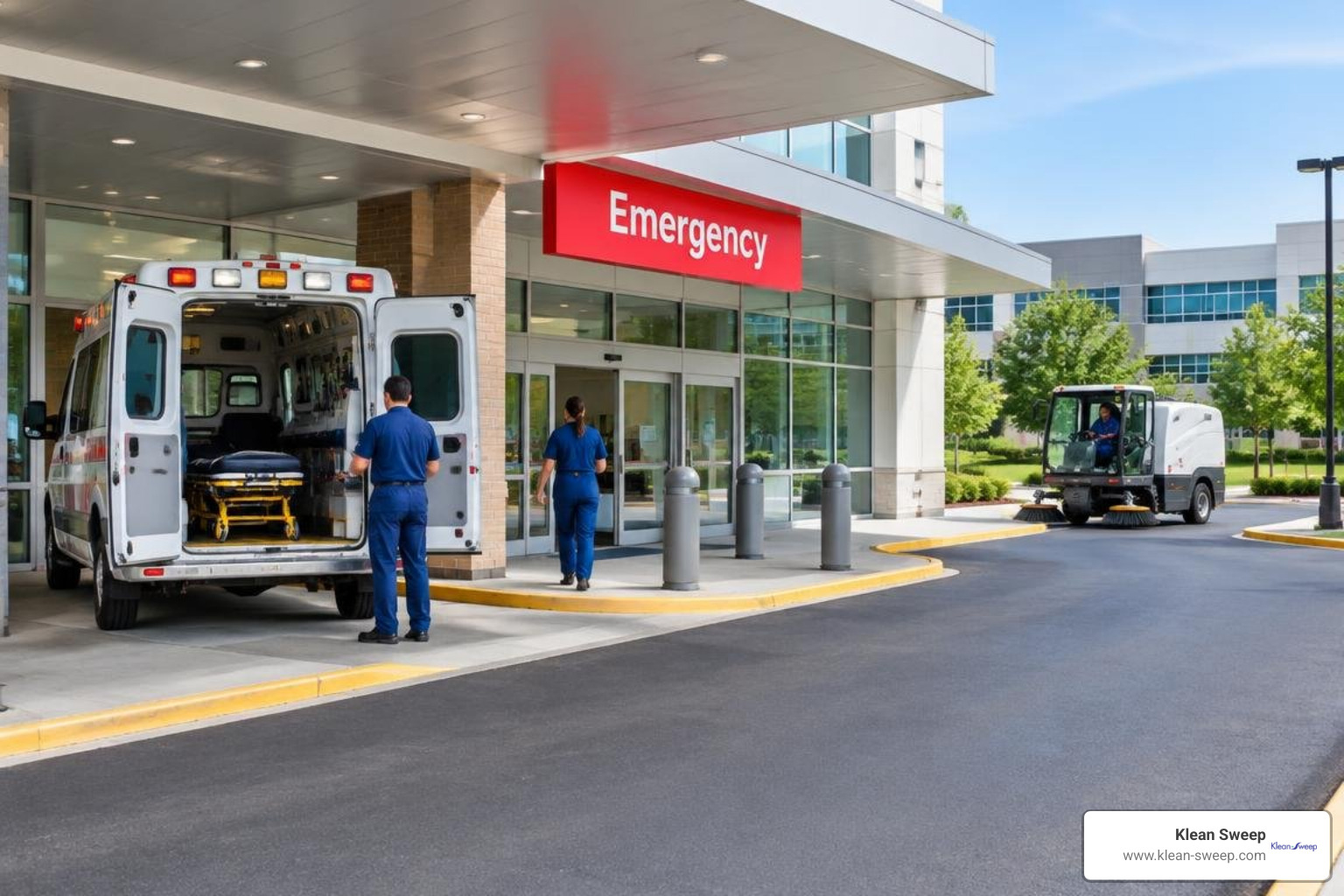
Routine sweeping ensures that walking surfaces maintain traction and that painted navigational aids—such as pedestrian crossings, ADA accessibility stalls, and no-parking emergency vehicle zones—stay clearly visible. Keeping emergency room driveways clear of debris is essential to avoid flat tires or delays for responding ambulances.
Our operators run heavy-duty magnetic bars mounted across sweeper bumpers to catch discarded metal, loose nails, screws, and sharp hardware that could puncture ambulance tires during critical patient transfers.
Environmental Compliance and Stormwater Runoff Protection
Hospital campuses feature large impermeable surface areas. When rain falls across acres of parking decks and asphalt bays, it washes unmanaged surface pollutants directly into local stormwater systems. In coastal and river-adjacent Southern California regions, commercial facilities must comply with strict Municipal Separate Storm Sewer System (MS4) discharge permits and Clean Water Act standards.
Learning how street sweeping protects clean water resources reveals that regular mechanical and vacuum cleaning is one of the most cost-effective best management practices (BMPs) available to institutional facilities. Capturing nonpoint source pollutants at the surface prevents heavy metals, brake dust, and automotive hydrocarbons from washing into municipal waterways and coastal habitats.
Mitigating Chemical Pollutants and EPA Water Quality Standards
Automotive traffic leaves behind a steady coating of environmental pollutants, including motor oil, antifreeze, and tire wear particles. When these settle onto parking lots, they bind to fine sediments and wash away during storms. Street and lot sweeping significantly lowers pollutant discharge:
- Total Solids (TS): Removal efficiencies range from 9% with monthly mechanical sweeping up to 31% with weekly regenerative air and vacuum sweeping.
- Total Phosphorus (TP): Removal efficiencies scale from 3% under monthly broom sweeping to 8% with weekly regenerative sweeping.
- Total Nitrogen (TN): Removal efficiencies increase from 3% with basic mechanical methods up to 7% with weekly vacuum-assisted passes.
Aligning hospital exterior maintenance with broader municipal street sweeping programs allows healthcare systems to meet regional EPA water quality benchmarks, pass stormwater compliance audits, and support sustainability initiatives like LEED certification.
Preventing Catch Basin Clogging and Campus Flooding
Beyond chemical filtration, sweeping prevents localized flooding. Autumn foliage, beverage containers, and landscape clippings quickly wash toward drainage inlets during sudden downpours. Once these materials accumulate over catch basin grates, water backs up across parking lanes, creating deep puddles, hiding curbs, and blocking pedestrian access to facility entrances.
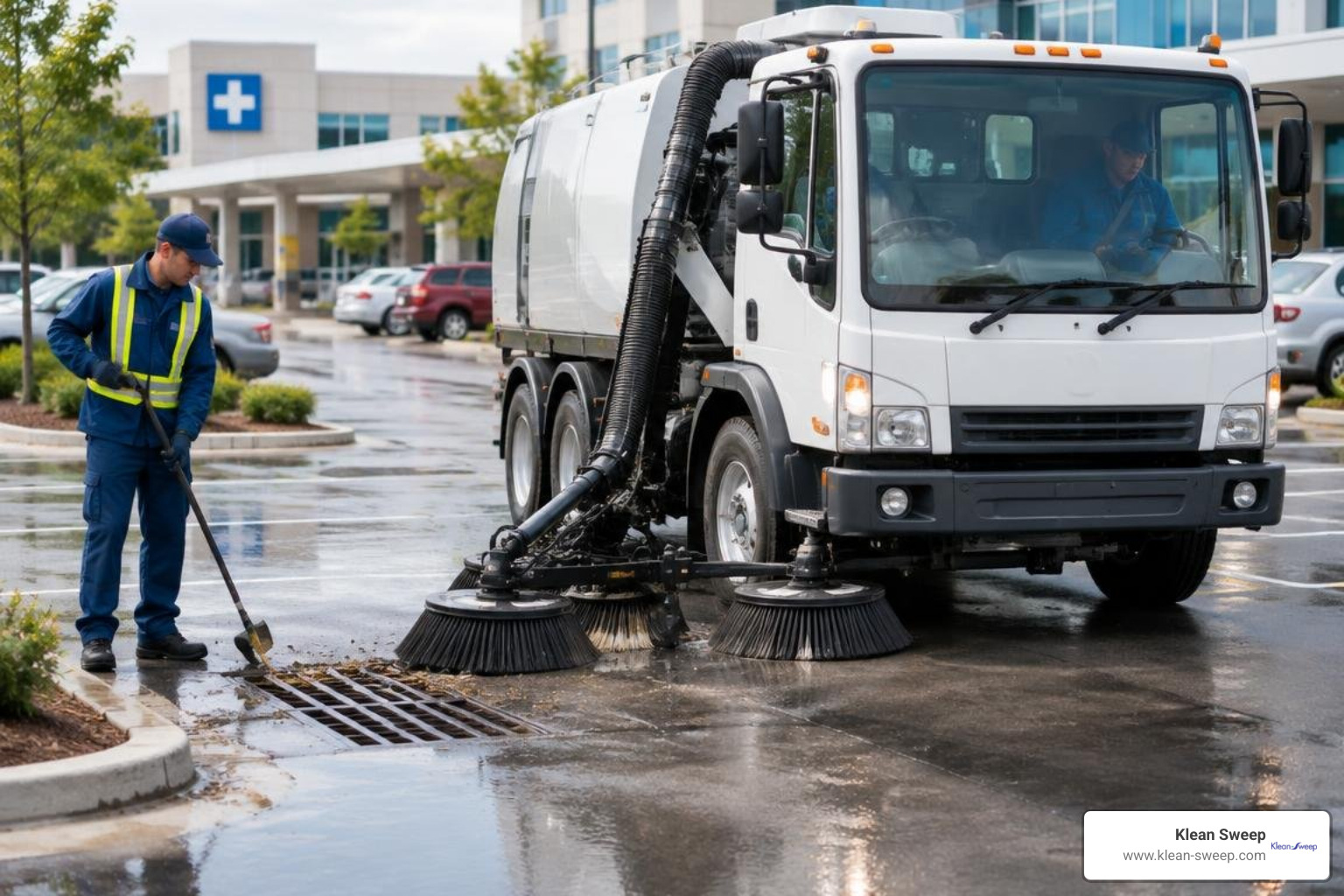
Proactive surface sweeping captures heavy debris before it enters drainage structures. Pairing scheduled sweeping with timely stormwater system maintenance protects underground catch basins from silt accumulation, prevents pipe blockages, and keeps emergency transport lanes dry and passable during heavy storms.
Specialized Sweeper Technologies for Healthcare Campuses
Sweeping a hospital requires specialized equipment designed for sensitive environments. Standard industrial sweepers can produce loud engine noise and blow fugitive dust clouds into the air—disturbing recovering patients and compromising air intake systems. Using modern, well-maintained equipment backed by professional street sweeper capabilities guarantees comprehensive debris removal without compromising quiet, dust-controlled healthcare standards.
Mechanical Broom vs. Regenerative Air vs. Vacuum-Assist Systems
Selecting the right sweeper depends on surface conditions, debris volume, and noise requirements:
| Sweeper Technology | Primary Debris Size Capture | Fine Particulate Retention (PM10) | Relative Noise Output | Ideal Hospital Application |
|---|---|---|---|---|
| Mechanical Broom | Coarse gravel, heavy sand, sticks, large litter | Moderate; can generate airborne dust without continuous water spray | Higher mechanical noise profile | Perimeter access roads, post-construction cleanups, heavy debris zones |
| Regenerative Air | Medium litter, fine sand, dirt, broken glass | High; recirculates airblast within a sealed hood to trap fines | Controlled; low acoustic profile with proper engine baffling | Main surface parking lots, medical office access ways, outpatient lots |
| Vacuum-Assist | Fine dust, microscopic allergens, light surface trash | Superior; uses dedicated vacuum suction with dry dust filtration | Low to moderate; smooth continuous airflow | Clinical wing perimeters, areas near HVAC air intakes, emergency drop-offs |
Regenerative air and vacuum-assist sweepers are the top choice for healthcare campuses because they capture fine particles without exhausting dirty air back into the environment.
Multilevel Garage Scrubbing and Low-Clearance Challenges
Parking structures create distinct maintenance challenges. Multi-tier garages feature low overhead clearances, structural support columns, tight turning radii, and enclosed spaces that hold exhaust soot and tire dust. In winter months or coastal regions, vehicles track in road salts, chlorides, and ocean mist. If chlorides penetrate the concrete deck, they corrode internal reinforcing steel (rebar), causing concrete spalling, cracking, and expensive structural damage.
Maintaining these structures requires specialized low-profile sweepers paired with industrial ride-on scrubbers. Sweeping removes abrasive surface sand that wears down deck waterproofing coatings, while scrubbing washes away embedded motor oils, grease spots, and corrosive salts. Pairing sweeping with deep surface pressure washing keeps multi-level concrete decks bright, clean, and structurally sound.
Establishing Operational Protocols to Minimize Campus Disruption
Hospitals operate 24 hours a day, 7 days a week. Unlike commercial retail centers that clear out overnight, healthcare campuses experience non-stop traffic from shift changes, patient admissions, and emergency vehicles. Exterior cleaning must run smoothly without blocking access routes or disturbing patient recovery.
Working with specialized commercial sweeping services gives hospital facility managers a customized operational plan built around actual campus activity.
Recommended Frequency for Parking Lot Sweeping for Hospitals
Sweeping schedules should reflect traffic volume, property layout, and campus location:
- Emergency Department Drives and Ambulance Bays (Daily to 3x Weekly): Inspect and sweep these zones frequently using magnetic bars to clear tire-puncturing debris and slip hazards.
- Main Outpatient & Visitor Surface Lots (1x to 2x Weekly): Sweep regularly to pick up discarded food wrappers, leaf litter, and surface grit.
- Multi-Level Parking Structures (Weekly Sweeping, Bi-Annual Scrubbing): Vacuum decks weekly to remove abrasive silica dust and soot, followed by thorough scrubbing twice a year to clear oil and salt buildup.
- Staff Parking Lots & Perimeter Access Roads (1x Weekly or Bi-Weekly): Maintain clean access lanes to prevent debris from washing toward main entryways.
Nighttime Scheduling and Traffic Zone Phasing
To maintain steady traffic flow, operators should clean large surface lots in rolling sections overnight. Closing off specific zones with clear directional cones and signage lets sweeping crews work efficiently while leaving plenty of open stalls for late-shift personnel and visitors.
Technicians coordinate with campus security to confirm emergency access routes remain open before starting work. In municipalities like Beverly Hills, Carson, and Brea, adhering to safe municipal sweeping regulations ensures all sound levels and equipment operations follow local municipal codes.
Frequently Asked Questions About Hospital Parking Lot Maintenance
How does exterior lot sweeping support hospital infection control?
Exterior lot sweeping removes dust, biological matter, and trash before it reaches building entrances. This stops contaminants from getting tracked onto interior floors and reduces loose debris that attracts pests, helping maintain sanitary conditions inside.
How often should healthcare parking garages be swept and scrubbed?
High-traffic hospital parking structures should be vacuum-swept at least once a week to remove abrasive dirt and tire dust. Mechanical floor scrubbing should follow on a quarterly or bi-annual schedule to lift fluid leaks, surface grime, and corrosive salts.
What equipment minimizes airborne dust around sensitive clinical wings?
Regenerative air and vacuum-assist sweepers equipped with water-mist dust suppression systems are the best choice near sensitive clinical wings. They capture fine particles and run quietly without blowing dust clouds near patient windows or HVAC intakes.
Conclusion
Routine exterior cleaning is an essential part of healthcare facility maintenance. A clean, well-kept exterior protects pavement assets, helps prevent slip-and-fall injuries, keeps emergency vehicle routes clear, and supports local environmental compliance. By choosing professional equipment suited for healthcare campuses, facility managers ensure their grounds match the high standards of care provided inside the hospital.
Since 1969, our family-owned team at Klean Sweep has delivered dependable exterior property care across Torrance and the greater Los Angeles area. Explore viewing regional sweeping schedules and customized maintenance plans to set up a comprehensive exterior sweeping and maintenance schedule for your healthcare facility.