

What Are the Primary Duties and Responsibilities of a Street Sweeper Operator?
At its core, the role of a street sweeper operator is a specialized driving and maintenance position. Operating these heavy-duty vehicles requires a high level of concentration, spatial awareness, and technical skill. Operators do not simply drive; they must constantly monitor and adjust complex hydraulic, vacuum, and water systems to ensure effective cleaning while navigating tight spaces, low-hanging trees, and heavy traffic.
According to municipal standards, such as the City of Ceres Street Sweeper Operator Specifications, the role is defined by a diverse range of operational and manual tasks. The primary responsibilities of a professional operator include:
- Operating Motorized Sweeping Equipment: Safely driving and operating heavy-duty sweepers to clean public right-of-ways, commercial properties, retail centers, and parking structures.
- Conducting Pre-Trip and Post-Trip Inspections: Performing comprehensive daily vehicle inspections. This includes checking fluid levels (engine oil, coolant, hydraulic fluid), tire pressure, brake systems, warning lights, and safety devices to ensure the vehicle is in safe operating condition.
- Broom and Nozzle Management: Adjusting, replacing, and managing the inventory of gutter brooms, main pickup brooms, and dust-suppression water spray nozzles to match pavement conditions.
- Manual Debris Clearing: Using backpack leaf blowers (typically weighing around 25 pounds) and shovels to clear corners, sidewalks, and areas inaccessible to the sweeping vehicle, ensuring a spotless finish.
- Record Keeping and Documentation: Maintaining accurate daily activity logs, recording swept mileage, tracking water usage, and opening electronic work orders for any mechanical issues.
- Public and Customer Relations: Handling inquiries from commercial tenants or the public professionally, and reporting road hazards such as deep potholes, illegal dumping, or damaged signs to supervisors.
If you are interested in joining our professional team in Southern California, you can learn more about the Street Sweeper Driver role and our commitment to operational excellence.
Daily Operational Workflows
A typical shift for a sweeper operator begins long before the wheels touch the street. The daily workflow follows a structured sequence designed for safety and efficiency:
- Route Planning and Review: Operators must independently read and interpret digital route maps or GPS-guided dispatch systems, planning their sequence to maximize coverage and comply with local noise ordinances or sweeping hours.
- Sweeping Execution: While driving slowly along curb lines (usually between 5 to 10 mph), the operator continuously adjusts broom pressure and water spray flow to control dust and dislodge packed dirt.
- Hopper Management and Disposal: As the sweeper’s hopper fills with trash, leaves, and heavy sediment, the operator must clean the internal hopper screens to maintain suction. Once full, they transport and dump the collected waste at approved municipal transfer stations or commercial disposal facilities.
- End-of-Shift Clean Down: At the end of the shift, the operator performs a post-trip inspection, thoroughly washes the interior of the hopper, flushes out the water spray nozzles, and prepares the vehicle for the next shift.
Auxiliary Maintenance Tasks
While operating the sweeper is the primary function, professional operators frequently perform auxiliary maintenance tasks to support overall property and municipal upkeep. On the road, they must be prepared to make minor mechanical adjustments, such as replacing worn broom segments or unclogging water lines.
Depending on the contract or municipal setting, operators may also run auxiliary equipment like pressure washers to clean sidewalks, or drive water trucks to assist with dust control. In municipal public works departments, operators are often cross-trained to assist with broader maintenance tasks, such as repairing street surfaces, filling potholes, clearing storm drains before major winter rains, or responding to emergency hazardous material spills.
What Equipment and Vehicle Types Do Operators Use?
Street sweeping technology has evolved significantly over the decades. Modern fleets utilize different sweeping mechanisms depending on the specific environment, surface type, and material being collected. Understanding these differences is essential for selecting the right machine for commercial and municipal applications.
| Sweeper Type | Cleaning Mechanism | Best Suited For | Key Environmental Benefit |
|---|---|---|---|
| Mechanical Broom | Rotating gutter and main brooms sweep debris onto a conveyor belt that deposits it into a hopper. | Large debris, gravel, construction sites, asphalt millings, and heavy leaf accumulation. | Efficient removal of large physical debris before it blocks storm drains. |
| Regenerative Air | A closed-loop system blasts high-velocity air into a sweeping head to dislodge fine dust, which is then vacuumed back into the hopper. | Even surfaces, commercial parking lots, parking structures, and permeable pavements. | Exceptional containment of fine particulate matter (PM10 and PM2.5) without releasing dust. |
| Vacuum Filter | A powerful vacuum nozzle suctions dirt directly from the pavement, utilizing water spray for dust suppression. | Uneven, patched roadways, deep catch basins, and sand or fine dirt removal. | Deep cleaning of cracks and crevices where fine pollutants settle. |
| Waterless Sweeper | Dry dust-suppression systems utilizing shrouded brooms and dry vacuum filtration instead of water sprays. | Freezing climates, cement plants, and industrial sites where water cannot be used. | Conserves water resources and prevents slurry buildup in industrial settings. |
At Klean Sweep, we utilize a state-of-the-art fleet of alternative-fuel vehicles to deliver comprehensive sweeping services for commercial properties across Southern California, ensuring we match the exact technology needed to the specific demands of your site.
Mechanical Broom Sweepers
Mechanical broom sweepers are the workhorses of the industry. They rely on large, rotating cylindrical brooms that physically grab debris from the road surface and throw it onto a conveyor system (either a belt or a squeegee elevator), which carries the waste up into the hopper.
These machines are highly effective at collecting heavy, bulky materials such as gravel, broken asphalt, and thick piles of wet leaves. A mechanical street sweeper can clean up to 20 miles of curb per day, making them the standard choice for construction site cleanup, street resurfacing projects, and seasonal leaf removal.
Regenerative Air Sweepers
Regenerative air sweepers utilize a highly efficient, closed-loop airflow system. Instead of relying solely on brooms, these units blast high-velocity air into a wide sweeping hood positioned beneath the truck. This air stream dislodges fine dust and debris trapped in the pavement’s microscopic pores. The vacuum side of the hood then immediately sucks the air and debris back into the hopper, where the air is filtered and recirculated.
Because they do not vent dirty air back into the atmosphere, regenerative air sweepers are incredibly effective at capturing fine particulate matter. They are the ideal choice for flat surfaces, commercial retail centers, and multi-level parking structures.
Vacuum Sweepers
Vacuum sweepers operate much like a giant, truck-mounted shop vacuum. They feature a powerful suction nozzle located on one side of the vehicle, usually paired with a small gutter broom to channel debris toward the vacuum intake.
These machines are highly maneuverable and are excellent for cleaning uneven, cracked, or patched roadways where mechanical brooms might skip over low spots. They are also frequently used to clean out catch basins, remove heavy sand deposits, and vacuum up fine litter in urban curb lines.
Waterless Sweepers
Waterless sweepers are designed to operate without the traditional water spray systems used for dust control. Instead, they feature completely enclosed, shrouded broom systems paired with high-efficiency dry vacuum filtration systems.
These sweepers are critical for industrial sites like cement plants, where adding water would create a hard slurry that ruins the sweeping mechanism. They are also essential for operating in freezing winter conditions where spraying water would create dangerous ice hazards on the roadway.
What Qualifications and Licenses Are Required to Become an Operator?

Becoming a professional street sweeper operator requires a combination of commercial driving credentials, technical aptitude, and physical stamina. Because these vehicles are large, heavy, and operate in close proximity to pedestrians and traffic, employers maintain strict standards for hiring and training.
To explore career opportunities and see what it takes to join our dedicated team, you can review our open positions and apply as a Street Sweeper Driver in Torrance CA.
Commercial Driver’s License (CDL) Requirements
For the vast majority of municipal and heavy-duty commercial sweeping positions, a commercial driver’s license is mandatory. The specific requirements include:
- Class A or Class B CDL: Operators must obtain a Class B CDL at minimum, which allows them to operate vehicles with a Gross Vehicle Weight Rating (GVWR) of more than 26,000 pounds.
- Tanker Endorsement (N): Because street sweepers carry large onboard water tanks (often ranging from 200 to 500 gallons) to supply their dust-suppression systems, operators must hold a tanker endorsement to safely manage the liquid surge while driving.
- Air Brake Endorsement: Most commercial sweeper chassis utilize air brake systems, requiring operators to pass the air brake knowledge and practical tests.
- Clean Driving Record: Candidates must present a clean Department of Motor Vehicles (DMV) printout, demonstrating a history of safe driving free of major violations.
- Medical Examiner’s Certificate: Operators must pass regular Department of Transportation (DOT) physical examinations to maintain their commercial driving privileges.
These strict standards are mirrored in municipal recruitment guidelines, such as the CalOpps Street Sweeper Operator Job Announcement, which highlights the necessity of professional licensing and defensive driving certifications.
Physical and Environmental Demands
The role of a street sweeper operator is physically demanding and requires excellent stamina. Operators spend the majority of their shifts inside a truck cab, which involves sitting, steering, and operating foot controls for up to 8 to 10 hours at a time. The constant vibration of the sweeping machinery can be taxing on the body.
Additionally, operators must step in and out of the high cab frequently to perform manual tasks. Essential physical functions of the job require the ability to lift or move objects weighing up to 100 pounds occasionally, and up to 25 to 50 pounds frequently when handling heavy debris, clearing hopper blockages, or changing heavy broom segments.
The work environment is primarily outdoors, exposing operators to all types of weather conditions—including intense Southern California summer heat—as well as dust, vehicle exhaust, grease, oil, and high noise levels. Wearing appropriate Personal Protective Equipment (PPE), such as high-visibility vests, safety glasses, hearing protection, and steel-toed boots, is a daily safety requirement.
How Do Street Sweepers Protect Public Health and the Environment?
Street sweeping is far more than an aesthetic service; it is a critical line of defense for public health and environmental preservation. Roadways and parking structures act as collection basins for a wide variety of toxic pollutants, including heavy metals from brake pads (copper, zinc, lead), motor oil, tire wear particles, trash, and organic debris. Without regular sweeping, these pollutants are washed directly into local ecosystems.
Stormwater Management and Compliance
When rain falls on paved surfaces, it creates stormwater runoff that carries accumulated street debris directly into storm drains. In coastal regions like Southern California, these storm drains empty directly into local rivers, channels, and the Pacific Ocean without undergoing any water treatment.
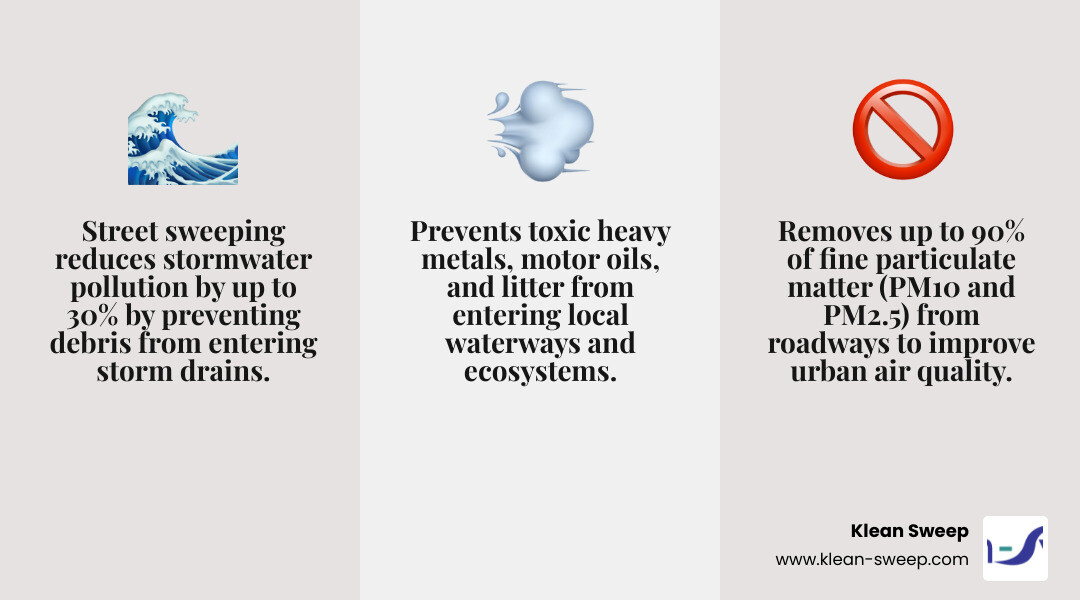
Regular street sweeping can reduce stormwater pollution by up to 30% by preventing organic debris and heavy metals from entering these drains. By removing leaves, pine needles, and litter, sweepers also prevent catch basins from becoming clogged, which directly mitigates localized street flooding during heavy winter storms.
Further, professional sweeping helps commercial property owners and municipalities comply with strict National Pollutant Discharge Elimination System (NPDES) permits and local stormwater quality regulations.
To understand how these environmental programs are structured on a municipal level, you can read about the City of Los Angeles Bureau of Street Services Street Sweeping Programs, which coordinate sweeping efforts to protect regional watersheds.
Public Safety and Hazard Mitigation
Street sweepers play an essential role in keeping public right-of-ways and commercial parking lots safe for motorists, cyclists, and pedestrians. By removing broken glass, metal shards, nails, and gravel, sweepers significantly reduce the risk of popped tires, vehicle damage, and pedestrian slips and falls.
Additionally, street sweepers can remove up to 90% of particulate matter (specifically PM10 and PM2.5) from roadways. This prevents microscopic dust and heavy metal particles from being kicked up into the air by passing vehicles, which substantially improves urban air quality and reduces respiratory hazards.
In the event of an emergency, such as a traffic accident or a hazardous material spill, sweeper operators are often dispatched immediately to clean up debris, absorb spilled fluids, and restore safe driving conditions.
How Are Sweeping Routes and Schedules Managed?
Managing a sweeping operation requires precise scheduling, route optimization, and coordination with local regulations. Sweeping vehicles must navigate busy urban grids, tight commercial parking structures, and industrial parks while minimizing disruptions to traffic and business operations.
To learn more about how sweeping schedules are structured and how to find them in your area, check out our comprehensive guide to finding local street sweeping schedules.
Commercial vs. Municipal Scheduling
The timing of sweeping operations depends heavily on whether the route is commercial or municipal:
- Commercial Sweeping: For retail shopping centers, office parks, and commercial parking structures, sweeping is almost exclusively performed during overnight or early morning hours (typically between 10:00 PM and 6:00 AM). Sweeping when businesses are closed ensures maximum safety, as there are no pedestrians or parked cars blocking the sweeper’s path.
- Municipal Sweeping: City street sweeping is generally conducted during daytime hours. To ensure the sweepers can reach the curb line where 90% of debris accumulates, municipalities establish scheduled sweeping zones paired with temporary parking restrictions. This requires close coordination with local parking enforcement officers who ticket or tow vehicles parked in active sweeping zones.
For a detailed look at municipal schedules in our primary service area, you can view our complete list of street sweeping schedules in Los Angeles.
Holiday and Weather Adjustments
Sweeping schedules must constantly adapt to seasonal changes, holidays, and weather events. During the autumn “leaf drop,” sweeping frequencies are often increased to handle the heavy volume of organic waste. Conversely, during heavy rainstorms, sweeping operations may be suspended, as sweeping wet, heavy slurry can damage equipment and is highly inefficient.
Schedules also shift around major national holidays. When municipal offices and trash collection services close, street sweeping is typically paused. To stay informed about these seasonal changes, you can read our guide on everything you need to know about Los Angeles street sweeping holidays.
Frequently Asked Questions About Street Sweeper Duties
Do street sweeper operators need a commercial driver’s license?
Yes, in most cases. While some light-duty, parking lot-sized sweepers can be operated with a standard Class C driver’s license, heavy-duty municipal and commercial street sweepers require a valid Class A or Class B Commercial Driver’s License (CDL). Additionally, because these trucks carry large water tanks for dust control, operators must have a tanker endorsement, along with an air brake endorsement.
What are the main physical demands of a street sweeping job?
The job requires significant physical stamina. Operators must be able to sit and drive for long periods while managing the continuous vibration of the machine. They must also perform manual labor, which includes lifting up to 100 pounds occasionally (such as lifting heavy debris or changing broom segments) and lifting 25 to 50 pounds frequently. Operators must also be comfortable working outdoors in all weather conditions, handling dusty environments, and operating backpack leaf blowers and shovels to clean hard-to-reach areas.
How does street sweeping benefit commercial property owners?
Regular sweeping provides several critical benefits for commercial properties:
- Aesthetics and Curb Appeal: Clean parking lots and structures present a professional image that welcomes customers and tenants.
- Asset Preservation: Removing abrasive dirt, sand, and gravel prevents the premature deterioration of asphalt, sealcoating, and striped lines, saving thousands of dollars in repaving costs.
- Liability Reduction: Sweeping removes slip-and-trip hazards like broken glass, loose gravel, and wet leaves.
- Environmental Compliance: Regular sweeping keeps trash and heavy metals out of catch basins, ensuring the property complies with local stormwater runoff regulations and avoids costly environmental fines.
Conclusion
Street sweeper operators are essential to the daily maintenance of our cities and commercial properties. Their daily dedication keeps our roads safe, protects our local waterways from toxic runoff, improves the air we breathe, and preserves the life of our paved infrastructure. It is a skilled, demanding profession that requires technical expertise, physical stamina, and a strong commitment to safety.
At Klean Sweep, we take immense pride in supporting these dedicated operators. As a family-owned business serving the greater Los Angeles area since 1969, we have built our reputation on using state-of-the-art, environmentally friendly equipment to deliver premier commercial sweeping, stormwater cleaning, pressure washing, and exterior maintenance services. By ensuring our operators are highly trained and equipped with the best technology, we help Southern California property managers maintain clean, safe, and fully compliant properties.