

Why Proper Care for Stained Concrete Floors Protects Your Commercial Property
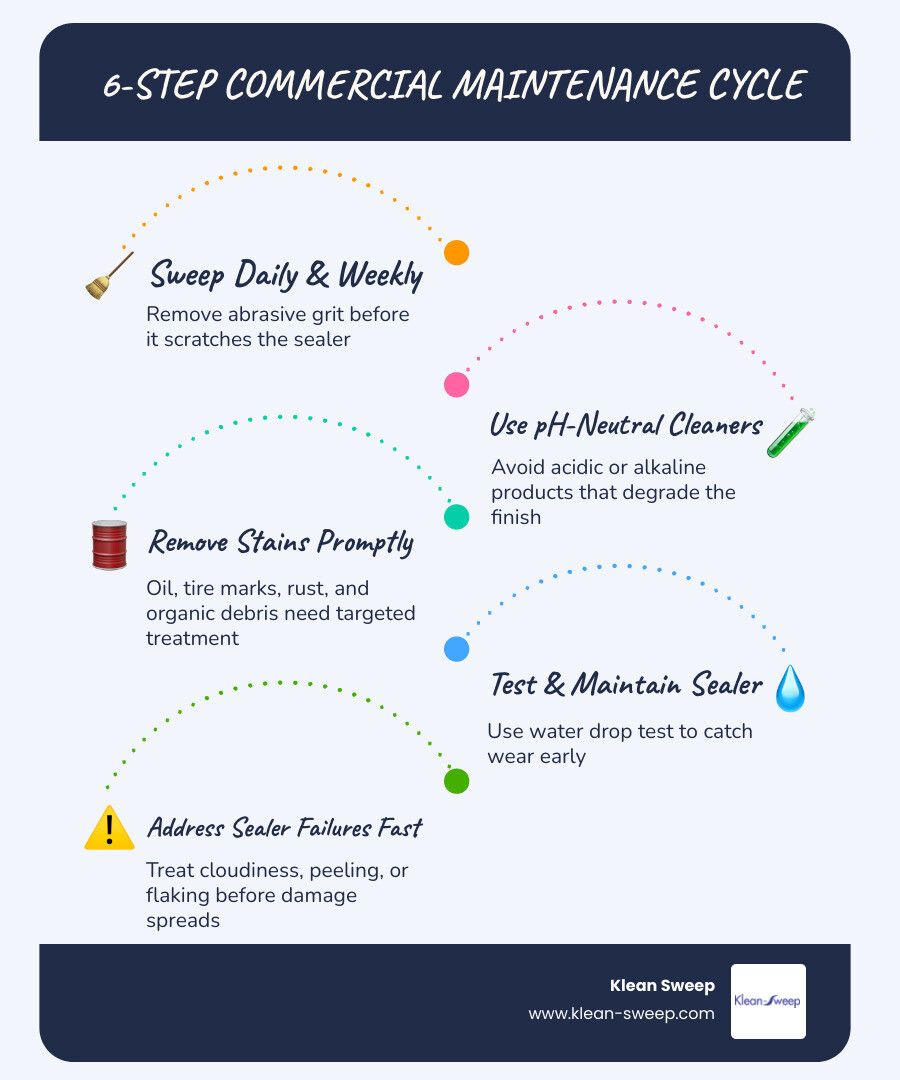
Care for stained concrete floors in a commercial setting comes down to six core maintenance steps. Here’s a quick summary:
- Sweep daily and weekly — remove abrasive grit before it scratches the sealer
- Use pH-neutral cleaners — avoid acidic or alkaline products that degrade the finish
- Remove tough stains promptly — oil, tire marks, rust, and organic debris need targeted treatment
- Test and maintain the sealer — use the water drop test to catch wear early
- Address sealer failures fast — treat cloudiness, peeling, or flaking before damage spreads
- Adjust for your local climate — Southern California’s UV exposure, hard water, and coastal air accelerate sealer breakdown
Stained concrete is a smart choice for commercial plazas, parking structures, and exterior common areas. It’s durable, attractive, and low-maintenance — when it’s properly maintained.
The key word is properly. The sealer is what protects the stain beneath it. When that sealer degrades from foot traffic, vehicle traffic, chemical exposure, or harsh weather, the color underneath starts to fade, scratch, and absorb stains. And in high-traffic commercial environments across greater Los Angeles, that degradation happens faster than most property managers expect.
One industry case study compared two acid-stained floors after nine years. The floor that received regular wax and cleaning looked pristine. The one that didn’t showed significant color loss and wear in high-traffic zones. The difference wasn’t the installation — it was the maintenance.
I’m Jana Hanson, and I’ve overseen exterior concrete maintenance for commercial and industrial properties across Southern California for over a decade at Klean Sweep — a company my father founded in 1969 and built on the principle that quality care for stained concrete floors and exterior surfaces is never optional. In the sections below, I’ll walk you through exactly how to protect your investment.
The Commercial Guide to Care for Stained Concrete Floors
To build a highly effective maintenance strategy, we must first look at how the concrete was colored. Commercial exterior stained concrete generally falls into one of two categories: acid-stained (reactive) or water-based stained (non-reactive).
The type of stain used during the initial application determines how the color behaves under physical stress and UV light, which directly dictates how we care for the surface.
- Acid-Stained Concrete: Acid stains contain metallic salts dissolved in a mild hydrochloric acid solution. When applied, they chemically react with the calcium hydroxide in the concrete matrix. This chemical reaction creates a permanent, translucent, marbled color that becomes an integral part of the concrete surface. Because the color is chemically bonded, it cannot chip, peel, or fade easily. Learn more about the permanent nature of these finishes in this guide on How To Maintain Stained Concrete For Long-Lasting Beauty – Affordable Concrete San Antonio .
- Water-Based Stained Concrete: Water-based stains do not rely on a chemical reaction. Instead, they deposit acrylic polymers and pigments directly into the open pores of the concrete. While they offer a much wider and more predictable range of colors, they sit closer to the surface. Without a strong protective topcoat, water-based stains are more vulnerable to UV degradation and physical wear.
While many property managers look up acid washing vs staining to understand these chemical reactions, the stakes are much higher for exterior commercial spaces.
Whether your Pasadena parking structure features water-based pigments or your Beverly Hills retail plaza boasts a rich, acid-stained marbled finish, both rely entirely on a protective sealer to survive the elements. If the sealer fails, the stain is left completely vulnerable to traffic, weather, and chemical spills.
For a deeper dive into the initial application process that sets the stage for long-term maintenance, check out How to Stain Concrete Floors.
Step 1: Establish a Daily and Weekly Sweeping Routine
In busy commercial spaces, the greatest threat to your stained concrete isn’t heavy vehicles—it is the tiny, abrasive particles of dirt, sand, and grit tracked in by pedestrians and wind. When left on the surface, these particles act like sandpaper under the weight of foot traffic and rolling tires, slowly grinding away the protective sealer.
To prevent this micro-abrasion, we recommend a strict schedule of daily sweeping and weekly deep debris removal.
For large outdoor retail centers in Torrance or commercial plazas in Carson, utilizing professional day porter services and parking lot sweeping is the most efficient way to keep these abrasive elements at bay. Professional sweepers use specialized, soft-bristled equipment that lifts heavy debris and fine dust without scratching the delicate topical sealer.
Consistent debris removal is the absolute foundation of concrete floor cleaning for long lasting durability. By removing the grit before it can be ground into the surface, you significantly extend the lifespan of your sealer and preserve the high-gloss shine of your stained concrete.
Step 2: Use the Right Cleaning Agents and Equipment
When it comes to washing commercial exterior stained concrete, using the wrong chemical can ruin a beautiful floor in minutes. Many standard commercial degreasers and off-the-shelf cleaning products contain harsh acids, strong alkalis, or solvents that chemically strip or dull concrete sealers.
For routine washing, we use commercial-grade, walk-behind or ride-on industrial floor scrubbers equipped with soft nylon brushes or non-abrasive microfiber pads. These machines apply even pressure and immediately vacuum up the dirty water, preventing dirt from settling back into the concrete’s pores.
For a complete breakdown of safe washing techniques, refer to How to Clean Acid Stain Concrete Floors: A Complete Guide – Rustic Roots Living .
Why pH-Neutral Solutions Matter for the Care for Stained Concrete Floors
The most critical rule of stained concrete maintenance is to use strictly pH-neutral cleaning solutions (ideally with a pH level of 7.0).
Concrete is naturally alkaline. When you introduce acidic cleaners—such as vinegar, citric cleaners, or phosphoric acid—they cause chemical etching by eating away at the calcium hydroxide in the concrete. This process permanently ruins the smooth surface, leaving it rough, dull, and highly prone to trapping dirt.
Similarly, highly alkaline cleaners like bleach or ammonia can degrade the chemical bonds of acrylic sealers, causing them to break down, turn yellow, or peel. Ammonia also leaves a sticky, tacky residue that actively attracts dust and grime, making your floor look dirty again almost immediately.
Using a pH-neutral cleaner ensures you lift grease and surface dirt without compromising the chemical integrity of your sealer. For a detailed look at concrete chemistry and why pH balance is non-negotiable, read the ph neutral guide keeping your concrete floors from having a meltdown.
Step 3: Remove Tough Commercial Stains Safely
Commercial exterior concrete faces a constant barrage of harsh contaminants. In parking structures and plazas, oil spills, tire marks, rust from metal fixtures, and organic debris (like fallen leaves, bird droppings, or berries) can quickly create unsightly stains.
To remove these tough stains without stripping the protective sealer or damaging the underlying color, you must use a targeted, non-destructive approach:
- Oil and Grease Stains: Never use solvent-based degreasers that can dissolve acrylic sealers. Instead, apply a specialized pH-neutral biological or enzymatic concrete cleaner. For deep, set-in oil stains on parking decks, we apply a professional chemical poultice (often utilizing an absorbent powder mixed with a neutral cleaning agent). Let the poultice dwell for 10 to 15 minutes to break the molecular bonds of the oil, scrub gently with a soft-bristled brush, and rinse thoroughly.
- Tire Marks: Hot tires can leave dark rubber deposits on sealed concrete. Spray a mild, pH-neutral citrus-free cleaner over the marks, allow it to dwell to soften the rubber, and scrub gently with a soft nylon brush before rinsing.
- Rust Stains: Acidic rust removers will instantly etch concrete and strip sealers. To safely lift rust, we use specialized, non-acidic chelating agents that bind to the iron oxide molecules and lift them from the surface without reacting with the concrete’s calcium hydroxide. You can read more about these advanced techniques in the secret to a rust free concrete floor.
- Organic Debris: Tannins from wet leaves, bird droppings, and berries can leave stubborn organic stains. Address these immediately by blotting the spill rather than rubbing it, which can spread the stain. Wash the area with warm water and a neutral detergent.
While general guides on concrete floor stain removal suggest basic fixes, commercial properties require industrial-grade, eco-friendly solutions that comply with local runoff regulations while protecting high-traffic surfaces.
Step 4: Test and Maintain the Protective Sealer Layer
The sealer is the unsung hero of your stained concrete floor. It acts as a sacrificial barrier, absorbing the physical punishment of foot traffic, vehicle tires, and weather so that the underlying color remains untouched.
To ensure your sealer is still doing its job, we perform a simple, reliable diagnostic called the Water Drop Test:
- Pour a quarter-sized drop of clean water onto a high-traffic area of your stained concrete.
- Observe the water for 30 seconds.
- The Verdict: If the water beads up tightly, your sealer is intact and performing beautifully. If the water slowly spreads out or begins to darken the concrete, your sealer is wearing thin. If the water soaks into the concrete immediately, the sealer has failed completely, leaving the porous concrete open to deep staining and moisture damage.
Commercial exterior concrete typically utilizes one of two topical sealers:
- Acrylic Sealers: Available in both solvent-based and water-based formulas, acrylics are highly breathable and excellent for exterior plazas. They provide a beautiful gloss but require more frequent maintenance.
- Polyurethane or Epoxy Sealers: These high-performance coatings offer superior chemical and abrasion resistance, making them ideal for heavy-use parking structures. However, they must be formulated with strong UV inhibitors to prevent yellowing under the intense Southern California sun.
When to Reseal to Ensure Proper Care for Stained Concrete Floors
To maintain continuous protection, commercial exterior stained concrete plazas, driveways, and walkways should be resealed every 1 to 2 years. Covered parking structures or semi-protected commercial areas may stretch this interval to 2 to 5 years, depending on traffic volume.
When applying a new sealer, timing and preparation are everything. If you are dealing with newly poured concrete, you must allow it to cure for a full 28 days before applying the first sealer coat. Applying sealer too early traps moisture within the curing slab, leading to immediate sealer failure.
Furthermore, you must always match your sealer types. Applying a water-based acrylic directly over an old solvent-based acrylic (or vice versa) without proper preparation will cause complete adhesion failure, resulting in bubbling, peeling, and a ruined finish within weeks.
Step 5: Address Sealer Failures and Cloudiness
If your stained concrete has turned cloudy, white, or is starting to peel, you are witnessing a classic sealer failure.
Cloudiness or “blushing” is almost always caused by moisture entrapment. This occurs when water vapor rising from the sub-slab becomes trapped beneath a non-breathable topical sealer, or when the sealer was applied during high heat or high humidity, preventing it from bonding correctly.
To repair these common issues, we must analyze the type of sealer and the severity of the failure:
- Peeling and Severe Cloudiness: When a sealer begins to flake or peel, a simple topcoat won’t fix it. You must chemically strip the failed sealer. We strictly avoid mechanical sanding or grinding on stained concrete because sanding can permanently damage the thin, stained surface layer, ruining the marbled color. Instead, we apply a commercial-grade chemical stripper, scrub with a stiff nylon brush, neutralize the pH, and rinse the surface thoroughly.
- Solvent-Based Acrylic Haze: If the cloudy sealer is a solvent-based acrylic, it can often be restored using a xylene treatment. Applying xylene temporarily re-liquefies the acrylic, allowing trapped moisture to escape and letting the sealer re-bond to the concrete as it dries.
- Preparation is Key: Before applying any new sealer or performing a restoration, the slab must be completely clean, dry, and free of residues. For a comprehensive look at the preparation steps that prevent these failures, see How to Clean Concrete Floors for Staining: Prep Steps That Make or Break Results.
Step 6: Adapt Maintenance for Southern California Climates
Maintaining stained concrete in Southern California presents a unique set of environmental challenges. From Pasadena to Brea, and down to the coastal areas of Torrance and Carson, our local climate directly impacts how sealers degrade:
- Intense UV Exposure: The constant, intense Southern California sun accelerates the breakdown of topical sealers, particularly acrylics. Without UV-resistant additives, your sealer will degrade rapidly, leading to faded colors and a dull finish. We always specify sealers with high-quality UV inhibitors for outdoor plazas and rooftop parking decks.
- Coastal Salt Air: Properties in Los Angeles coastal zones, like Santa Monica or near Torrance, face airborne salts that can settle on the concrete. If these salts penetrate the sealer, they can cause sub-fluorescence—a process where salt crystals expand inside the concrete pores, causing micro-cracking and sealer delamination. Regular washing with fresh, pH-neutral water is essential to remove these salt deposits.
- Hard Water Deposits: Southern California water is notoriously high in calcium and magnesium. If you wash your stained concrete and allow it to air-dry under the hot sun, the evaporating water will leave behind a stubborn white mineral haze. To prevent this, we always squeegee or dry the floors thoroughly after washing, or use water-softening systems for deep cleaning.
Frequently Asked Questions about Commercial Concrete Care
Can you use a steam pressure washer on stained concrete?
No, you should never use a steam pressure washer or a steam mop on sealed stained concrete. Steam cleaning generates intense heat and moisture that quickly softens and clouds acrylic and epoxy-based sealers, leading to peeling, bubbling, and premature failure.
For commercial pressure washing, keep the water temperature cool or warm (never steam), and keep the pressure strictly under 1200 PSI using a wide-angle spray nozzle. Hold the wand at least 12 inches from the surface to avoid physically lifting the sealer.
How long does a commercial stained concrete floor last?
When properly sealed and maintained, commercial stained concrete floors have an expected lifespan of 25+ years. The secret to this longevity is treating the sealer as a required, sacrificial wear layer.
By performing routine sweeping, using pH-neutral cleaners, and reapplying the protective topcoat every few years, you ensure that physical wear never actually reaches the stained concrete itself.
What is the cost of professional commercial concrete restoration?
While we do not quote specific pricing due to variables in project size, location, and surface condition, professional commercial concrete restoration is highly cost-effective compared to replacing a damaged slab.
A standard professional strip and reseal is a highly efficient way to restore a cloudy or peeling floor. If the color has faded due to neglected sealer, a professional color refresh and reseal can bring back the original vibrancy of the stain.
Investing in a regular professional maintenance program is always more economical than waiting for the sealer to fail completely, which requires extensive chemical stripping and color restoration.
Conclusion
Taking proper care for stained concrete floors is one of the most effective ways to preserve the beauty, safety, and value of your commercial property. By establishing a daily sweeping routine, using only pH-neutral cleaning solutions, addressing stains immediately, and maintaining a strong sacrificial sealer layer, you can keep your exterior plazas and parking structures looking pristine for decades.
At Klean Sweep, we have been providing environmentally friendly, professional exterior maintenance services since 1969. Based in Torrance, CA, and serving the greater Los Angeles area—including Beverly Hills, Carson, Pasadena, and Brea—our family-owned business utilizes state-of-the-art equipment and highly trained crews in professional blue uniforms to keep your commercial concrete in peak condition.
Don’t let neglected sealers or improper cleaning ruin your valuable stained concrete. Contact us today to learn more about our professional our services concrete floor scrubbing and let our team customize a worry-free maintenance program for your commercial property.