Types of Commercial Concrete Refinishing and Scrubbing
Commercial and industrial facilities across Southern California — from high-volume retail parking structures in Beverly Hills to busy logistics bays in Carson and manufacturing facilities in Torrance — require high-grade cleaning methods tailored to heavy surface wear. Standard mopping or hose rinsing simply pushes contaminants into concrete’s porous matrix. To achieve true restoration, we deploy aggressive mechanical scrubbing, high-pressure hot water washing, and targeted chemical treatments.
For routine exterior upkeep and heavy dirt extraction, professional Concrete Floor Scrubbing provides the foundation for long-term slab performance.
Power Scrubbing and Pressure Washing Services
When dealing with heavy vehicle traffic, grease buildup, and ground-in soil, power scrubbing and high-pressure steam cleaning are the premier defense methods. Heavy-duty industrial auto-scrubbers utilize counter-rotating brushes or disc pads alongside proprietary cleaning solutions to agitate, lift, and suspend surface grime. Once loosened, integrated vacuum systems recover the wastewater immediately, preventing contaminated slurry from drying back into the slab or washing into local storm drains.
For deep-seated contaminants like embedded grease, hydraulic fluids, and tire skid marks, we pair scrubbing with high-pressure washing systems. Our high-pressure hot water equipment heats water up to 200°F+, breaking down stubborn hydrocarbon chains that cold water cannot affect. You can learn more about how we utilize these high-performance techniques in The Ultimate Guide to Commercial Pressure Washing Services. Combined with vacuum water recovery, this dual-action approach ensures surface oil extraction while maintaining compliance with local stormwater regulations in cities like Pasadena and Brea.
Hone and Guard vs. Commercial Polishing
Beyond deep cleaning, commercial property owners frequently need surface refinement to protect their concrete against ongoing chemical exposure and traffic abrasion. Two primary refinishing options are hone and guard treatments and full mechanical polishing.
The hone and guard method — often referred to in the industry as a “poor man’s polish” — uses an abbreviated grinding process (typically 0–100 grit diamond abrasives) to smooth out surface imperfections, open the surface pores, and allow a lithium silicate densifier to penetrate deeply into the slab. A protective, high-solids guard chemical is then applied and high-speed burnished into the surface.
In contrast, full mechanical polishing requires multi-pass grinding and honing with fine diamond abrasives (ranging from 100 up to 3000 grit) to achieve a high-gloss, reflective finish without needing topical coats.
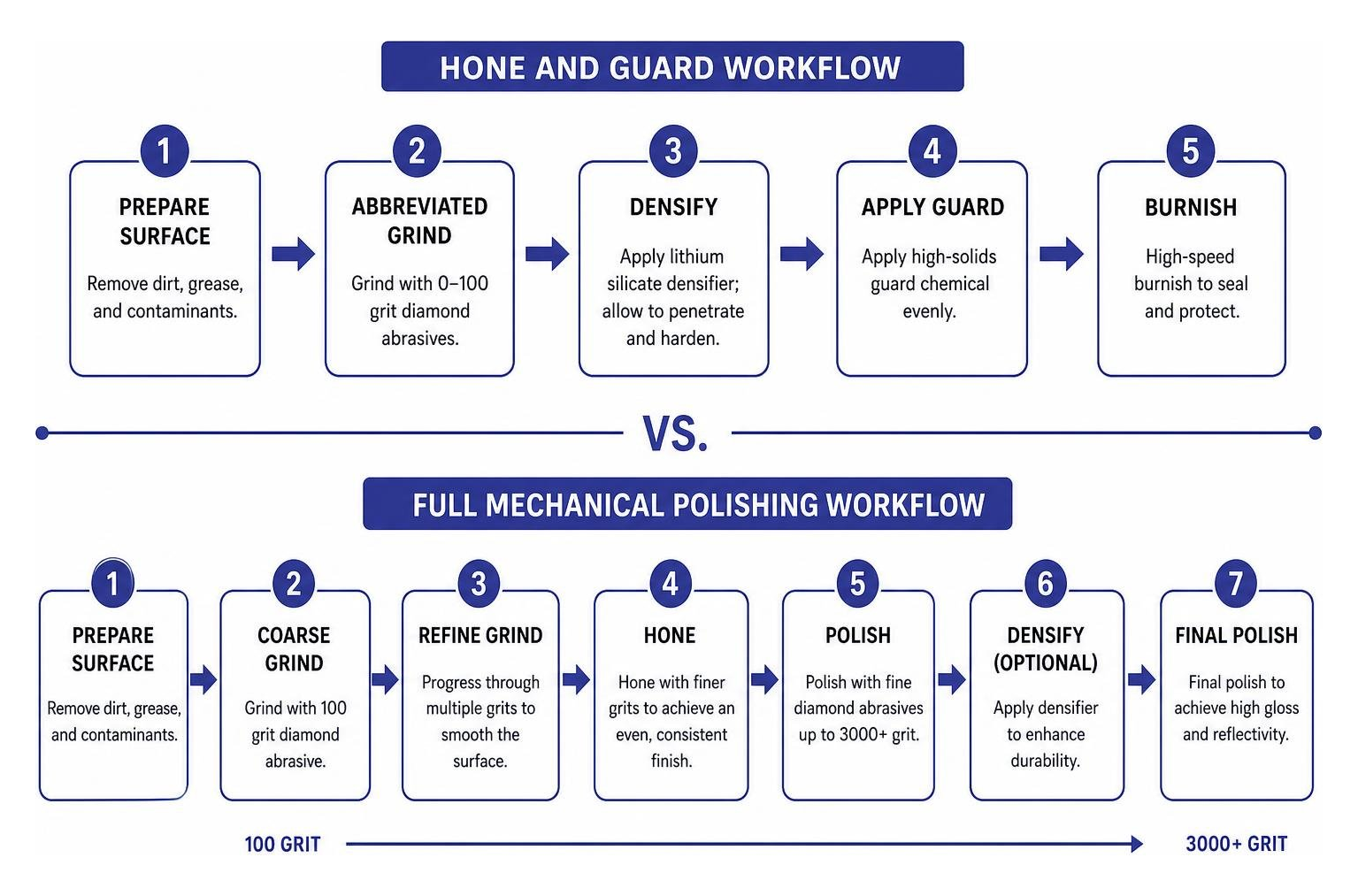
Here is how these two refinishing approaches compare for commercial properties:
| Feature / Metric | Hone and Guard System | Full Mechanical Polish |
|---|---|---|
| Abrasive Grit Progression | 0 to 100 Grit (Abbreviated grinding) | 100 to 3000+ Grit (Multi-pass mechanical grinding) |
| Surface Appearance | Smooth, low-sheen satin finish | High-gloss, mirror-like finish |
| Primary Mechanism | Chemical densification + burnished topical guard | Pure mechanical polishing + internal densification |
| Slip Resistance | Excellent wet & dry traction | Smooth finish; requires traction additives in exterior zones |
| Cost Efficiency | Highly budget-friendly for large commercial areas | Higher upfront investment due to multiple grinding passes |
| Ideal Applications | Parking decks, exterior walkways, utility bays | Showrooms, retail interiors, high-profile commercial lobbies |
Key Benefits of Hiring a Commercial Concrete Floor Cleaning Service

Commercial concrete floors are subjected to environmental stress every single day. Sunlight, moisture, vehicle exhaust, motor oil, and heavy machinery wear down the slab’s protective skin over time. Hiring a professional concrete floor cleaning service delivers concrete benefits that directly impact your facility’s safety, liability, and operating budget:
- Enhanced Slip Resistance & Safety: Accumulations of engine oil, coolant, and tire rubber create serious slip and fall hazards for pedestrian traffic. Deep scrubbing removes slick residues and restores natural micro-texture to concrete surfaces.
- Dust-Proofing & Slab Hardening: Unsealed concrete naturally produces fine alkaline dust through abrasive wear. Applying specialized densifiers chemically converts free lime inside the concrete into durable calcium silicate hydrate, locking down concrete dust.
- Improved Curb Appeal & Branding: Clean, well-maintained parking decks and exterior commercial grounds send an immediate signal of professionalism and security to visitors, tenants, and customers.
- Structural Longevity: Hydrocarbons and acid deposits slowly degrade the cement paste binding your aggregate together. Periodic deep cleaning prevents spalling, pitting, and costly structural concrete repairs down the line. To explore how regular maintenance shields your investment, check out our guide on Concrete Floor Cleaning for Long-Lasting Durability.
What to Expect From an Exterior Concrete Floor Cleaning Service
When our crews execute a commercial concrete cleaning project, we follow a rigorous, standardized workflow engineered to deliver streak-free, thorough results without damaging the concrete matrix.
First, we perform detailed surface preparation, clearing all loose dirt, trash, and heavy debris. Next, we apply specialized, eco-friendly degreasers tailored to the specific contaminants on your slab. To understand the mechanical precision behind achieving a streak-free finish, read our breakdown on How to Scrub Concrete Floors Without Streaks.
A critical step during hot water extraction is maintaining proper chemical equilibrium. Highly acidic or overly aggressive alkaline cleaners can etch concrete, destroying the top paste layer and leaving the slab susceptible to moisture intrusion. We utilize strictly balanced solutions — as detailed in The pH Neutral Guide: Keeping Your Concrete Floors From Having a Meltdown — ensuring dirt and oils dissolve cleanly while preserving the concrete slab.
Commercial Surface Stain and Rust Removal
Certain concrete stains require specialized chemical restoration beyond standard scrubbing and pressure washing. Parking garages and outdoor commercial lots frequently suffer from two severe stain types: deep-set petroleum saturations and iron oxidation (rust).
Battery acid leaks from parked vehicles create stubborn orange and yellow rust burn stains by reacting with the iron compounds present in the aggregate and cement. Standard pressure washing will not remove these chemical burns. We utilize targeted rust-neutralizing chemistry to dissolve iron oxides safely without etching surrounding concrete. Learn more about restoring discolored slabs in The Secret to a Rust-Free Concrete Floor.
For deep oil penetration, standard surface degreasers often fail because oil migrates deep into concrete capillary pores. We apply industrial-grade poultice treatments and deep-penetrating emulsifiers that draw oil upward to the surface where it can be completely flushed and extracted using high-pressure steam equipment.
Commercial Concrete Cleaning Process and Cost Factors
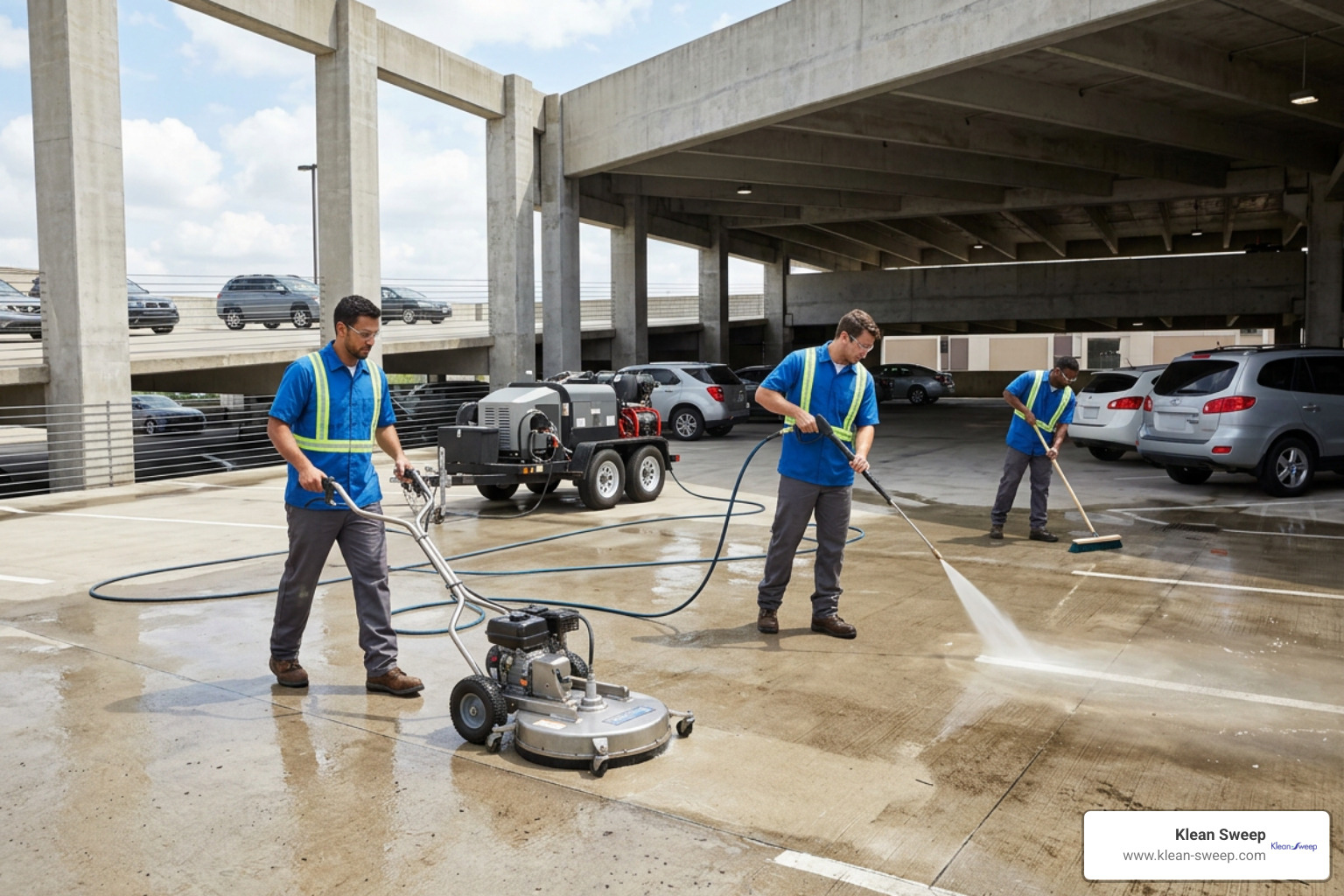
Every commercial concrete cleaning project presents unique site variables. Rather than relying on flat-rate guesswork, commercial pricing structures depend on several critical factors that dictate equipment selection, crew size, and labor time:
- Total Square Footage: Larger, open parking structures or industrial complexes benefit from economies of scale, lowering the overall cleaning cost per square foot compared to small, confined properties.
- Severity of Stains & Contamination: Slabs with heavy engine oil build-up, extensive tire marks, or chemical burns require multi-stage pre-treatments, chemical hot water extraction, and localized spot treatments.
- Site Layout & Water Accessibility: Open, flat parking decks with direct water hookups streamline cleaning operations. Conversely, multi-level structures with tight turns, limited overhead clearance, or restricted drainage access require specialized low-profile equipment and auxiliary water transport.
- Environmental & Wastewater Recovery Compliance: Commercial concrete cleaning in Southern California mandates strict compliance with local storm drain protection rules. Facilities operating near sensitive drainage zones require complete closed-loop water recovery systems. Discover how high-pressure washing combined with environmental compliance transforms commercial slabs in Stop the Grime With a Power Washed Concrete Floor.
Choosing the Right Commercial Concrete Floor Cleaning Service Contractor
Selecting a commercial concrete contractor requires looking closely at their equipment, environmental safety compliance, and regional experience. Concrete cleaning in commercial environments is vastly different from light-duty pressure washing.
When evaluating service providers across Los Angeles County, ensure your contractor meets the following criteria:
- Heavy Industrial Equipment: Verify that the contractor operates heavy-duty planetary floor grinders, dual-action rotary scrubbers, and high-pressure steam cleaning units capable of sustained continuous operation.
- Integrated Wastewater Recovery: Ensure their truck-mounted units feature vacuum recovery to capture wash water, filtration units, and compliant containment systems that prevent illegal runoff into storm sewers.
- Local Southern California Experience: Work with a team that understands regional climate factors, seasonal oil accumulation patterns, and local municipal mandates in cities like Torrance, Carson, Beverly Hills, and Pasadena.
- Off-Hours Scheduling: Your contractor should offer flexible night, weekend, or holiday scheduling to perform deep scrubbing without disrupting business operations, tenant parking, or retail customer traffic.
Frequently Asked Questions about Commercial Concrete Cleaning
How does commercial concrete floor cleaning differ from tile or VCT care?
Commercial concrete floor cleaning differs fundamentally from tile, natural stone, or vinyl composition tile (VCT) maintenance due to the underlying physical structure of the substrate and its operational environment. VCT relies on delicate topical acrylic waxes that require periodic stripping and recoating. Tile relies on grout lines that absorb liquids separately from ceramic surfaces.
Concrete is a thick, monolithic, porous slab designed to bear extreme structural weight, heavy forklift traffic, and rolling vehicle abrasion. Standard topical waxes applied to exterior concrete would rapidly peel, flake, and bubble under vehicle tire friction and UV exposure. Consequently, concrete floor maintenance utilizes deep mechanical scrubbing, penetrating lithium densifiers, hot water extraction, and specialized non-topical protective guards that chemical-bond inside the pores rather than sitting as a thin film on top. Property owners maintaining regional facilities can explore specialized maintenance standards such as Tile & Grout Cleaning Carson CA for interior tile structures, while trusting specialized concrete scrubbing for structural slabs.
Can commercial concrete scrubbing remove deep oil and battery acid stains?
Yes, professional commercial concrete scrubbing combined with hot water extraction and targeted neutralizing chemistry can effectively remove or dramatically lighten deep oil saturations and battery acid stains.
While basic power washing only rinses surface dirt, our multi-stage restoration process utilizes industrial-grade emulsifiers that break down hydrocarbon bonds deep within the concrete’s pores. For deep petroleum stains, we apply chemical poultices that draw deeply absorbed oil up to the surface layer. Battery acid burns and rust discoloration are treated with specialized acid-neutralizing agents that chemically break down iron oxides, restoring uniform color to your exterior concrete slab.
How often should commercial parking structures undergo deep concrete cleaning?
Most commercial parking structures, loading docks, and exterior commercial plazas in Southern California should undergo deep concrete scrubbing at least twice a year. However, optimal cleaning frequency depends on specific facility factors:
- High-Traffic Parking Garages: Semiannual or quarterly deep steam scrubbing to manage oil leaks, exhaust soot, and tire rubber marks.
- Retail & Shopping Plazas: Quarterly cleaning around high-pedestrian entrances and trash enclosures to eliminate grease, spilled beverages, and gum deposits.
- Industrial Loading Docks & Warehousing Exterior Slabs: Monthly or bi-monthly power scrubbing to prevent hazardous chemical buildup and dust accumulation.
Establishing a consistent preventative cleaning schedule prevents oil from deeply saturating the slab, keeping your property safe, visually appealing, and compliant year-round.
Conclusion
A well-maintained concrete slab is essential for commercial property safety, regulatory compliance, and operational efficiency. Over time, engine oil, heavy vehicular traffic, chemical spills, and environmental grime break down unprotected concrete, leading to costly structural repairs and unsafe slip hazards.
At Klean Sweep, we have provided expert exterior commercial property maintenance across Torrance, Los Angeles, and Southern California since 1969. As a family-owned business utilizing state-of-the-art power scrubbers, high-pressure steam cleaning units, and environmental water recovery systems, we help commercial property owners keep their facilities clean, safe, and long-lasting.
Ready to revitalize your parking structure, loading dock, or commercial exterior slab? Explore our specialized Concrete Floor Scrubbing Services or contact our team today to request a customized service proposal!