

Why a Clean Basement Concrete Floor Matters for Commercial Properties
Clean basement concrete floor maintenance is one of the most overlooked responsibilities in commercial and industrial facility management. Here’s a quick breakdown of how to get it done right:
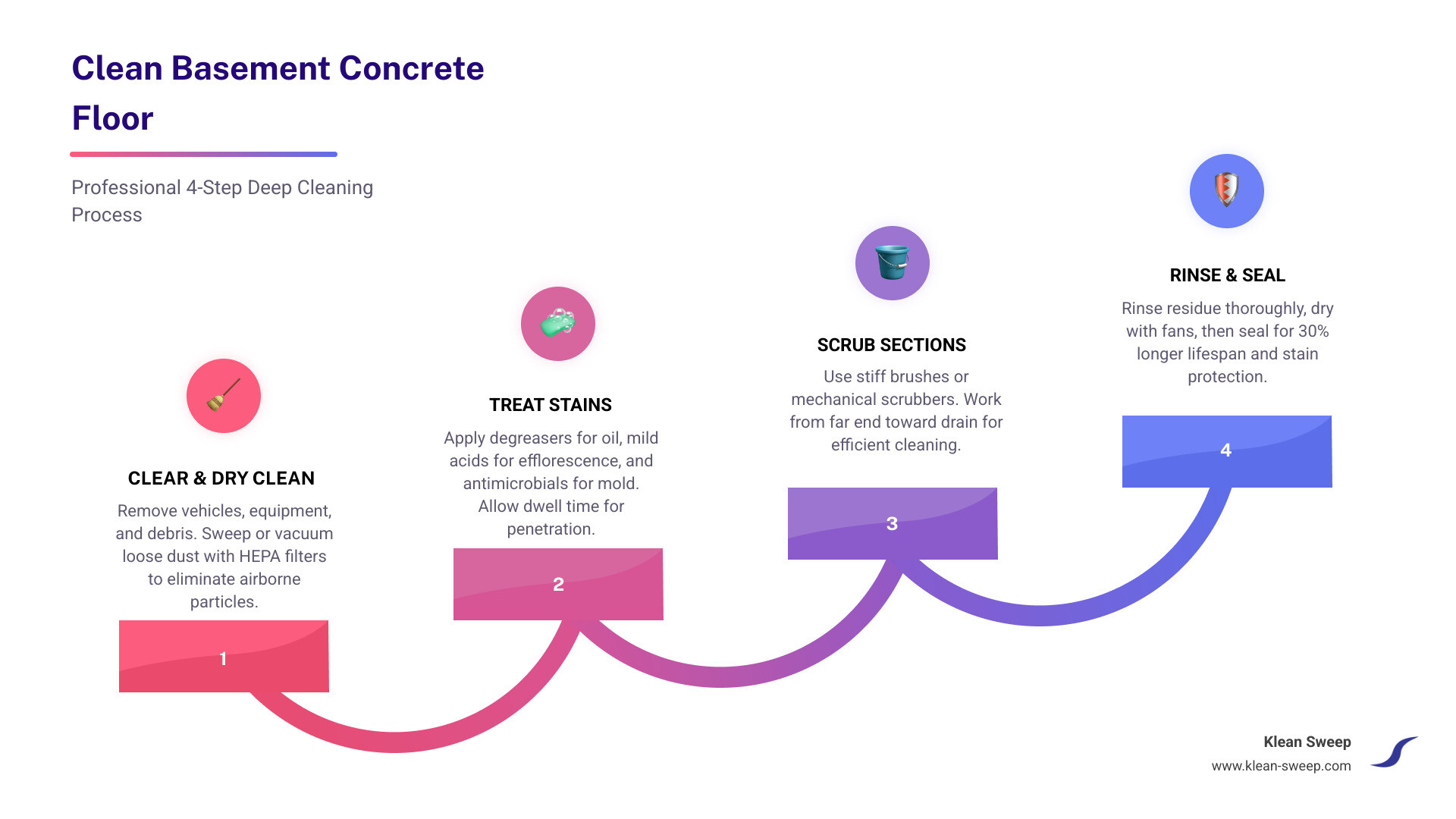
How to clean a basement concrete floor (quick steps):
- Clear the area — remove vehicles, equipment, and stored items
- Dry clean first — sweep or vacuum all loose debris and dust
- Treat stains — use a degreaser for oil, vinegar or mild acid for efflorescence, and a diluted antimicrobial solution for mold
- Scrub in sections — work from the far end toward the drain using a stiff-bristled brush or mechanical scrubber
- Rinse thoroughly — remove all cleaner residue with clean water
- Dry completely — use fans, squeegees, and dehumidifiers
- Seal the surface — apply a concrete sealer to protect against future staining and moisture
Parking basements and commercial concrete floors take a beating. Vehicle traffic, chemical spills, construction dust, and moisture all work together to degrade the surface over time. Left unchecked, that buildup doesn’t just look bad — it creates slip hazards, accelerates concrete deterioration, and can put your property out of compliance with local regulations.
The good news? A properly cleaned concrete floor can last significantly longer and look noticeably better. Research shows that regular cleaning can extend a concrete floor’s lifespan by up to 30% and make the space appear measurably brighter.
Most property managers don’t ignore their floors on purpose — they just don’t know where to start.
This guide covers everything from the right equipment to stain-specific treatments, so you can make an informed decision about DIY maintenance or calling in a professional team.
I’m Jana Hanson, and I’ve spent years running Klean Sweep, one of the largest exterior maintenance companies in the Los Angeles area, where clean basement concrete floor restoration is a core part of the commercial services we provide. That hands-on experience is the foundation of everything you’ll find in this guide.
Essential Equipment to Clean Basement Concrete Floor
To achieve a professional-grade clean basement concrete floor, you need more than a simple household mop and bucket. Because concrete is porous, it traps dirt, oils, and fine particulates deep within its surface. For large-scale commercial or industrial basements in Southern California, having the right “cleaning army” is the difference between a surface-level wipe and a deep restoration.
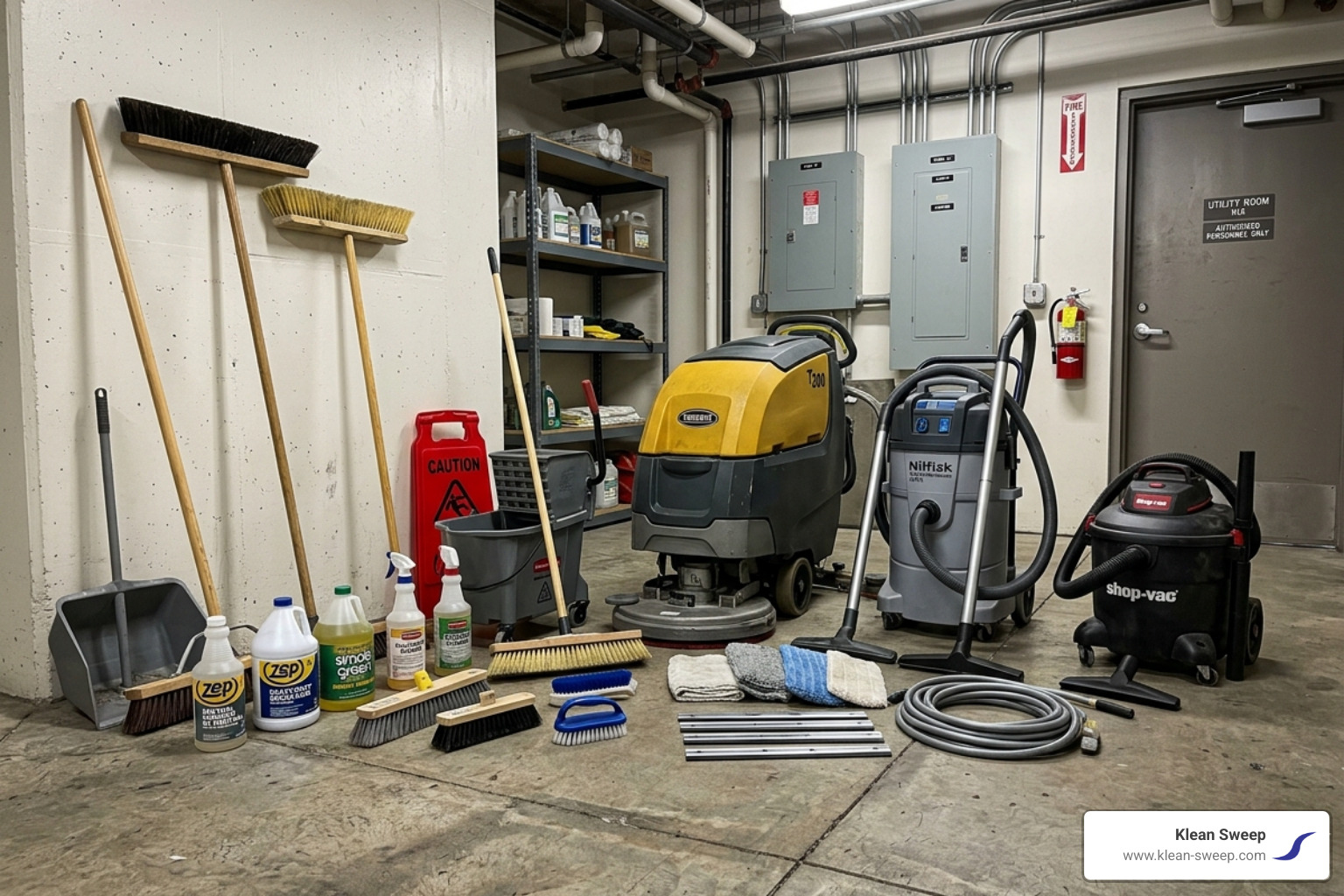
Here is the essential gear we recommend for April 2026:
- Industrial Brooms and Sweeping Compounds: For large areas, standard brooms won’t cut it. We use heavy-duty push brooms. To prevent dust from becoming airborne, use a sweeping compound (like a wax or oil-based grit) that “grabs” the dust.
- Shop Vacuums or HEPA Vacs: A high-capacity wet/dry vacuum is necessary to remove fine construction dust and standing water.
- pH-Neutral Cleaners: For general maintenance, avoid harsh acids or highly alkaline cleaners that can etch the surface. A pH-neutral cleaner is safe for the concrete and the environment.
- Heavy-Duty Degreasers: In parking basements, oil and grease are inevitable. You’ll need a concentrated degreaser to break down petroleum-based spots.
- Stiff-Bristled Brushes: Use nylon or poly brushes with long handles. Avoid metal brushes, as they can leave behind tiny fragments that eventually rust and stain the floor.
- Commercial Pressure Washers: For exterior-facing basement ramps or heavily soiled areas, a pressure washer (set between 2,500 and 3,000 PSI) is highly effective. However, use caution indoors to manage overspray and drainage.
- Personal Protective Gear (PPE): Safety is paramount. Always wear chemical-resistant gloves, eye protection, and closed-toe shoes. If you are dealing with mold or using bleach, a respirator or high-quality mask is a must.
For more detailed insights on choosing the right tools, you can check out this Expert Guide to Deep Cleaning and Maintaining Concrete.
Professional Process for Commercial Concrete Restoration
Cleaning a massive commercial space requires a systematic approach. You can’t just throw water on the floor and hope for the best. At Klean Sweep, we follow a rigorous multi-stage process to ensure the concrete is not only clean but structurally preserved.
The first step is always Area Preparation. This involves removing all vehicles, storage pallets, and equipment. We also perform Moisture Testing. If you notice a white, powdery substance (efflorescence) or damp spots, it indicates that water is seeping through the slab. We often use the “plastic wrap test”—taping a square of plastic to the floor for 24 hours—to see if condensation forms underneath, which tells us if the concrete is truly dry enough for sealing.
For those looking for expert assistance, you can find more info about concrete floor cleaning services to see how professional-grade equipment handles these challenges.
Dry Cleaning and Dust Mitigation
Before a drop of water touches the floor, you must remove the “dry” mess. This is especially critical for new construction or recently renovated facilities. Construction dust is incredibly fine and, when mixed with water, creates a thick slurry that is much harder to remove.
We recommend using sweeping compounds to keep dust on the floor rather than in the lungs of your staff. For high-traffic Los Angeles facilities, HEPA-filtered vacuums are the gold standard for capturing airborne particles and ensuring a truly clean basement concrete floor.
Deep Scrubbing Your Clean Basement Concrete Floor
Once the loose debris is gone, it’s time for the mechanical phase. We apply the cleaning solution and allow for chemical dwell-time. This means letting the cleaner sit on the surface for 10–15 minutes (without letting it dry) to break down molecular bonds between the dirt and the concrete.
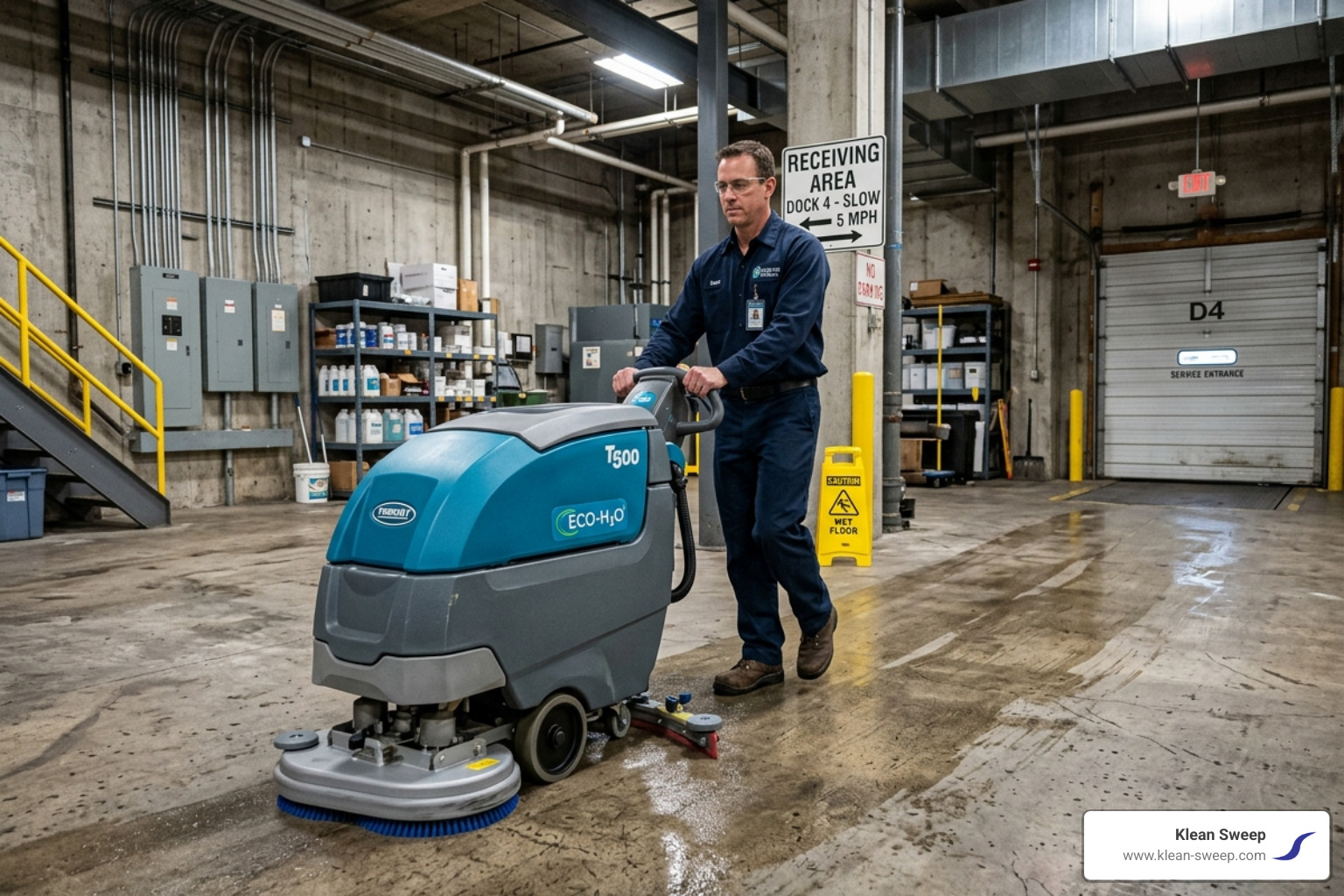
Next, we use mechanical scrubbing. In large commercial basements, we use walk-behind or ride-on scrubbers that use rotating brushes to agitate the surface. For stubborn spots, hot water extraction or steam cleaning can be used to lift deep-seated grime.
Rinsing and Industrial Drying
The most common mistake in DIY cleaning is failing to rinse. If soap residue remains, it creates a slippery film that actually attracts more dirt. We use specialized squeegee techniques to move dirty water toward drains, followed by a thorough rinse with fresh water.
Finally, we employ high-volume fans and industrial dehumidifiers. Concrete is like a sponge; it can hold moisture for days. To prevent mold growth or “musty” smells, the floor must be bone-dry before you move equipment back in.
Targeted Stain Removal for Industrial Surfaces
Not all dirt is created equal. A clean basement concrete floor in a Pasadena parking structure faces different challenges than one in a Torrance warehouse.
Eliminating Oil and Chemical Spills
Oil is the enemy of concrete. Because the surface is porous, oil soaks in quickly. For fresh spills, use an absorbent like kitty litter or baking soda. For older, set-in stains, we use enzymatic cleaners. These products contain “good” bacteria that actually eat the oil molecules.
For the toughest industrial stains, a poultice application (a paste made of a solvent and an absorbent material) can be applied to the spot, covered with plastic, and left for 24 hours to “draw” the oil out of the concrete pores.
Managing Efflorescence and Mineral Deposits
If you see white, chalky streaks, you’re dealing with efflorescence. This happens when vapor transmission carries minerals through the concrete; the water evaporates and leaves the salt behind.
To treat this, we use a mild acid solution or a 50/50 mix of white vinegar and water. This process, often called acid etching, helps dissolve the minerals. We then perform pH balancing by rinsing with a basic solution (like water and baking soda) to neutralize the acid and protect the floor’s integrity. For more on this, see Professional Concrete Cleaning & Sealing in Southern California.
Advanced Recovery: Post-Construction and Flood Management
Flooding is a nightmare for any property manager in Southern California during the rainy season. Whether it’s a burst pipe or a heavy storm, standing water on concrete leads to mold and structural weakening.
| Feature | DIY Recovery | Professional Recovery (Klean Sweep) |
|---|---|---|
| Water Removal | Small wet-vacs, manual mopping | High-capacity sump pumps & truck-mounted vacuums |
| Disinfection | Standard bleach (can damage finishes) | Hospital-grade antimicrobial treatments |
| Drying Time | 3–5 days (high mold risk) | 24–48 hours with industrial dehumidifiers |
| Deep Clean | Surface scrubbing | Mechanical agitation & hot water extraction |
When managing a post-flood or post-construction site, we prioritize disinfection protocols. Floodwater often carries bacteria and hazardous chemicals. We apply a diluted bleach solution (1 cup per gallon) or a commercial antimicrobial treatment, letting it sit for at least 10 minutes to ensure all pathogens are neutralized. For long-term protection, check out Concrete Floor Cleaning for Long-Lasting Durability.
Why You Should Seal a Clean Basement Concrete Floor
After the floor is scrubbed and dried, we highly recommend sealing. Pore densification involves applying a liquid sealer that penetrates the concrete and hardens.
- Stain Resistance: Spills stay on the surface rather than soaking in.
- Maintenance Reduction: Sealed floors are much easier to sweep and mop.
- 30% Lifespan Increase: Sealing protects the concrete from “dusting” and structural wear.
- Aesthetic Boost: A fresh seal can make a basement appear 30% brighter, improving safety and visibility.
Frequently Asked Questions about Concrete Maintenance
How often should commercial basement floors be cleaned?
For high-traffic commercial basements in areas like Beverly Hills or Downtown LA, we recommend a deep mechanical clean every 1–2 months. For storage-only basements or utility rooms, 2–4 times a year is usually sufficient to prevent dust buildup and mold.
Is pressure washing safe for indoor parking basements?
Yes, but only if the facility has adequate drainage and ventilation. We typically use 2,500–3,000 PSI with a wide-angle nozzle. The danger of indoor pressure washing is the “mist” it creates, which can settle on electrical components or walls, leading to mold. Professional teams use water recovery systems to mitigate this.
What are the common mistakes in large-scale concrete cleaning?
The most common mistakes include:
- Using the wrong brush: Metal brushes can cause rust spots.
- Skipping the rinse: This leaves a slippery, dirt-attracting residue.
- Inadequate drying: Moving items back onto damp concrete is a recipe for mold.
- Ignoring the source: Cleaning mold without fixing the moisture leak means the mold will be back in a week.
Conclusion
A clean basement concrete floor is more than just an aesthetic choice; it’s a critical part of property maintenance that impacts safety, brightness, and the long-term value of your facility. From Los Angeles to Brea, commercial properties that invest in regular floor care see a significant return in the form of extended floor life and reduced repair costs.
Whether you are dealing with construction dust, stubborn oil stains, or the aftermath of a Southern California storm, following a professional process ensures the job is done right the first time.
At Klean Sweep, we’ve been family-owned since 1969, providing the greater Los Angeles area with state-of-the-art concrete cleaning and pressure washing. If your basement has been ignored for too long, we’re here to help you transform it into a bright, safe, and durable space.
Ready to revitalize your facility? Explore Our Services / Concrete Floor Cleaning in Torrance, CA and let us take the hard work off your hands.