

Why Is the 2026 Super El Niño Threatening Commercial Properties in Torrance?
For commercial property managers in Torrance and the greater Los Angeles basin, preparing for the 2026 Super El Niño means acting now to clear parking lots, loading docks, and catch basins before the first major storm hits. Proactive commercial street and parking lot sweeping and professional stormwater cleaning remove the sediment, debris, and pollutants that cause drain blockages, surface flooding, and regulatory violations during heavy atmospheric rivers.
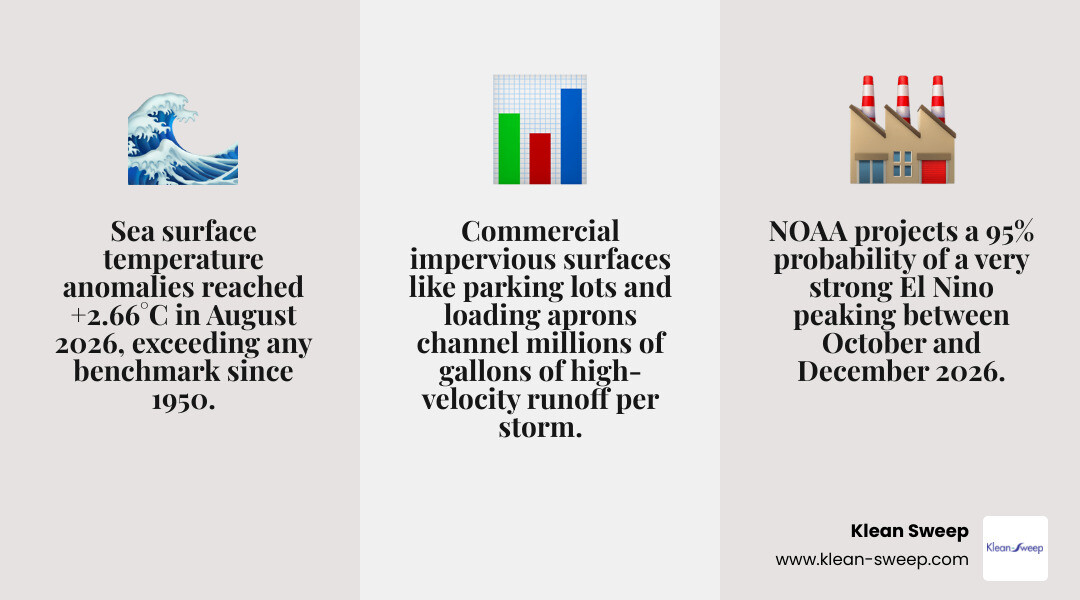
As of September 2026, meteorologists have confirmed what commercial property managers across Southern California have feared: the 2026 Super El Niño has officially crossed critical thresholds. Sea surface temperature anomalies in the equatorial Pacific reached +2.66°C in August, exceeding recorded benchmarks dating back to 1950. The National Oceanic and Atmospheric Administration (NOAA) Climate Prediction Center now projects a 95% probability of a very strong event peaking between October and December 2026.
For commercial facility managers, logistics hub supervisors, and industrial park directors in Torrance, Carson, Pasadena, and the greater Los Angeles basin, this atmospheric setup brings significant operational challenges. When high-intensity atmospheric rivers make landfall, they drop massive volumes of water over short durations.
In the Los Angeles South Bay, where heavy manufacturing, aerospace facilities, distribution centers, and sprawling retail centers dominate the landscape, our regional infrastructure depends heavily on private stormwater capture and municipal conveyance systems operating at peak efficiency.
The historical precedent is sobering. During the 1997–98 El Niño, Southern California was battered by recurring storm systems that transformed the paved Los Angeles basin into a series of localized flash floods. The Los Angeles River went from a manageable stream to a raging torrent in mere hours, backing up urban storm drains and overwhelming commercial properties that had neglected their exterior maintenance.
Commercial sites face unique vulnerabilities during severe weather events:
- Expansive Impervious Surfaces: Vast parking lots, multi-level parking structures, loading aprons, and industrial rooftops prevent natural infiltration, channeling millions of gallons of high-velocity runoff directly toward private catch basins.
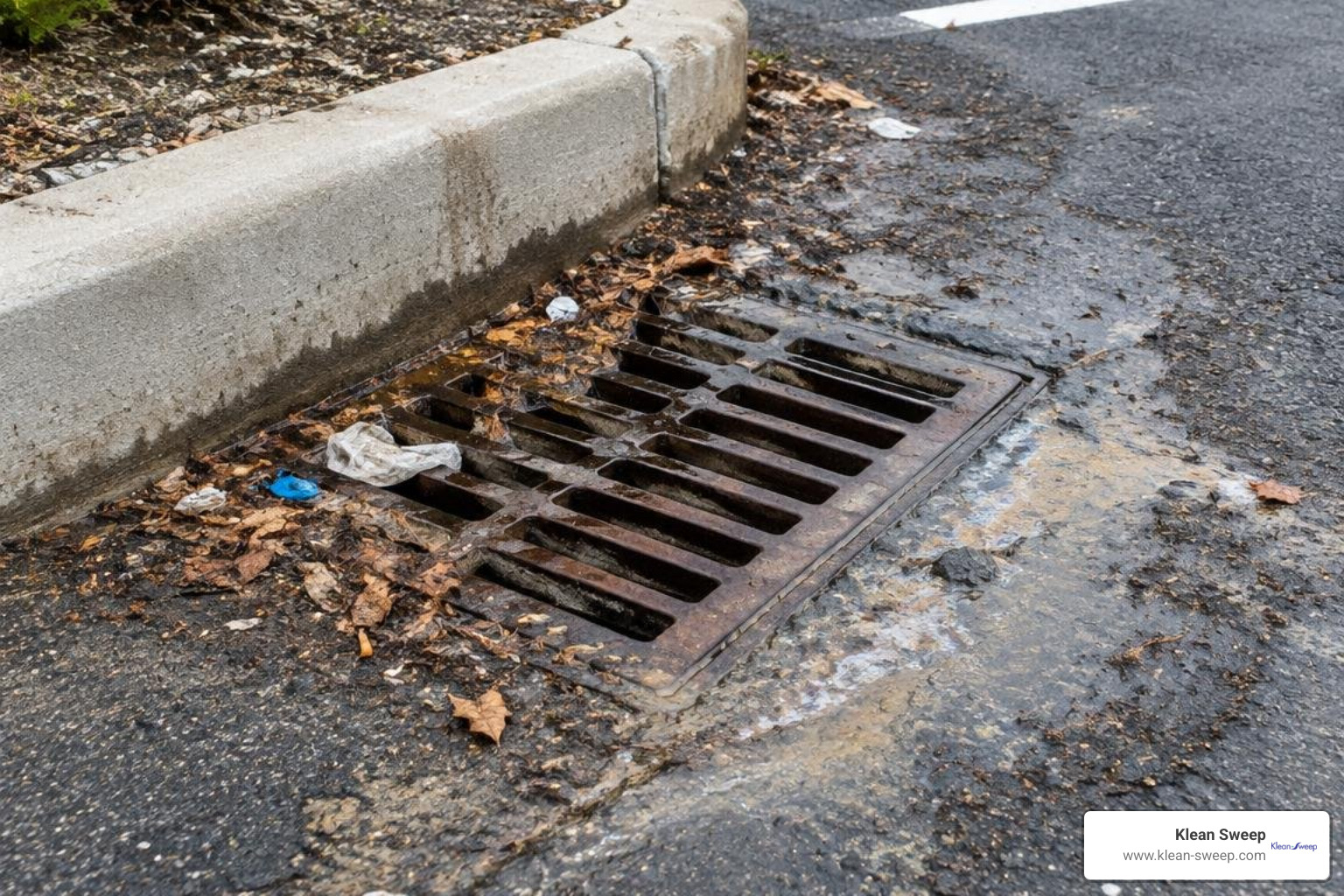
- Debris Congestion: Heavy winds carry branches, trash, and packaging materials into exterior grated inlets, forming surface dams that flood surrounding asphalt and loading docks.
- Subsurface Silt Buildup: Subsurface catch basins, oil-water separators, and underground retention vaults that sat uncleaned during the dry summer months quickly fill with sediment, causing rapid backups.
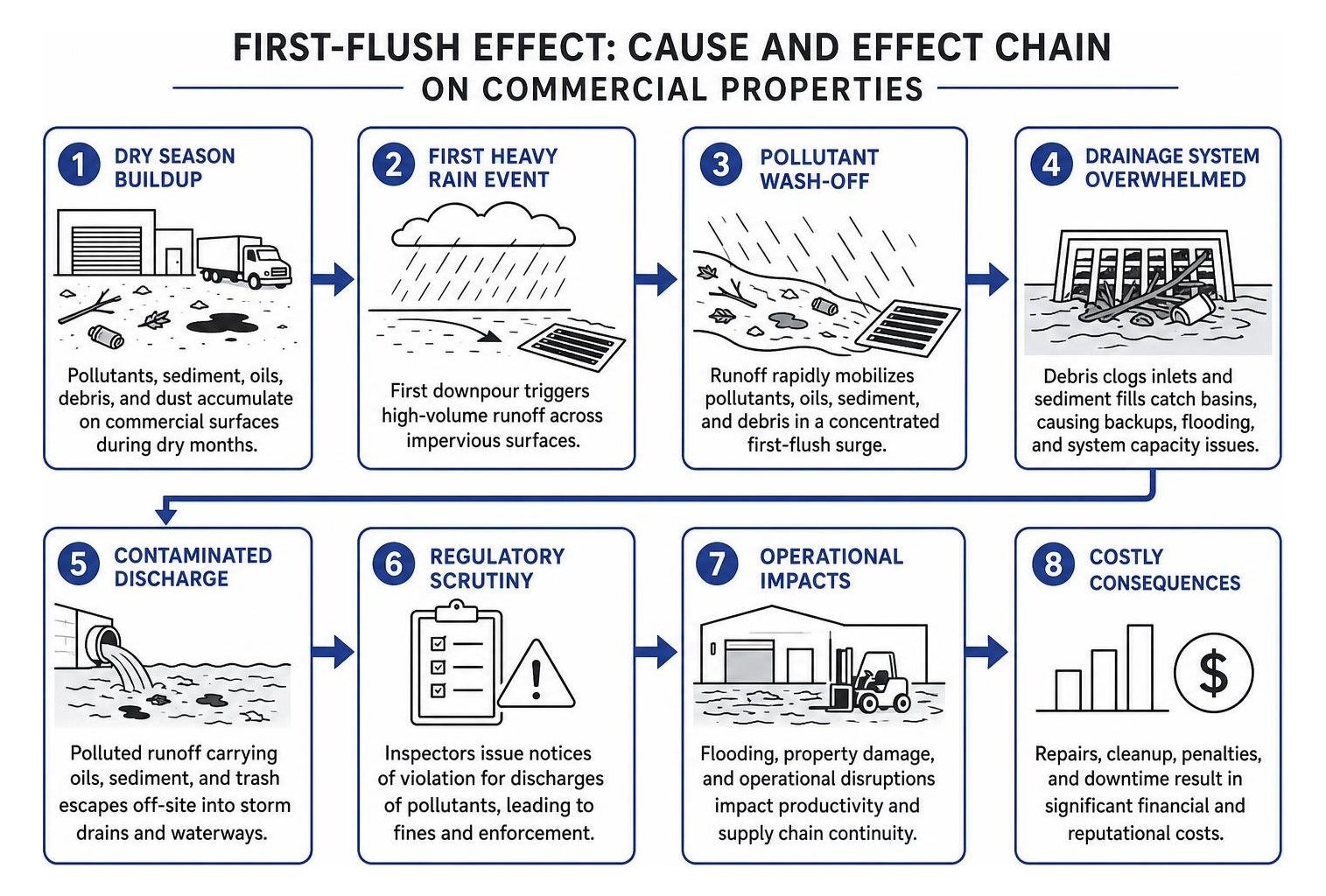
- Regulatory Scrutiny: Increased runoff brings immediate scrutiny from local stormwater inspectors, who issue notices of violation when dirty water, oils, and sediment escape off-site into public storm channels.
Delaying proactive maintenance until the peak of the storm season leaves commercial sites exposed to structural pavement deterioration, supply chain interruptions, and steep regulatory penalties.
What Is the “First-Flush” Effect and Why Does It Overwhelm Industrial Drainage?
The most dangerous storm of any rainy season is the very first one. In Southern California, the prolonged, arid summer months allow months of industrial particulates, vehicle fluids, tire rubber, and fine dust to settle across commercial parking lots, service roads, and loading docks.
When the first heavy atmospheric river hits Torrance and the greater LA area, it triggers the first-flush effect—a rapid hydrologic wash-off that carries concentrated pollutants accumulated across dry months directly into exterior drainage networks.
Water quality studies demonstrate that pollutant concentrations in stormwater discharges during the early part of the wet season range from 1.2 to 20 times higher than during storms occurring late in the season. Instead of a gradual release, the initial high-volume surge strips the pavement clean in a single, concentrated wave of contamination.
Common Commercial Surface Contaminants
During this first downpour, several primary pollutants are rapidly mobilized from unmaintained commercial surfaces:
- Petroleum Hydrocarbons: Motor oils, diesel residues, hydraulic fluids, and grease deposited on loading bays and parking stalls.
- Heavy Metal Particulates: Brake dust containing copper, zinc from tire wear, and metallic shavings from industrial machinery.
- Sediment and Silt: Loose topsoil, sand, gravel, and degraded asphalt aggregate that quickly settle inside underground catch basins.
- Chemical Residues: Commercial fertilizers, cleaning agents, and airborne manufacturing emissions that have settled on concrete and rooftops.
- Gross Pollutants: Single-use plastics, packaging debris, pallets fragments, and organic landscape waste.
Unmaintained parking structures and weathered commercial asphalt surfaces amplify both the velocity of the runoff and its pollutant load. Pavement cracks and unsealed expansion joints trap fine particulate matter until torrential rain forces it loose.
When high-velocity water carries these heavy solids into uncleaned drain basins, the solids rapidly settle over the outlet pipes, blinding the grates and creating an impenetrable barrier.
Preventing this initial shock is vital not only for maintaining flood-free logistics yards, but also for protecting local water systems from contamination. Once these toxic compounds enter the storm drain system, they flow untreated into local channels like the Dominguez Channel and Santa Monica Bay.
How Does Extreme Rainfall Impact SWPPP and NPDES Compliance for Local Facilities?
For industrial facilities, logistics yards, construction sites, and major commercial centers throughout Torrance, Carson, and Los Angeles County, stormwater management is a strict legal obligation. Under the federal Clean Water Act, facilities operating under the National Pollutant Discharge Elimination System (NPDES) General Industrial or Construction Stormwater Permits must develop and rigorously maintain a site-specific Stormwater Pollution Prevention Plan (SWPPP).
During an extreme weather pattern like the 2026 Super El Niño, regulatory agencies—including the Los Angeles Regional Water Quality Control Board and local municipal inspectors—increase surveillance. Public awareness and civic involvement, including regional storm response monitoring initiatives, mean that turbid or oily runoff leaving private commercial gates is quickly reported to enforcement authorities.
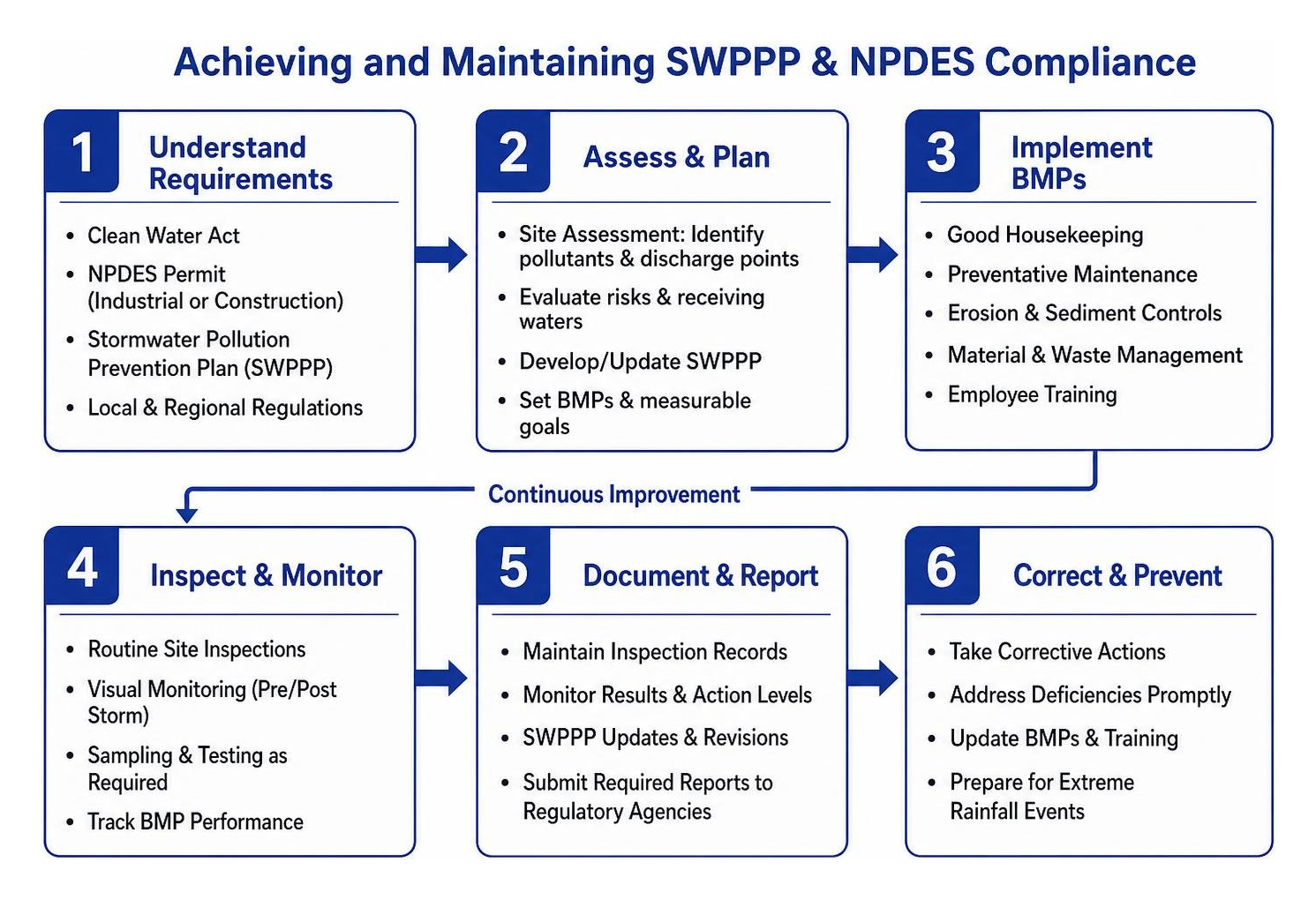
The Environmental Protection Agency (EPA) estimates that unmanaged industrial and construction sites can lose between 20 and 150 tons of soil per acre annually due to stormwater runoff. When high-volume storms hit sites with degraded or missing Best Management Practices (BMPs), the resulting sediment plumes and chemical discharges can lead to:
- Mandatory Cease-and-Desist Orders: Regulators can halt exterior industrial operations, construction activities, and loading dock access until compliance is restored.
- Administrative Civil Liability Fines: Daily financial penalties accumulate rapidly for every day a facility discharges untreated or unmonitored runoff exceeding Numeric Action Levels (NALs).
- Mandatory Mitigation and Monitoring: Non-compliant sites are often forced to install costly continuous-monitoring equipment and complete extensive remediation projects under regulatory oversight.
Regional leadership has made storm readiness a major priority. Municipal initiatives, such as LA County El Niño storm preparations, emphasize that commercial and industrial property operators must verify their sediment basins, catch basins, and runoff treatment devices before heavy precipitation begins.
Neglecting maintenance during a dry summer does not excuse wet-season violations; instead, it establishes clear evidence of operational negligence during an inspection.
Critical BMP Checklist for Facility Managers
To protect your commercial property from severe regulatory enforcement and flooding, we recommend running through this critical BMP compliance checklist:
- Review and Update SWPPP Documentation: Ensure your written plan reflects all current exterior operations, material storage areas, and emergency contacts before storm season.
- Inspect and Clear Silt Fences and Bio-Swales: Clear out accumulated trash, cut back overgrown vegetation, and replace torn geotextile fabrics along your property perimeter.
- Service Catch Basins and Drop Inlets: Vacuum out all built-up grit, leaf litter, and sludge from subterranean sumps to ensure unhindered water flow.
- Inspect Inlet Protection Inserts: Clean or replace drain bags, sediment filter inserts, and rock berms around surface parking grates.
- Contain Hazardous Materials and Waste: Ensure all exterior chemical storage, scrap piles, and waste bins are securely covered, elevated, and bermed.
- Document Every Maintenance Action: Keep detailed logs of all sweeping, catch basin vacuuming, and BMP inspections to establish a clear paper trail for regulatory audits.
What Are the Key Warning Signs of Stormwater System Failure on Commercial Sites?
Drainage failures rarely happen without warning. During an atmospheric river event, a compromised system reveals subtle red flags before catastrophic flooding inundates your loading docks, parking areas, or equipment yards.
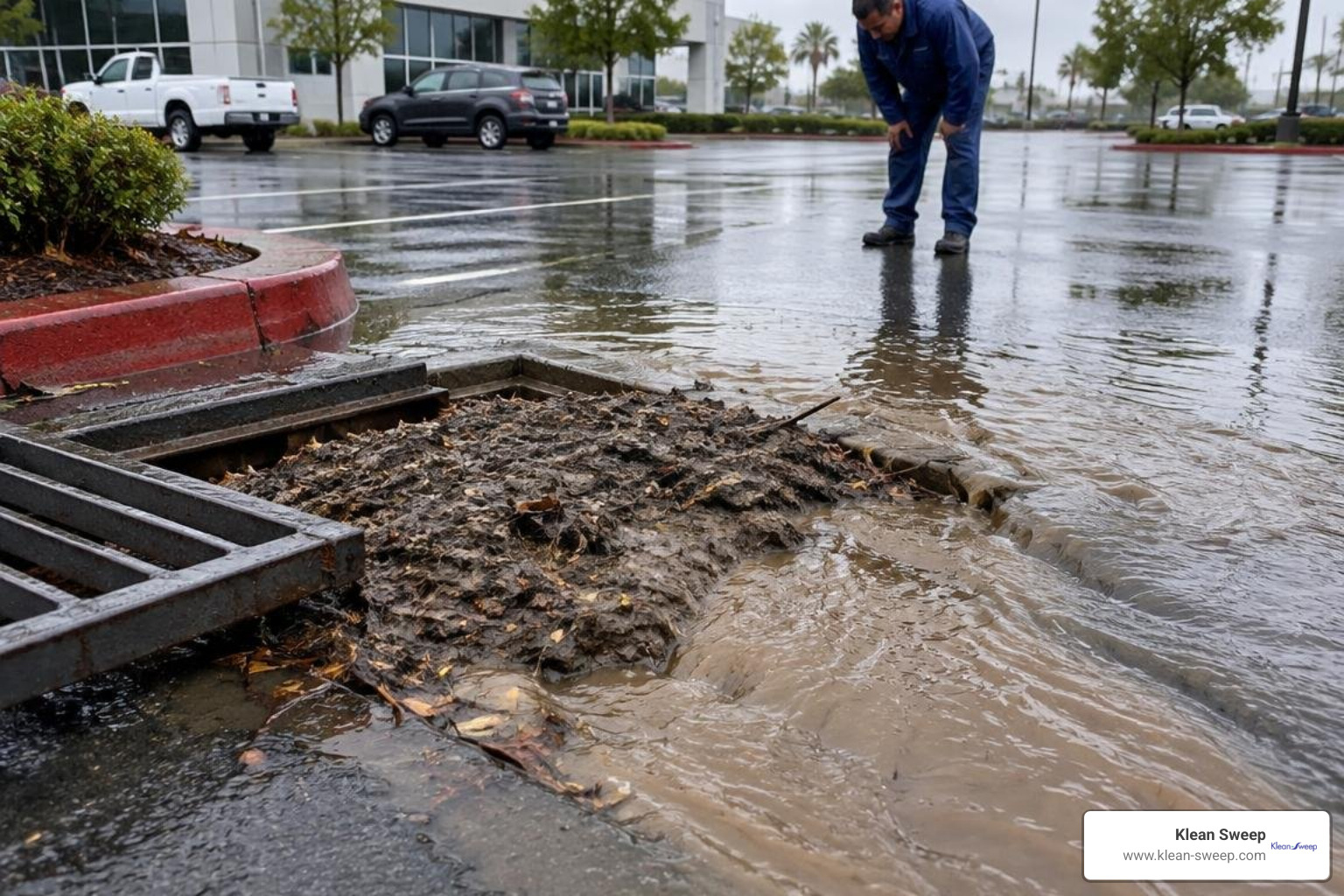
Property managers in Torrance, Beverly Hills, Pasadena, and Brea should train their exterior maintenance staff to identify these primary warning signs:
- Standing Water and Slow Drainage: If water remains pooled around parking lot grates or across loading aprons more than two hours after rain stops, the subsurface catch basin or outlet pipe is partially blocked.
- Silt and Sediment Rings: Circular patterns of dried mud, tire dust, and fine silt left around catch basin grates indicate that water backed up, crested the curb, and drained too slowly.
- Gurgling or Bubbling Inlets: Audible bubbling from storm drain grates during a downpour signals trapped air caused by downstream line blockages or an overloaded main line.
- Asphalt Undermining and Pavement Cracking: Water that cannot escape through designated subsurface pipes will erode the aggregate base under your asphalt, causing sinkholes, alligator cracking, and structural failure around drain collars.
- Foul Odors Near Basins: Rotten, sulfurous odors indicate stagnant organic sludge, decaying leaf litter, or trapped oil decomposing in uncleaned clarifiers and sumps.
- Municipal Backflow: In severe storms, overloaded municipal trunk lines can force dirty stormwater backward through private storm lines, pushing water up through low-elevation parking grates.
| Warning Sign | Underlying Cause | Required Commercial Corrective Action |
|---|---|---|
| Persistent surface pooling | Blinded inlet grates or silt-filled sumps | High-vacuum sediment extraction and surface power sweeping |
| Pavement subsidence around drains | Base erosion from cracked underground pipes | Structural pipe inspection, jetting, and asphalt repair |
| Sludge and oil sheen in runoff | Saturated oil-water separator / clarifier | Full clarifier pump-out and filter media replacement |
| Sediment accumulation along curbs | Heavy wash-off from unpaved or dirty areas | Regenerative air street sweeping and perimeter barrier re-alignment |
| Bubbling or backflow from inlets | Main storm line blockage or downstream restriction | High-pressure hydro-jetting to clear downstream line obstructions |
How Do Professional Sweeping and Stormwater Cleaning Services Protect Your Facility?
Safeguarding a commercial property during a Super El Niño requires a coordinated maintenance approach. While municipal storm infrastructure handles the overall volume of the Los Angeles basin, private property managers are entirely responsible for the cleanliness and operational capacity of their own exterior surfaces and underground drainage networks.
At Klean Sweep, we have spent more than five decades providing comprehensive commercial exterior maintenance solutions across Torrance, Carson, Pasadena, Brea, and greater Los Angeles. Managing stormwater runoff requires combining surface-level debris removal with subterranean cleaning.
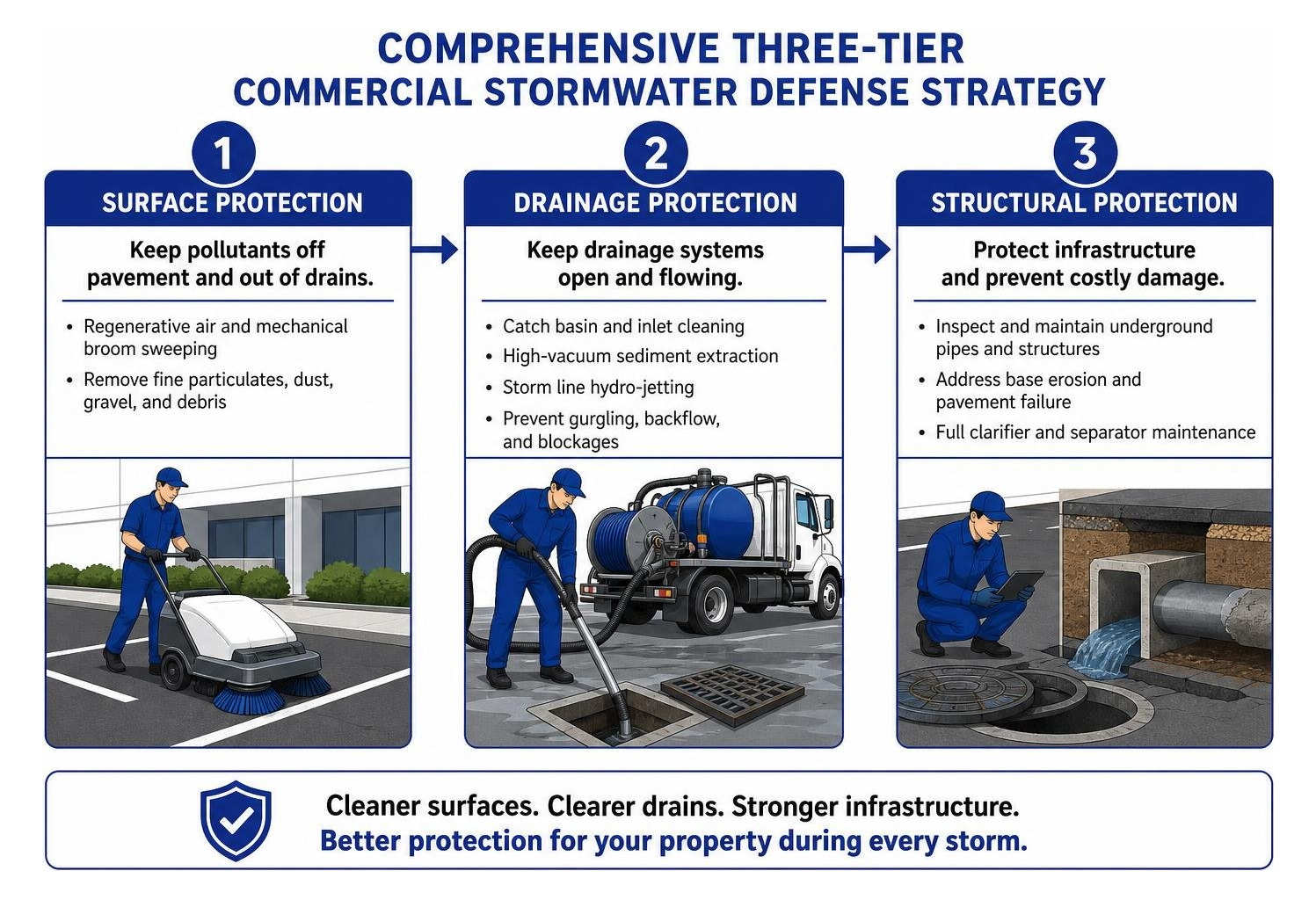
1. High-Efficiency Parking Lot and Street Sweeping
The most cost-effective way to manage stormwater pollution is to stop debris before it ever reaches a drain. Our advanced fleet of regenerative air and mechanical broom sweepers removes fine particulates, heavy metals, industrial dust, and gravel from parking areas and access roads.
Scheduling routine commercial street and parking lot sweeping serves as your frontline defense against catch basin failure. Studies consistently show that routine street sweeping protects regional water quality by eliminating the fine dry-season contaminants that drive the first-flush effect.
2. Comprehensive Catch Basin and Underground Cleaning
Surface sweeping must be paired with below-ground maintenance. Catch basins, interceptors, and underground detention tanks are designed with sumps that trap heavy silt, trash, and heavy metals. When these sumps reach capacity, any additional runoff washes straight into municipal lines or backs up across your parking stalls.
Using our specialized hydro-vacuum trucks, our teams pump out sludge, extract trapped trash, and clean subterranean catch basins, clarifiers, and interceptor vaults. Investing in professional stormwater cleaning ensures your below-ground infrastructure retains 100% of its engineered hydraulic capacity before atmospheric rivers strike Southern California.
3. Integrated Day Porter Services
Stormwater maintenance isn’t just a seasonal project; it requires continuous site cleanliness. Daily operations across commercial business parks generate packaging waste, discarded beverage containers, and loose landscape debris that quickly wash into storm drains during high winds and sudden cloudbursts.
Deploying dedicated day porter services for debris prevention keeps your property clean between major sweeping cycles. Our porters routinely empty exterior waste receptacles, police perimeter fencing, clear trash from landscape perimeters, and inspect catch basin grates for visible obstructions, preventing debris dams during sudden downpours.
4. Eco-Friendly Exterior Pressure Washing and Concrete Cleaning
Industrial loading docks, trash enclosures, and parking structures frequently accumulate grease, hydraulic fluid stains, and chemical residues that cannot be removed by dry sweeping alone.
Our hot-water pressure washing and steam cleaning systems lift stubborn surface grease and heavy soil deposits. We utilize full wastewater recovery and filtration systems to ensure zero wash-water escapes into storm drains, keeping your site spotless and fully compliant with local environmental regulations.
Understanding the long-term operational and legal importance of regular stormwater system maintenance protects commercial property owners from expensive emergency repairs and property damage.
What Are the Most Frequently Asked Questions About Stormwater Management?
How often should commercial catch basins be cleaned during an El Niño season?
During a Super El Niño year, commercial catch basins should undergo a complete vacuum cleanout at least twice annually: once in early autumn (September or October) before the first major storm cycle, and once mid-season (January or February) to remove sediment accumulated during early atmospheric rivers.
Additionally, facility personnel should perform visual inspections of surface grates and clear away exterior trash and leaves before and immediately following every major rain event. If your site generates high levels of sediment, such as a distribution center, industrial fabrication plant, or active construction project, quarterly cleanouts may be required to maintain compliance and avoid structural backups.
What is the difference between parking lot sweeping and stormwater system cleaning?
While both services are essential components of commercial stormwater management, they address different parts of your exterior infrastructure:
- Parking Lot Sweeping: Focuses on the surface layer of your property. Regenerative air and mechanical broom sweepers pick up trash, tire rubber, loose aggregate, and surface dust from parking stalls, drive aisles, and loading aprons. This is a preventative measure that stops debris from entering the drainage system.
- Stormwater System Cleaning: Focuses on the subterranean infrastructure. Using high-powered hydro-vacuum trucks and hydro-jetting lines, technicians pump out compacted sludge, extract standing wastewater, clean oil-water clarifiers, and jet clogged underground pipes. This process clears the subsurface pathways that convey heavy water flows away from your buildings.
Combining both services creates an uninterrupted barrier against site flooding and environmental violations.
What should a property manager do immediately if commercial drains begin to back up?
If an exterior catch basin or parking apron begins flooding during a storm, take these immediate operational steps:
- Prioritize Safety and Secure the Zone: Cordon off flooded parking bays, loading docks, or low-lying drive aisles with safety cones and barricades. Never allow vehicles or pedestrians into deep, murky water where dislodged manhole covers may be hidden.
- Inspect and Clear Surface Inlets (Safely): Using rakes or heavy-duty hooks—and wearing high-visibility gear and heavy protective gloves—remove branches, trash bags, or pallets pinned against surface grates by water pressure. Often, clearing surface debris provides immediate relief.
- Never Remove Grates During Active Flow: Do not lift or remove drainage grates to increase flow rate. Removing grates allows massive debris to enter underground pipes, turning an easily fixed surface ponding issue into a catastrophic subterranean pipe blockage.
- Deploy Sandbags to Protect Key Structures: Place sandbags around warehouse roll-up doors, electrical vaults, and low-lying commercial entryways to redirect runoff away from building envelopes.
- Call a Professional Hydro-Vacuum Emergency Response Team: Contact our team at Klean Sweep immediately to deploy hydro-vacuum units to pump out the flooded basin and restore drainage before water reaches building interiors.
How Can Torrance Property Managers Prepare Before the Next Storm Hits?
The 2026 Super El Niño will severely test commercial drainage networks across Southern California. With ocean temperature anomalies at historic highs and intense precipitation patterns forecast across Los Angeles County, waiting until water rises across your loading docks or parking aprons is an expensive mistake.
Proactive exterior property maintenance protects your physical assets, keeps commercial tenants operating without disruption, and provides the documentation needed to prove compliance during regulatory audits.

At Klean Sweep, we have proudly served Torrance, Beverly Hills, Carson, Pasadena, Brea, and the broader Southern California region since 1969. As a family-owned commercial exterior maintenance company, we bring cutting-edge regenerative air sweepers, high-capacity hydro-vacuum trucks, and dedicated personnel to every job. Whether you manage a major logistics facility, an open-air retail center, or an industrial manufacturing plant, we have the experience and equipment to keep your property running smoothly.
Do not wait for the first atmospheric river of the season to reveal the weak points in your drainage system. Contact the Klean Sweep team today to schedule a comprehensive exterior site evaluation and establish a customized sweeping and stormwater cleaning maintenance plan before the next storm arrives.