

When Does Your Commercial Property Need Stormwater Catch Basin Cleaning in Torrance?
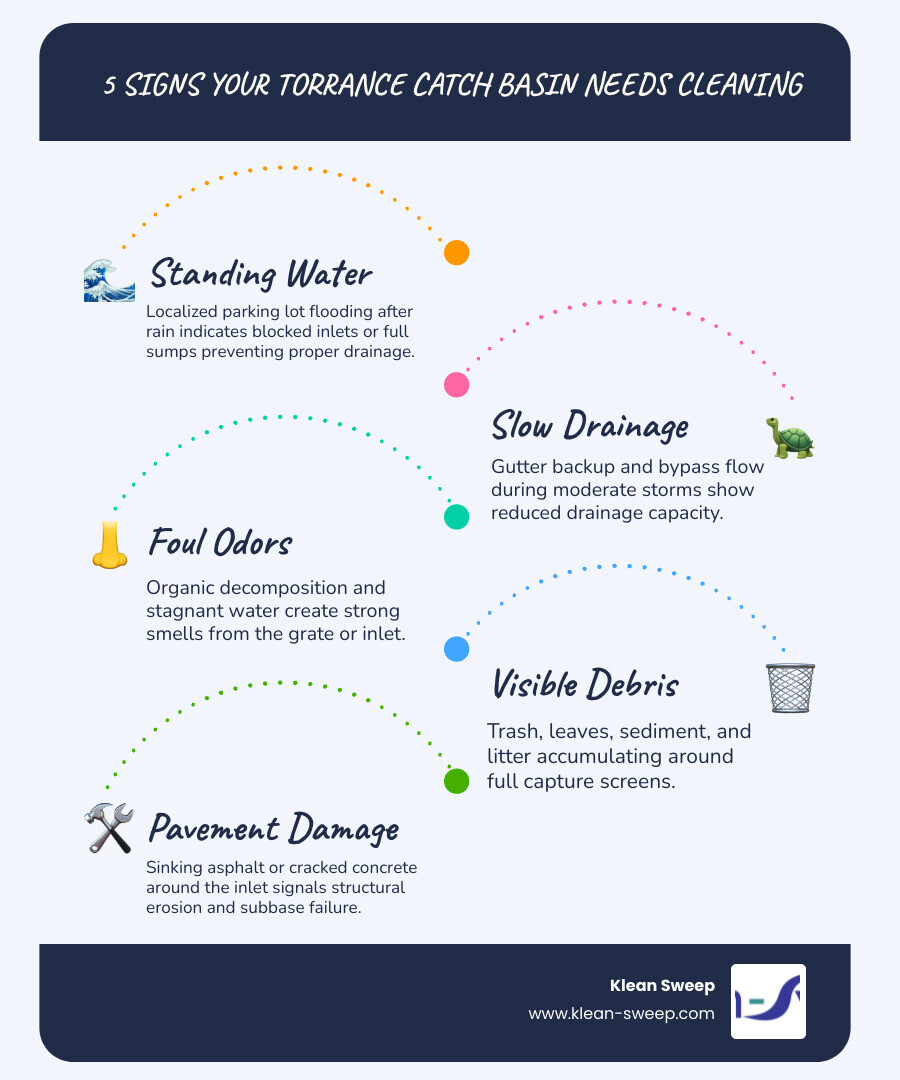
If you manage a commercial or industrial property in Torrance and need to know whether your catch basins require cleaning, here are the 5 signs to watch for:
- Standing water or localized flooding in your parking lot after rain
- Slow drainage even during moderate rainfall
- Foul odors coming from the grate or inlet
- Visible debris, trash, or sediment building up around or inside the basin
- Sinking asphalt or cracked concrete around the catch basin inlet
Stormwater catch basin cleaning in Torrance is one of the most overlooked maintenance tasks for commercial property managers — until a flooded parking lot or a regulatory notice makes it impossible to ignore. Torrance sits within the Machado Lake watershed and the Walteria Basin drainage area, two systems under strict TMDL and MS4 Permit regulations. That means blocked or dirty catch basins aren’t just a nuisance — they can put your property out of compliance with EPA and local stormwater rules.
The good news? The warning signs are easy to spot once you know what to look for.
I’m Jana Hanson, and I’ve spent over a decade leading Klean Sweep’s expansion into stormwater cleaning services across the greater Los Angeles area — including helping commercial property managers in Torrance stay ahead of stormwater catch basin cleaning in Torrance requirements before they become costly problems. Klean Sweep has been serving Southern California since 1969, and exterior stormwater maintenance is one of the most critical services we provide to commercial and industrial clients today.
Understanding Catch Basins and Torrance Stormwater Regulations
To understand why catch basin maintenance is so critical in Torrance, we first need to look at how these systems are engineered and the strict environmental regulations governing our region.
A catch basin (often referred to as a storm drain or curb inlet) is the entry point for stormwater runoff. It consists of a grate at street or parking lot level, a curb inlet, and an underground chamber called a “sump.” The sump is designed as a built-in pretreatment area. It sits below the level of the outlet pipe, allowing heavy sediment, sand, gravel, and trash to settle out of the water while the cleaner surface water drains out through the outlet pipe to the municipal storm drain system.
Unlike the indoor sewer system, which sends wastewater to a treatment plant, the municipal storm drain system in Torrance discharges runoff directly to local waterways and the Pacific Ocean without treatment. Because of this direct connection, the City of Torrance enforces strict environmental codes to prevent water pollution.
The Machado Lake and Walteria Basin Watersheds
Torrance is situated in a highly sensitive ecological zone:
- The Machado Lake Watershed: Spanning approximately 23 square miles, this watershed drains directly into Machado Lake (located in Ken Malloy Harbor Regional Park). The City of Torrance accounts for 30% of the total drainage area, with its Total Maximum Daily Load (TMDL) Implementation Area covering 35.6% of the watershed.
- The Walteria Retention Basin: This critical infrastructure asset manages a watershed of approximately 2,287 acres—92.61% of which is located within Torrance. The Walteria Retention Basin is so vital to local flood control and natural groundwater recharge that the Phase I Improvement project was awarded at a construction cost of $5,715,700.
Because these watersheds are heavily urbanized, they are prone to capturing high levels of pollutants. To protect them, the Los Angeles Regional Water Quality Control Board enforces the Municipal Separate Storm Sewer System (MS4) Permit.
Under the Machado Lake Trash TMDL, the City of Torrance was required to install full-capture trash screens on 100% of catch basin filters. Furthermore, the city operates under strict waste load allocations (WLAs) for nutrients: a final WLA of 301 kg for Total Phosphorus and 3,008 kg for Total Nitrogen. While municipal monitoring shows Torrance is currently in compliance, maintaining these low numbers requires ongoing vigilance from both public entities and private commercial property owners.
For more details on local municipal infrastructure, you can review the Sewer and Wastewater – City of Torrance guidelines. To learn more about how clean drains safeguard our coastal ecosystems, read our article on The Importance of Stormwater Cleaning for Protecting the Environment.
5 Signs Your Commercial Property Needs Stormwater Catch Basin Cleaning in Torrance
Neglecting your drainage system can quickly escalate from a minor nuisance to a major liability. If you manage a commercial facility, shopping center, or industrial park in Southern California, keep an eye out for these five warning signs. Catching these indicators early allows you to schedule preventative maintenance before the next heavy downpour.
For a complete overview of why proactive care is so essential, explore our guide on The Importance of Regular Stormwater System Maintenance.
Sign 1: Standing Water and Localized Parking Lot Flooding
If you notice “ponding”—large pools of standing water—around your catch basin grates or in low-lying areas of your parking lot after a mild rain, your system is failing to route water away. In multi-level parking structures and commercial driveways, localized flooding can create severe slip-and-fall hazards for customers, impede vehicle traffic, and eventually seep into commercial building foundations.
Sign 2: Slow Drainage During Moderate Rainfall
When a catch basin’s sump is packed to the brim with sand and muck, there is no room left for incoming water. As a result, stormwater cannot enter the outlet pipe quickly enough. You will notice water backing up along the gutters, or a “bypass flow” where water flows right over the grate and down the asphalt instead of draining. This indicates that your basin’s capacity has been severely compromised.
Sign 3: Foul Odors Emitting from the Grate
A healthy catch basin should not smell like a sewer. However, when leaves, grass clippings, soil, and trash sit in a wet sump for weeks or months, they begin to decompose anaerobically. This organic decay produces a distinct rotten-egg smell. Additionally, if the basin’s trap or flapper device (designed to block sewer gas backflow) is broken or buried under mud, those foul odors will escape freely into your commercial common areas.
Sign 4: Visible Debris, Trash, and Sediment Accumulation
Take a walk around your commercial property. If you see plastic bottles, leaves, dirt piles, or heavy sediment caked on top of the steel grates, the inside of the basin is likely in even worse shape. In Torrance, many catch basins are equipped with automatic retractable trash screens. When these screens are choked with debris, they cannot open during heavy flows, leading to immediate blockages.
Sign 5: Sinking Asphalt or Cracked Concrete Around the Inlet
This is a structural emergency. When a catch basin is severely clogged, water can back up and seep into the joints between the concrete collar and the surrounding asphalt. Over time, this water erodes the subbase soil supporting your pavement. As the soil washes away, the asphalt around the inlet will begin to crack, sag, or completely sink, creating a massive liability and requiring a costly catch basin installation and replacement service to correct.
The Professional Catch Basin Cleaning Process
Cleaning a commercial catch basin is not a DIY job. It requires heavy-duty machinery, specialized safety training, and proper disposal protocols to ensure that the removed pollutants are handled legally.
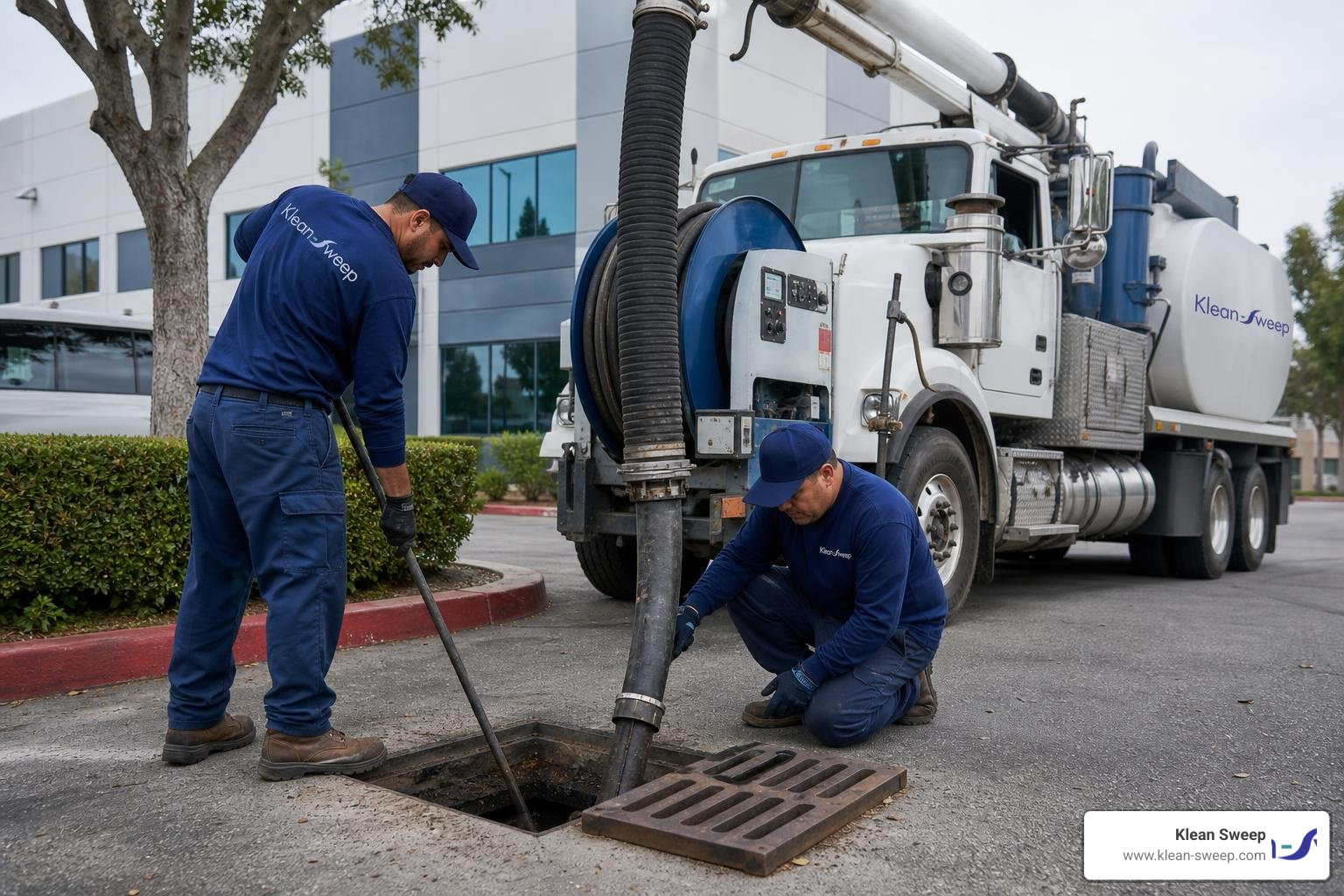
At Klean Sweep, we utilize a highly structured, environmentally friendly process to restore your storm drains to peak performance. You can read more about our comprehensive commercial property solutions on Our Services page.
Specialized Equipment for Stormwater Catch Basin Cleaning Torrance
To clean deep underground sumps efficiently, we use specialized equipment, including:
- Vactor Trucks (Vacuum Trucks): These high-powered trucks use a large-diameter suction hose to vacuum out heavy mud, standing water, rocks, and trash directly from the sump.
- Clamshell Buckets: For smaller or harder-to-reach basins, mechanical catch basin cleaners equipped with hydraulic clamshell buckets can physically scoop out heavy debris.
- Hydro Jetting Systems: If the outlet pipes leading away from the catch basin are choked with grease, hard water scale, or dirt, we utilize high-pressure water jetting to scour the pipe walls clean. For serious blockages, professional hydro jetting is required to restore full pipe capacity.
Whether we are performing routine maintenance or clearing a severe clog, using the right tools prevents damage to the underlying pipes and structure.
Environmental and Financial Impacts of Neglecting Maintenance
As a commercial property manager, ignoring your catch basins can lead to a financial avalanche. Below is a comparison of what you can expect with a proactive maintenance schedule versus the cost of waiting for a system failure:
| Feature / Consequence | Proactive Regular Maintenance | Delayed / Emergency Response |
|---|---|---|
| Service Cost | Budget-friendly, predictable operating expense | Premium emergency rates, unexpected capital drain |
| Property Damage Risk | Extremely low; water drains safely away | High; potential parking lot flooding and structural damage |
| Regulatory Standing | Full compliance with EPA, MS4, and local permits | Risk of heavy municipal fines and stop-work orders |
| Infrastructure Lifespan | Extends catch basin and asphalt life by years | Premature structural failure requiring excavation |
| Environmental Impact | Traps pollutants; protects local watersheds | Floods trash and heavy metals directly into the ocean |
If a blocked storm drain causes severe flooding on your commercial property, you may find yourself facing thousands of dollars in emergency restoration bills. In such crises, commercial property owners often have to call in professional water damage cleanup services to dry out water-logged commercial structures.
Worse yet, if stormwater backups mix with local sewer lines, it can trigger highly hazardous backups, requiring immediate emergency sewage cleanup to sanitize the area.
Proactive maintenance prevents these emergencies entirely. By trapping trash, heavy metals, and hydrocarbons at the source, you also do your part to keep Southern California’s beaches clean. To understand how sweeping and drain maintenance work hand-in-hand to protect our oceans, check out our piece on Why Street Sweeping is the Unsung Hero of Clean Water.
Scheduling Your Stormwater Catch Basin Cleaning Torrance
To keep your commercial property safe and compliant, we recommend scheduling professional stormwater catch basin cleaning in Torrance at least once or twice per year.
The absolute best time to schedule this service is in the late summer or early fall, just before the Southern California winter rainy season begins. This ensures your basins have 100% of their storage capacity ready to handle heavy seasonal downpours. Properties with high vehicle traffic—such as shopping centers, logistics warehouses, and busy parking structures—may require quarterly cleanings due to the rapid accumulation of brake dust, oil, and litter.
To keep trash from entering your basins in the first place, many property managers pair catch basin cleaning with daily or weekly porter services. You can learn how this combined approach keeps your site pristine by reading about our Day Porter Services for Better Stormwater Management.
Frequently Asked Questions About Stormwater Maintenance
How often should commercial catch basins be cleaned in Torrance?
For most commercial properties in Torrance, we recommend cleaning catch basins at least once a year, ideally in the fall before the winter rains arrive. However, if your property experiences high traffic, has heavy tree canopy cover, or is an industrial site subject to strict Stormwater Pollution Prevention Plan (SWPPP) mandates, you should opt for semi-annual or quarterly cleanings.
What happens to the debris removed during catch basin cleaning?
The mud, water, trash, and organic debris vacuumed out of catch basins cannot simply be dumped on the ground or in a standard landfill. Because this waste contains concentrated heavy metals, motor oil, and other urban pollutants, it must be hauled to a certified waste disposal facility. There, the liquids are separated and treated, and the solid waste is disposed of in strict accordance with local and state environmental laws.
Can street sweeping reduce the frequency of catch basin cleaning?
Yes, absolutely! Regular parking lot and street sweeping is your first line of defense. By removing leaves, sand, dust, and litter from your asphalt surface before the wind or rain can wash them into your drains, you drastically reduce the speed at which your catch basin sumps fill up. This “source control” method keeps your drainage system running longer and saves you money on underground cleanouts.
Conclusion
Your commercial property’s stormwater system is your defense against costly flooding, structural damage, and environmental liabilities. Staying ahead of stormwater catch basin cleaning in Torrance is a simple, highly effective way to protect your investment, keep your tenants safe, and remain in perfect compliance with local water quality regulations.
Since 1969, Klean Sweep has been Southern California’s trusted, family-owned partner for premier commercial property maintenance. Equipped with state-of-the-art vactor trucks, sweeping fleets, and pressure-washing systems, our highly trained teams are ready to keep your property’s exterior clean, compliant, and beautifully maintained.
Don’t wait for the next storm to find out if your drains are clogged. Contact us today to schedule an inspection and customize a preventative maintenance plan tailored specifically to your facility. Explore our specialized Stormwater Cleaning Services and request your free consultation today!