

How to Power Wash Commercial Brick Safely
For safe brick power washing, start with an inspection, not the spray wand. Check for loose mortar, cracks, paint, or fragile brick. Protect nearby plants, electrical fixtures, and storm drains. On sound, unpainted masonry, test a hidden spot, use a brick-safe cleaner, and wash at low pressure, typically 500 to 1,000 PSI. Keep the nozzle moving and rinse well. If the brick is old, damaged, or historic, do not pressure wash it without a masonry assessment.
I’m Jana Hanson. Since taking over my family’s exterior maintenance business in 2012, I’ve helped guide commercial property care across greater Los Angeles, including the careful planning that brick power washing requires.
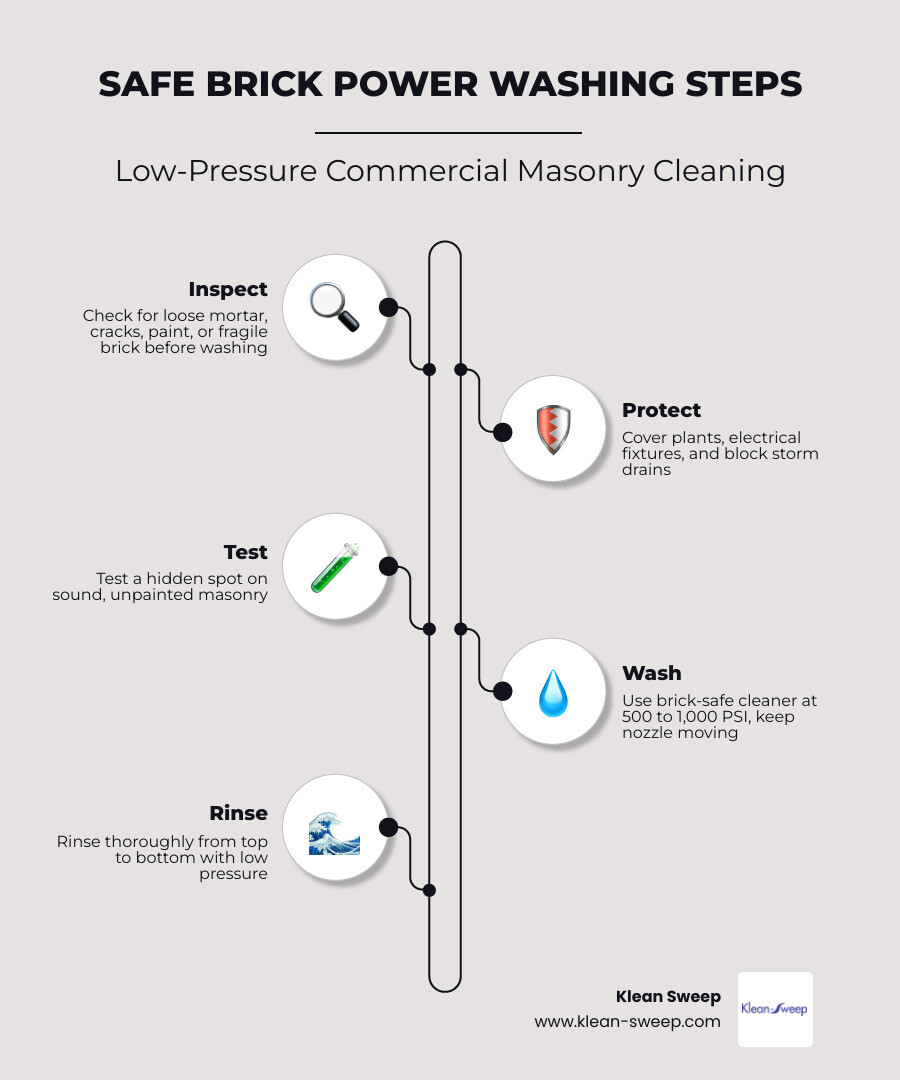
Must-know brick power washing terms:
Understanding Pressure, Soft Wash, and Brick Power Washing Differences
Maintaining commercial masonry requires understanding how water temperature, mechanical pressure, and chemical chemistry interact. Commercial brick façades, exterior retail walkways, and parking structure perimeter walls endure continuous exposure to vehicle exhaust, airborne grease, urban soot, and biological growth. Using an incorrect washing method can quickly erode masonry faces or blast out structural mortar beds.
The term “pressure washing” refers to cold-water cleaning relying primarily on mechanical impact. In contrast, “power washing” introduces high-temperature water or thermal steam into the flow. Thermal energy breaks the molecular bonds of heavy grease, atmospheric traffic films, and oily residues without demanding excessive hydraulic force. “Soft washing” shifts the cleaning burden almost entirely away from pressure, using chemical application at under 400 to 500 PSI to eliminate organic growth like algae and mold before gentle rinsing.
| Method | Water Temperature | Pressure Range (PSI) | Primary Mechanism | Best Commercial Brick Application |
|---|---|---|---|---|
| Pressure Washing | Ambient (Cold) | 500 – 1,500 PSI | Hydraulic shear force | General dirt, loose debris, concrete flatwork |
| Power Washing | 140°F – 200°F (Hot) | 500 – 1,200 PSI | Thermal dissolution & hydraulic force | Grease, engine oils, carbon soot, heavy grime |
| Soft Washing | Ambient to Warm | 100 – 400 PSI | Chemical emulsification & biocidal action | Historic brick, delicate mortar, mold, algae |
When developing a commercial building maintenance strategy, following a comprehensive commercial power washing guide helps property managers balance chemical dwell times and flow volume to protect delicate architectural masonry. Professional restoration practices also align with guidance from heritage masonry cleaning studies and technical briefs to ensure long-term building envelope integrity.
Safe PSI and Flow Rates for Commercial Masonry
Commercial brick is an exceptionally durable building material, but it is fundamentally porous and vulnerable to abrasive impact. Standard fired clay brick features a hardened outer crust (the fireskin). If high-pressure washing gouges or chips away this exterior layer, water penetrates the softer inner clay body. This leads to irreversible surface delamination, pitting, and spalling—often referred to as brick fretting. Once fretting starts, it cannot be reversed and often requires complete brick replacement.
For sound commercial masonry, professional crews maintain an operating pressure between 500 and 1,000 PSI, with 1,500 PSI acting as an absolute maximum for hard-fired industrial brick. Experienced operators prioritize water flow volume—measured in gallons per minute (GPM)—over raw pressure. A high water volume of 4 to 8 GPM floods the brick surface, flushing suspended contaminants and dissolved chemical surfactants safely away without etching the clay face or chewing into joint mortar.
Risks of High Pressure on Historic Commercial Brick
Historic commercial buildings, retail arcades, and municipal structures over 75 years old require an even gentler approach. Historic bricks were often kiln-fired at lower, uneven temperatures, leaving their internal cores softer than modern structural brick. Furthermore, vintage structures rely on soft, lime-based mortar rather than modern Portland cement.
Applying standard pressure wand blasting to lime mortar will instantly dissolve and blow out mortar joints, leaving deep structural voids. For antique commercial properties across historic business districts, pressure washing should be kept below 400 PSI or replaced entirely with low-pressure chemical soft washing. The cleaning chemistry must be allowed to soak, dissolve pollutants, and rinse away freely without hydraulic shock.
Essential Equipment and Chemical Agents for Commercial Masonry
Executing high-level commercial exterior maintenance requires specialized equipment configurations designed for surface protection and environmental compliance. Standard light-duty pressure washers lack the steady thermal capacity and continuous high water volume necessary for commercial retail plazas or loading bays.
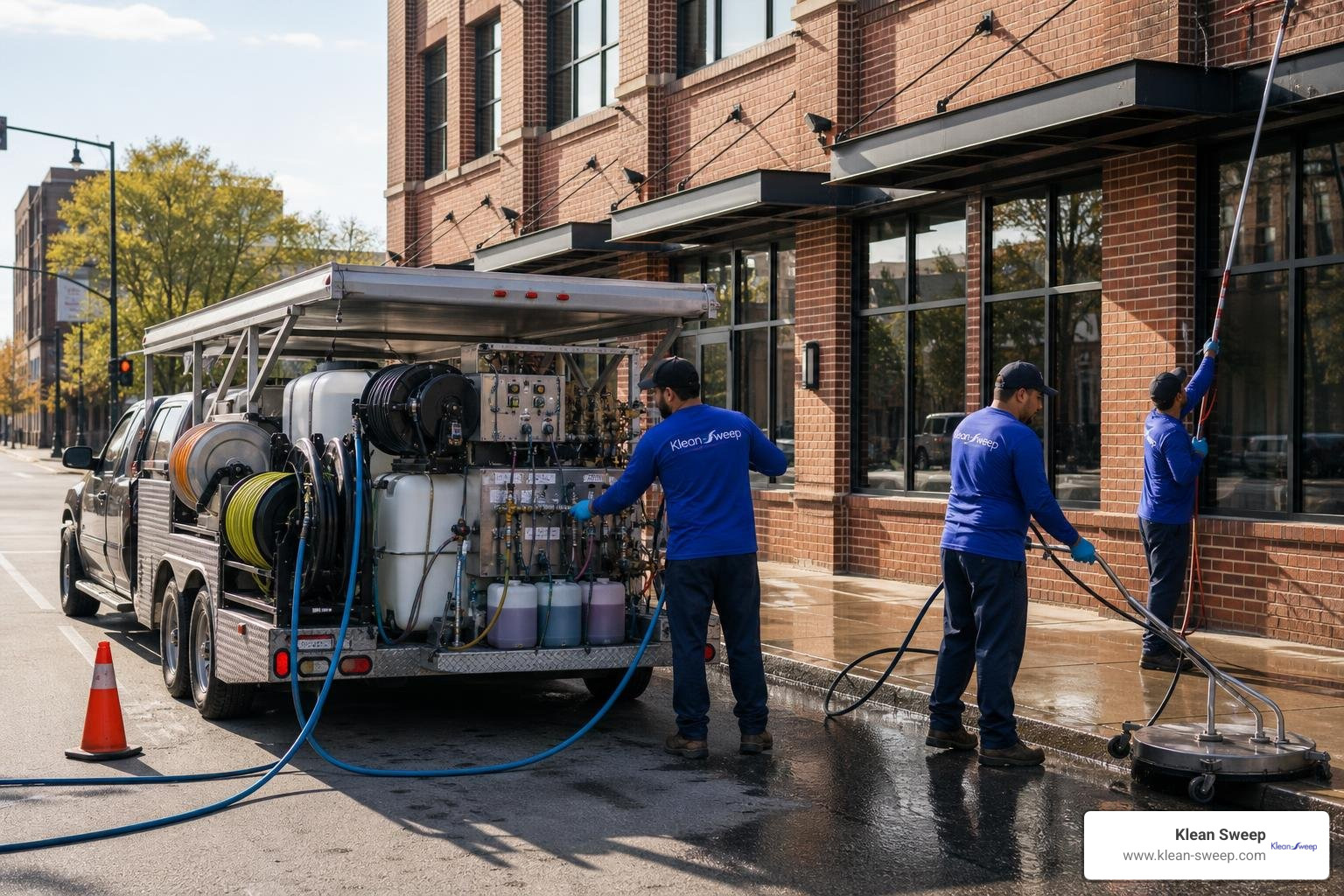
Commercial mobile rigs feature industrial burners capable of generating consistent 180°F to 200°F wash water, commercial dual-wand setups, and low-pressure downstream chemical injection manifolds. Furthermore, commercial properties require full EPA compliance. Industrial setups incorporate high-volume vacuum recovery berms and mobile filtration units to catch and contain wash water runoff before it enters municipal storm systems. Implementing these measures ensures properties adhere to crystal clear pressure washing standards that safeguard both infrastructure and surrounding ecosystems.
Selecting Nozzles and Equipment for Brick Power Washing
Nozzle selection controls the fan angle and surface impact of the water stream:
- 25-Degree Green Fan Nozzle: Used for general commercial brick washing. It distributes water across a medium fan pattern, preventing concentrated impact while providing sufficient shear to rinse away dissolved dirt.
- 40-Degree White Fan Nozzle: An ultra-safe, wide-spray nozzle optimal for applying detergents or performing final flood-rinsing on sensitive brick surfaces.
- 0-Degree Red Pinpoint Tip: Never use on brick. This hyper-concentrated stream acts like a hydraulic chisel, cutting deep grooves into brick faces and pulverizing mortar beds.
- Rotary Surface Cleaners: For expansive commercial brick plazas, walkways, and exterior steps, an 8-inch to 12-inch wand-mounted rotary surface cleaner provides uniform cleaning without causing zebra-striping or blowing mortar lines out of level flatwork.
Specialized Detergents and Chemical Pre-Treatments
Effective commercial cleaning relies on chemistry doing the heavy lifting rather than water pressure. Technicians apply tailored solutions depending on the nature of the deposit:
- Alkaline Cleaners & Surfactants: Excellent for emulsifying vehicle soot, general exterior grime, and hydrocarbon residues across retail storefronts and loading docks.
- Sodium Hypochlorite (SH) Pre-Treatments: Diluted, professional-grade biocide mixtures applied at low pressure eliminate organic growths like green algae, mildew, and moss within 5 to 10 minutes of dwell time.
- Masonry-Safe Acidic Cleaners: Specialized, buffered acidic cleaners remove calcium leaching, efflorescence, and mortar smear. Strong unbuffered chemicals like muriatic acid should be avoided, and never mix acid with any chlorinated cleaner or trisodium phosphate (TSP) due to the formation of hazardous vapors.
- Specialized Stripping Agents: When addressing exterior paint, applying proven methods to remove paint from brick using biodegradable, enzymatic, or solvent-based strippers softens synthetic coatings before a warm, low-pressure rinse.
Step-by-Step Commercial Masonry Cleaning and Restoration Workflow
Restoring commercial masonry requires an organized, safe workflow from initial setup through final inspection.
Commercial Site Preparation and Environmental Containment
Safety, environmental protection, and public risk mitigation must be completed before starting equipment:
- Site Staging and Safety Signage: Deploy safety cones, high-visibility perimeter tape, and hazard signage to direct pedestrian traffic away from commercial walkways and storefronts.
- Storm Drain Isolation: Block on-site storm drain grates and catch basins using weighted polyurethane drain covers, sediment filter socks, or vacuum collection dams to intercept detergent runoff.
- Utility Protection: Cover exterior building electrical outlets, high-voltage utility boxes, fire alarm pull stations, and security cameras with water-resistant tarps and industrial tape.
- Landscape Hydration: Saturate adjacent decorative landscaping, turf, and flower beds with clean water prior to chemical application. This keeps root systems hydrated and prevents them from absorbing overspray.
Executing Safe Brick Power Washing on Commercial Façades
Once the commercial work zone is secured, technicians carry out the systematic washing protocol:
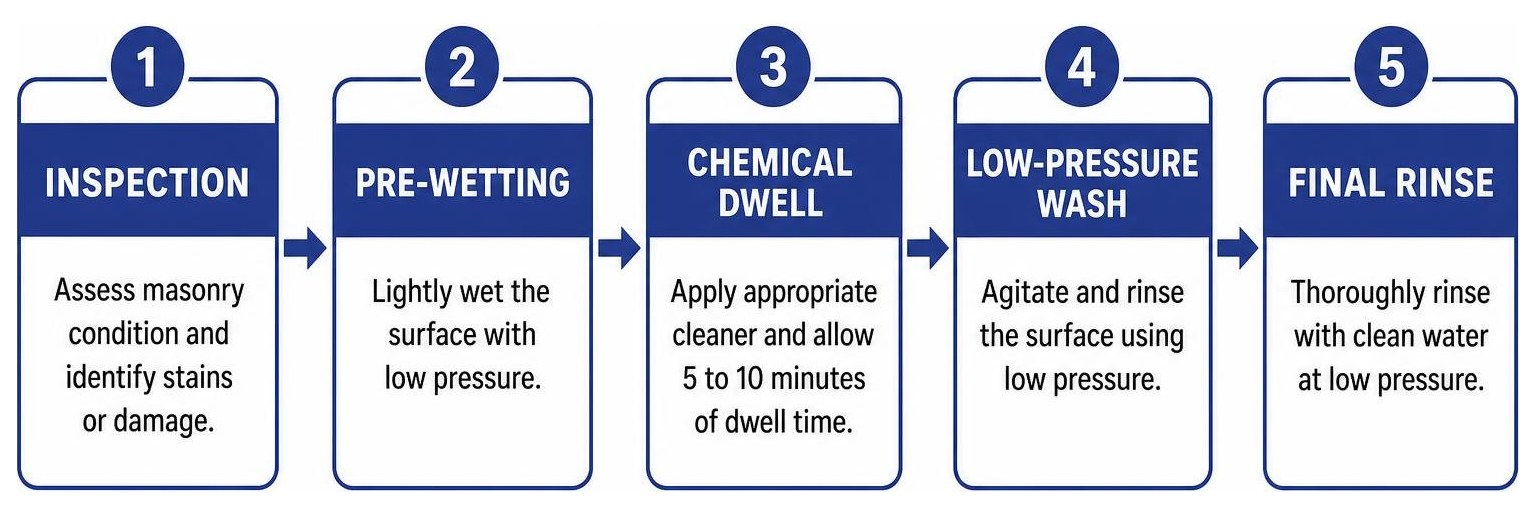
- Masonry Pre-Wetting: Saturate the brick wall with clean, low-pressure water from the bottom up. Fired brick acts like a dry sponge; pre-wetting prevents porous masonry from absorbing detergents deep into its core.
- Chemical Application: Apply the targeted detergent or biocide mix using a dedicated low-pressure chemical nozzle or foam proportioner. Always apply cleaning solutions from the bottom of the wall moving upward to prevent uneven streaks and drip patterns.
- Controlled Dwell Time: Allow the cleaning chemistry to work on the surface for 5 to 10 minutes. Do not allow detergents or bleach mixtures to dry completely on the warm brick face.
- Low-Pressure Hot Water Wash: Using a 25-degree or 40-degree spray tip at 500 to 1,000 PSI, wash the masonry while holding the wand at a consistent 45-degree angle. Maintain a safe standoff distance of 8 to 12 inches from the wall, working systematically across horizontal brick courses.
- Top-Down Flood Rinse: Switch to wide-angle, low-pressure rinsing and flush the entire facade starting from the top down. This thoroughly cleans away lifted soil, dislodged soot, and chemical residues.
Neutralization, Rinsing, and Post-Cleaning Protection
After applying alkaline or acidic specialty washes, the masonry must be thoroughly rinsed to return the wall surface to a neutral pH balance. Unneutralized chemical residues left within brick pores can cause future white salt haze or degrade mortar joints over time.
Once the building facade has dried completely (typically 24 to 48 hours), commercial property managers often choose to apply a breathable silane or siloxane masonry water-repellent sealer. Unlike topical acrylic coatings that trap moisture inside the wall, silane-siloxane sealers penetrate deep into the substrate, allowing internal water vapor to escape while repelling wind-driven rain, atmospheric vehicle soot, and exterior mold development.
Targeted Stain Removal: Efflorescence, Graffiti, Grease, and Paint
Commercial properties face tough, specialized stains that general surface washing cannot resolve. Treating these problems requires precise chemical strategies combined with professional hot water units.
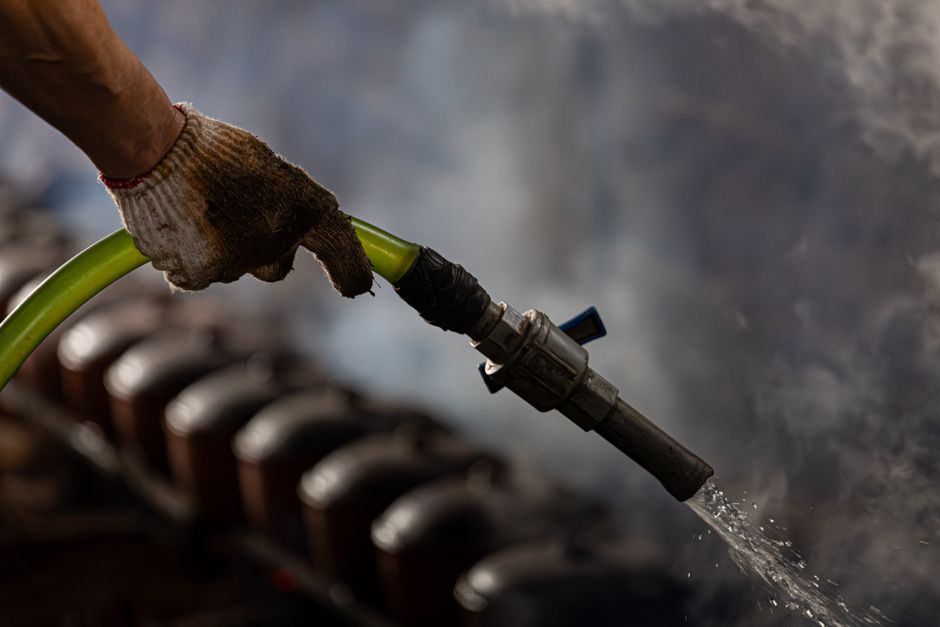
For stubborn industrial accumulations, incorporating specialized commercial steam cleaning services rapidly lifts embedded hydrocarbons, road oils, and gum from exterior brick entries and concrete walkways.
Removing Efflorescence and Hard Water Mineral Salts
Efflorescence appears as a powdery, white mineral haze across exterior brick surfaces. It occurs when moisture within the brick dissolves internal water-soluble mineral salts and carries them outward; as the water evaporates at the surface, it leaves crystallized salt deposits behind.
Treating efflorescence requires a specialized, low-pH masonry salt remover. Technicians pre-wet the brick thoroughly, apply the buffered acidic cleaner, and agitate gently using stiff natural or nylon bristle brushes—never steel wire brushes, which scratch brick faces and leave behind tiny metal particles that turn into rust streaks. After a brief dwell time, the wall is flushed thoroughly with clean, low-pressure water to clear all dissolved salts.
Eliminating Commercial Graffiti and Paint Overspray
Vandalism tags and paint overspray require chemical release rather than destructive pressure blasting:
- Apply a heavy-bodied, biodegradable paint remover formulated specifically for porous masonry across the tagged area.
- Allow the product adequate dwell time (often 15 to 30 minutes) to break down synthetic pigments and binders.
- Wash the area with high-temperature water (180°F to 200°F) at a gentle 600 to 800 PSI, lifting the emulsified paint from the masonry texture.
- Perform a secondary light scrub with an alkaline cleaner to remove any remaining pigment shadowing or chemical residue.
Degreasing Loading Docks and Pedestrian Walkways
Loading docks, dumpster pads, and restaurant exterior perimeter brick often suffer from heavy oil, cooking grease, and vehicle fluid contamination. Cold water simply pushes oil around, setting the stain deeper into the masonry.
Technicians apply heavy-duty, commercial-grade alkaline degreasers that convert oily fats and hydrocarbons into water-soluble soaps. Following chemical application, industrial hot water power washers delivering 190°F thermal output dissolve the grease on contact. Vacuum recovery systems immediately capture the emulsified oily runoff, protecting nearby stormwater drains and maintaining facility safety standards.
Frequently Asked Questions About Commercial Brick Cleaning
How often should commercial exterior brick surfaces be washed?
Commercial brick façades, retail entryways, and exterior walkways generally benefit from scheduled washing once a year. Properties situated along busy transportation corridors, shaded lots prone to algae, or dining districts with heavy foot traffic may require bi-annual service to control exhaust soot, organic growth, and surface grease accumulation.
Can power washing damage exterior mortar joints and sealants?
Yes. Direct, high-pressure water streams exceeding 1,500 PSI or narrow pinpoint nozzle tips will blast away joint mortar, strip exterior elastomeric sealants, and allow water intrusion behind the wall system. Maintaining an operating pressure between 500 and 1,000 PSI with wide fan nozzles protects pointing mortar while providing a thorough clean.
How is environmental wastewater contained during commercial washing?
Commercial cleaning teams comply with EPA Clean Water Act standards by placing inflatable or weighted berms around storm drains, directing runoff toward collection sumps, and employing truck-mounted vacuum reclamation units. The captured wash water is routed to an approved oil-water separator or off-site processing facility.
Conclusion
Commercial brick delivers timeless architectural appeal, structural strength, and outstanding longevity for retail centers, business parks, and corporate facilities. Protecting those masonry assets requires a balanced exterior cleaning approach that emphasizes low-pressure water delivery, advanced cleaning chemistry, thermal hot water capability, and strict environmental compliance.
At Klean Sweep, we have provided comprehensive, environmentally friendly exterior maintenance solutions across Southern California since 1969. Based in Torrance, CA, our family-owned business uses advanced commercial sweepers, vacuum water recovery equipment, and high-efficiency washing rigs to keep business facilities, parking structures, and commercial grounds in peak condition.
To keep your commercial brick, walkways, and exterior masonry clean, safe, and welcoming, contact our team to schedule professional steam cleaning and pressure washing services in Torrance CA.