

How Does the Los Angeles Street Sweeping Schedule Work?
To find your Los Angeles street sweeping schedule, enter your property address into StreetsLA’s interactive map lookup tool to identify your route code and enforcement hours, then verify whether your route falls on the 1st/3rd or 2nd/4th week cycle using the city’s master annual calendar. StreetsLA (the Bureau of Street Services) manages street cleaning across more than 4,700 curb miles where posted “No Parking” signs regulate curb access. For commercial facilities, industrial parks, and retail centers, these municipal schedules directly dictate when curbside parking is restricted for customers, employees, vendors, and delivery fleets.
Following municipal budget constraints and citywide hiring adjustments, the City of Los Angeles operates the majority of its street sweeping on a biweekly model rather than weekly service.
Under this biweekly framework, city routes are divided into two distinct operational cycles:
- 1st and 3rd Weeks of the Month: Sweepers service designated routes during the first and third calendar weeks.
- 2nd and 4th Weeks of the Month: Sweepers service the remaining routes during the second and fourth calendar weeks.
- 5th Weeks: During months that contain a fifth week (such as five-week months in 2026), municipal sweepers generally do not enforce biweekly parking restrictions on that fifth occurrence unless an exception is posted.
(Diagram: Biweekly Municipal Sweeping Schedule Workflow)
This schedule rotation significantly impacts commercial districts. When a route is restricted, curbs must remain completely unobstructed to allow mechanical broom sweepers to reach the curb line, where sediment, trash, and vehicle residue accumulate.
Municipal routes in Los Angeles also differ by operational time windows and route classifications:
- Night Patrol (NP) Routes: Typically marked with route identifiers containing “NP” (such as Route 3NP246). These operate during early morning hours—often between 4:00 AM and 6:00 AM—to sweep high-density commercial boulevards and transit corridors before peak morning delivery and customer traffic begins.
- Daytime Patrol (P) Routes: Regular daytime routes (such as Route 4P108 or Route 10P149) operate during standard daytime enforcement windows. These windows typically run in 2-hour or 3-hour blocks (e.g., 8:00 AM – 10:00 AM, 10:00 AM – 1:00 PM, or 12:00 PM – 3:00 PM).
Understanding whether your commercial frontage falls on an NP or P route—and whether it follows a 1st/3rd or 2nd/4th week rotation—allows commercial property managers to adjust loading dock hours, vendor deliveries, and employee parking schedules accordingly.
How Do You Find Your Specific Street Sweeping Route and Schedule in LA?
Pinpointing your facility’s exact municipal sweeping window prevents costly vehicle citations and logistics disruptions. Because posted signs on a single city block can vary from neighboring streets, commercial property operators should verify their route parameters digitally.
Here is the step-by-step lookup process:
- Access Official Municipal Tools: Visit the official Street Sweeping Near Me | Bureau of Street Services interactive map tool. Enter your commercial facility’s street address to view the designated route code, service days, and operating hours.
- Consult the Master Municipal Calendar: Cross-reference your route’s week rotation against the official Street Sweeping 2026 calendar published by the city. This calendar maps out exactly which dates correspond to the 1st/3rd and 2nd/4th week cycles throughout the year.
- Register for Municipal Alerts: Register your facility address through StreetsLA to receive automated email notifications 24 and 48 hours prior to scheduled sweeping. These automated notifications provide an operational buffer for facility managers to coordinate parking structure overflow and prevent commercial fleet citations.
- Track Route Identifiers Across Local Tools: Facility directors managing multiple commercial assets can consult our reference guide on where is the sweeper a guide to finding local schedules to track multi-property sweeping routes efficiently.
- Submit Municipal Service Inquiries: For questions regarding missed municipal routes or to report hazardous public street debris outside your commercial parcel, contact the city by dialing 311 or using the my311 mobile application (support available Monday–Friday 7:00 AM – 7:00 PM, weekends 8:00 AM – 4:45 PM), or email StreetsLA.ERT@lacity.org directly.

Navigating Surrounding Municipalities in Greater Los Angeles
Commercial properties operating outside the immediate City of Los Angeles municipal borders fall under independent municipal public works jurisdictions. Each surrounding municipality maintains distinct sweeping frequencies, parking enforcement rules, and holiday schedules:
- Beverly Hills: Commercial and arterial corridors are governed by the dedicated Street Sweeping Program | Beverly Hills, CA, which operates specialized commercial business district sweeping shifts.
- Pasadena: Commercial rights-of-way and boulevard sweeping operations are managed under municipal Street Sweeping schedules with strict overnight parking bans and specific daytime sweeping sectors.
- Torrance, Carson, and Brea: South Bay and North Orange County commercial hubs maintain individualized weekly or biweekly route schedules. For example, commercial industrial parks in Carson and Torrance coordinate sweeping to minimize interference with high-volume freight shipping lanes.
When commercial real estate portfolios span across municipal boundary lines, facility directors must avoid assuming City of LA biweekly rules apply everywhere. Always confirm whether the property falls under StreetsLA or an adjacent incorporated municipality.
What Are the Sweeping Schedules Across Major LA Zip Codes and Commercial Corridors?
The City of Los Angeles is divided into hundreds of distinct sweeping routes identified by alphanumeric codes. The density of routes within a zip code reflects the complexity of the street network, commercial corridor volume, and curb configurations.
The table below provides a comparative overview of route volumes and operational time blocks across key Los Angeles commercial zones:
| Zip Code | Primary Neighborhoods Covered | Total Sweeping Routes | Common Route Time Windows | Schedule Cadence |
|---|---|---|---|---|
| 90007 | Exposition Park, University Park, Adams-Normandie, Historic South-Central | 36 Routes | 4:00 AM – 6:00 AM (NP), 8:00 AM – 10:00 AM, 1:00 PM – 3:00 PM | Biweekly (1st/3rd & 2nd/4th) |
| 90026 | Echo Park, Silver Lake, Westlake, Chinatown, East Hollywood | 38 Routes | 8:00 AM – 10:00 AM, 10:00 AM – 1:00 PM, 12:00 PM – 3:00 PM | Biweekly (1st/3rd & 2nd/4th) |
| 90003 | South Park, Broadway-Manchester, Florence, Green Meadows, Vermont Knolls | 52 Routes | 7:00 AM – 9:00 AM, 8:00 AM – 11:00 AM, 12:00 PM – 2:00 PM | Biweekly (1st/3rd & 2nd/4th) |
| 90044 | Harbor Gateway, Harvard Park, Manchester Square, Vermont-Slauson | 52 Routes | 8:00 AM – 10:00 AM, 10:00 AM – 12:00 PM, 12:00 PM – 3:00 PM | Biweekly (1st/3rd & 2nd/4th) |
(Diagram: Commercial Curb Clearance and Logistics Management)
Downtown and Central Los Angeles (90007 and 90026)
In Central Los Angeles, commercial properties operate in dense, high-traffic corridors where curb turnover is continuous.
In zip code 90007, the city operates 36 distinct street sweeping routes across neighborhoods like Exposition Park (36 routes), University Park (14 routes), Adams-Normandie (16 routes), and Historic South-Central (26 routes). Commercial facilities along major thoroughfares often encounter early Night Patrol routes, such as Route 3NP246 (operating Thursday/Friday on the 2nd & 4th weeks from 4:00 AM to 6:00 AM) or daytime routes like Route 10P149 (Wednesday/Thursday on the 1st & 3rd weeks from 1:00 PM to 3:00 PM). Complete route listings can be reviewed via the 90007 Street Sweeping Schedule | SweepSpotter.
In zip code 90026, covering Echo Park, Silver Lake, Chinatown, and Westlake, StreetsLA manages 38 distinct routes. With high commercial activity along Sunset Boulevard and Alvarado Street, routes such as 4P108, 4P178, and 5P220 run staggered 2-hour and 3-hour windows (e.g., 8:00 AM – 10:00 AM or 11:00 AM – 2:00 PM). Commercial managers can track neighborhood route boundaries using the 90026 Street Sweeping Schedule | SweepSpotter.
South Los Angeles Commercial Corridors (90003 and 90044)
South Los Angeles features major commercial logistics corridors, industrial centers, and retail plazas that require careful management of curbside delivery access.
Zip code 90003 encompasses 52 street sweeping routes spanning Broadway-Manchester, Florence, Green Meadows, and South Park. Operating shifts run across Monday/Tuesday and Wednesday/Thursday rotations on 1st/3rd and 2nd/4th cycles, detailed in the 90003 Street Sweeping Schedule | SweepSpotter.
Similarly, zip code 90044 contains 52 routes across Harbor Gateway, Harvard Park, and Manchester Square. Major routes like Route 2P125 (operating Mondays on 2nd & 4th weeks from 8:00 AM to 10:00 AM) and Route 10P165 require commercial property owners to ensure curbside parking is cleared during scheduled hours. Facility teams can examine route details via the 90044 Street Sweeping Schedule | SweepSpotter and cross-reference wider city boundaries using our street sweeping schedule Los Angeles complete list.
How Can Commercial Properties and Drivers Avoid Street Sweeping Tickets?
Street sweeping parking citations issued by the Los Angeles Department of Transportation (LADOT) can disrupt operations and create friction for commercial tenants, corporate fleet managers, and patrons.
To ensure commercial operations run smoothly during municipal sweeping windows, consider these key strategies:
- Review Posted Signage Carefully: Always inspect physical signage on both sides of the street. In Los Angeles, opposing sides of the same street are swept on different days or during alternating time windows to maintain accessible parking on at least one side.
- Implement Structured Fleet Parking Protocols: Ensure delivery trucks, service vans, and employee vehicles are directed to on-site commercial parking structures or designated private surface lots during active municipal sweeping windows. Our operational guide on how to avoid Los Angeles street sweeping tickets outlines comprehensive fleet compliance strategies.
- Track Municipal Holiday Suspensions: LADOT suspends street sweeping parking enforcement on official city-recognized holidays. If a sweeping date coincides with an official holiday (such as New Year’s Day, Memorial Day, Independence Day, Labor Day, Thanksgiving, or Christmas), sweeping is canceled, and enforcement is lifted until the next scheduled biweekly cycle. Verify holiday schedules through our reference on Los Angeles street sweeping holidays everything you need to know.
- Maintain Unobstructed Curbs: Avoid staging waste bins, commercial roll-offs, or pallet staging in the public street gutter on designated sweeping mornings. Sweepers cannot clean around physical obstructions, leaving trash behind and increasing environmental stormwater violations.
Why Is Regular Sweeping Critical for Stormwater Compliance and Exterior Property Maintenance?
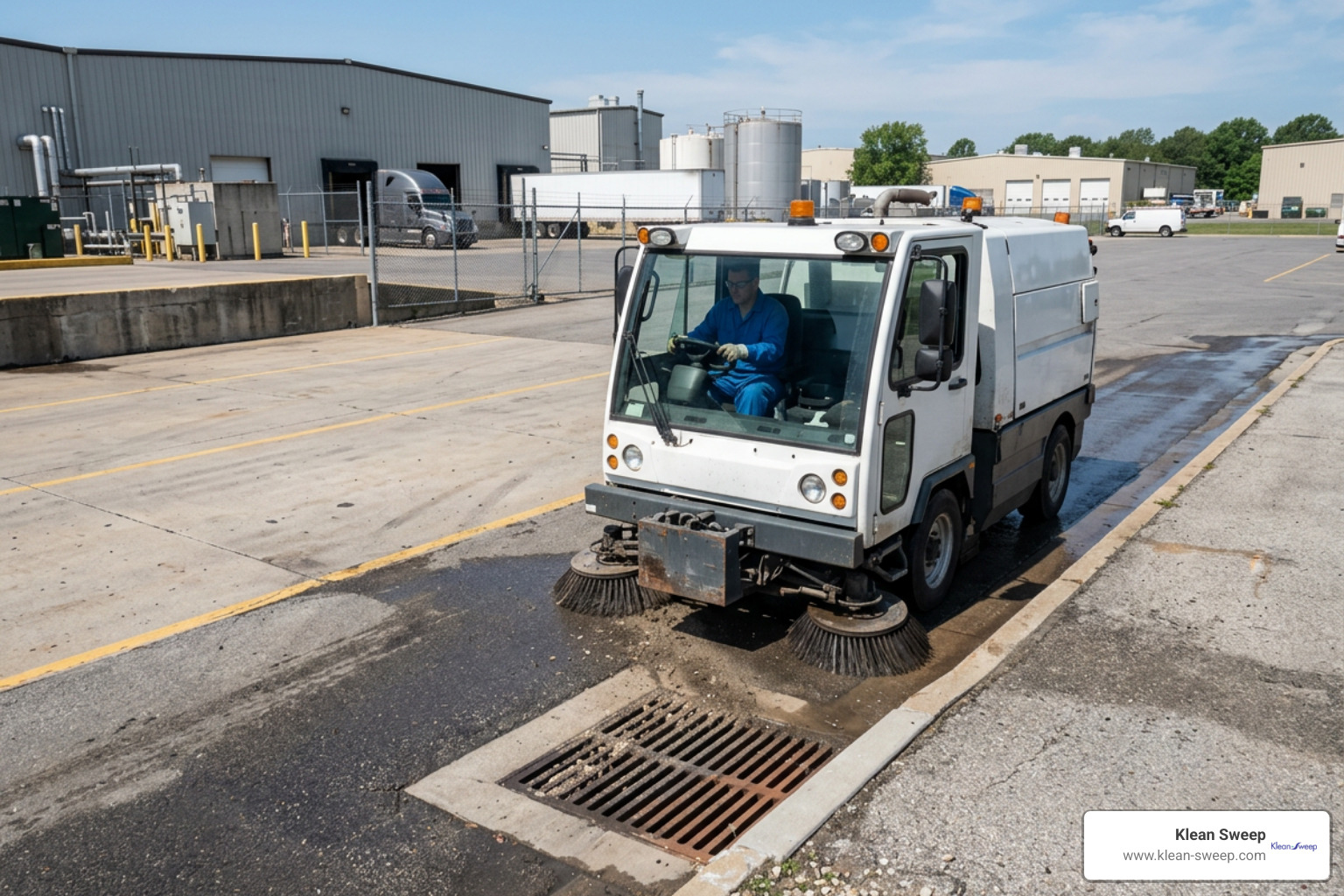
While municipal street sweepers maintain public curbs and public rights-of-way, commercial property owners and facility managers are legally responsible for maintaining their private exterior surfaces—including customer parking lots, multi-level parking structures, loading docks, and private access roads.
Stormwater Drainage and Environmental Compliance
In Southern California, stormwater runoff from commercial parking lots and industrial driveways flows directly into municipal storm drain networks, which discharge into local rivers and the Pacific Ocean without passing through a water treatment plant.
Under the EPA Clean Water Act and municipal National Pollutant Discharge Elimination System (NPDES) / MS4 permit regulations, commercial properties must prevent pollutants—such as motor oil, heavy metals from brake dust, chemical residues, tire rubber, and loose trash—from entering storm drains.
Regular power sweeping serves as a frontline Best Management Practice (BMP). As explored in our analysis of why street sweeping is the unsung hero of clean water, mechanical sweeping intercepts hazardous particulates before rain events wash them into storm catch basins.
Preserving Pavement and Protecting Property Value
Accumulated gravel, sand, glass, and grit act like sandpaper under heavy vehicle traffic, accelerating pavement wear, eroding asphalt sealcoats, and causing premature deterioration of parking structures.
Understanding the importance of street parking lot sweeping for clean and safe environments helps commercial asset owners minimize long-term capital repair costs while enhancing overall site curb appeal and safety.
Integrated Commercial Exterior Maintenance
A comprehensive exterior maintenance plan combines regular power sweeping with specialized services:
- Commercial Street and Parking Lot Sweeping: Scheduled regenerative air and mechanical broom sweeping for commercial centers, industrial parks, and parking structures.
- Stormwater Catch Basin Cleaning: Removing sediment buildup and debris from private catch basins to maintain proper water flow and regulatory compliance.
- Day Porter Services: Continuous on-site exterior cleaning, litter abatement, trash receptacle servicing, and perimeter maintenance.
- Pressure Washing and Steam Cleaning: High-temperature degreasing for loading docks, trash enclosures, building entrances, and oil-stained parking stalls.
- Concrete Floor Scrubbing: Heavy-duty scrub and recovery cleaning for multi-level commercial parking structures and industrial warehouse slabs.
Frequently Asked Questions About the LA Street Sweeping Schedule?
How does the City of Los Angeles define 1st/3rd and 2nd/4th week biweekly sweeping?
The City of Los Angeles determines biweekly cycles based on the calendar week in which dates fall, starting with the first day of the month:
- Week 1: Days 1 through 7 of the month.
- Week 2: Days 8 through 14 of the month.
- Week 3: Days 15 through 21 of the month.
- Week 4: Days 22 through 28 of the month.
- Week 5: Days 29 through 31 (when applicable).
If your facility’s route operates on the 1st and 3rd Tuesday, sweeping occurs on the Tuesday falling within Days 1–7 and Days 15–21. Official schedules can be verified using the StreetsLA 2026 annual calendar.
Does the city sweep commercial parking lots and private business roadways?
No. City of Los Angeles StreetsLA motor sweepers only service public streets, dedicated city thoroughfares, and publicly maintained curbs. Municipal sweepers do not enter private commercial parking lots, retail plazas, corporate office parks, multi-level parking structures, or private industrial alleys. Commercial property owners and facility managers must contract licensed private exterior maintenance contractors to sweep and maintain private vehicular surfaces.
What happens if a scheduled sweeping day falls on an official city holiday?
When a scheduled street sweeping day coincides with an official City of Los Angeles holiday, sweeping operations for that route are canceled for that day. Parking restrictions are not enforced on city holidays, and LADOT does not issue citations for street sweeping violations on those dates. Municipal sweeping on that specific route simply resumes during its next regularly scheduled biweekly cycle.
How Can Klean Sweep Help Maintain Your Commercial Exterior and Parking Areas?
Keeping track of municipal street sweeping schedules helps protect your commercial fleet, staff, and visitors from parking citations along public curbs. However, maintaining the cleanliness, safety, and regulatory compliance of your private commercial property requires a dedicated exterior maintenance program.
At Klean Sweep, we have provided commercial property managers, industrial facilities, and corporate centers with environmentally friendly exterior maintenance solutions across the greater Los Angeles area since 1969. As a family-owned and operated company based in Torrance, CA, our team utilizes state-of-the-art sweeping equipment and trained operators in professional uniforms to ensure your property remains pristine, safe, and fully compliant with local stormwater standards.
Our comprehensive commercial exterior maintenance services include:
- Scheduled commercial street and parking lot sweeping for retail centers, corporate parks, and parking structures
- Day porter services for exterior litter management and common area care
- Industrial pressure washing and steam cleaning for walkways, docks, and dumpster enclosures
- Concrete floor scrubbing and degreasing for commercial parking garages
- Stormwater runoff management and catch basin maintenance
Ensure your commercial exterior makes the right impression while staying compliant with Southern California environmental regulations. Contact the Klean Sweep team today to schedule a customized site evaluation and exterior maintenance program for your Los Angeles property.