

Why Streak-Free Concrete Floor Scrubbing Starts With the Right Approach
Concrete floor scrubbing done right leaves a clean, streak-free surface — done wrong, it leaves behind residue, water marks, and embedded grime that make a commercial property look neglected.
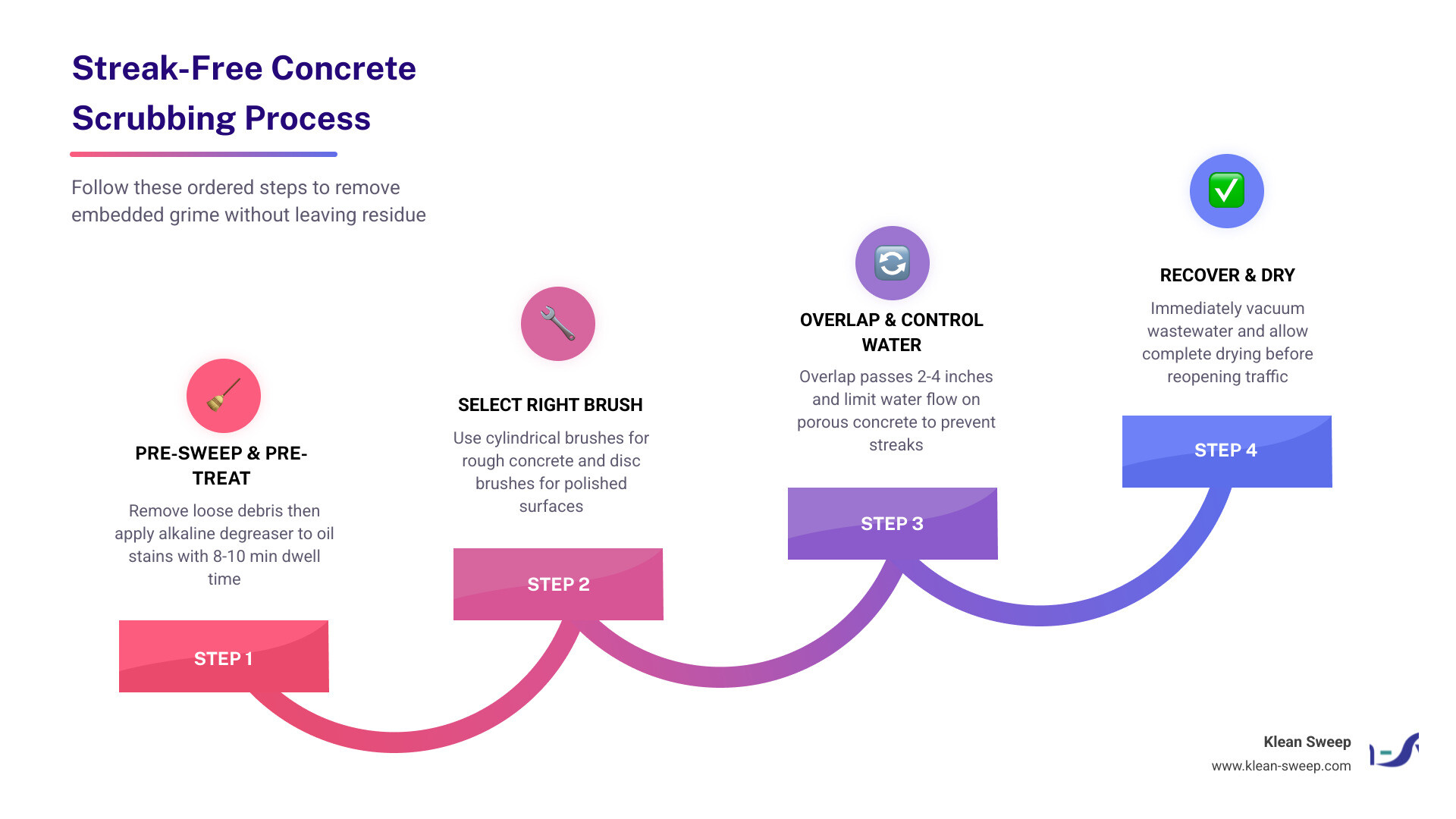
Here is a quick overview of how to scrub concrete floors without streaks:
- Pre-sweep the surface to remove loose debris before any water touches the floor.
- Pre-treat oil and grease stains with an alkaline degreaser — allow 8–10 minutes of dwell time.
- Choose the right brush — cylindrical for rough or debris-heavy concrete, disc for polished or sealed surfaces.
- Make overlapping passes — overlap each path by about 2–4 inches to avoid missed strips.
- Use controlled water flow — too much water on porous concrete leads to streaks and slow drying.
- Recover wastewater immediately with the machine’s squeegee and suction system.
- Allow the floor to dry completely before reopening to foot or vehicle traffic.
Concrete floors in parking structures, warehouses, and commercial facilities are porous. Oil, tire marks, and dust don’t just sit on the surface — they sink in. That makes routine scrubbing more than a cosmetic task. It is a critical part of maintaining a safe, compliant, and professionally presented property.
I’m Jana Hanson, and I’ve been leading Klean Sweep’s exterior maintenance operations across the greater Los Angeles area since 2012, building on over 55 years of company experience that includes concrete floor scrubbing for commercial and industrial clients of every size. In the sections below, I’ll walk you through exactly how we approach streak-free results — from equipment selection to chemical choice and technique.
Why Commercial Concrete Floors Require Specialized Care
At first glance, concrete looks indestructible. It supports thousands of tons of structural weight, withstands heavy vehicle traffic in busy parking structures, and handles the daily wear and tear of industrial operations. However, beneath that tough exterior lies a highly porous, sponge-like material.
Plain, unsealed concrete has millions of microscopic pores. When vehicles leak engine oil, transmission fluid, or coolant, these contaminants do not simply pool on top of the surface. They migrate deep into the concrete’s pores. Over time, these embedded fluids chemically bind with the concrete, creating dark, slippery stains that are incredibly difficult to lift with standard cleaning methods.

Furthermore, heavy vehicle traffic creates friction, leaving behind unsightly tire marks. In dry Southern California locations like Torrance, Carson, and Pasadena, concrete floors also act as a magnet for fine atmospheric dust, brake dust, and windblown grit. If left unaddressed, this abrasive grit is ground into the surface by tires and forklifts, slowly eroding the concrete and contributing to premature wear on forklift wheels and bearings—a mechanical headache that can easily cost upwards of $1,000 to repair.
This is why regular, professional maintenance is so essential. Proper mechanical scrubbing pulls these deeply embedded contaminants out of the pores rather than just smearing them across the surface. Investing in routine deep cleaning preserves long-lasting concrete durability, improves traction to prevent slip-and-fall accidents, and dramatically enhances the professional image of your facility.
Choosing the Right Equipment for Concrete Floor Scrubbing
When it comes to commercial concrete floor scrubbing, using the wrong machine can actually make your floors look worse. To achieve a streak-free, uniform finish, you must match your scrubbing equipment to the specific type of concrete surface you are cleaning.
The most critical decision you will make is choosing between a disc brush and a cylindrical brush configuration.
- Disc Brushes: These flat, circular pads rotate parallel to the floor. Disc systems deliver up to 45% more downward force than cylindrical systems, making them the absolute best choice for flat, smooth, polished, or sealed epoxy floors. However, because they rely on flat surface contact, they require a thorough pre-sweeping pass. If you attempt to use a disc scrubber on a floor covered in loose grit or small debris, the pads will drag those particles across the floor, leaving behind swirl marks and scratches.
- Cylindrical Brushes: These roller-style brushes rotate perpendicular to the floor at high speeds (typically 600 to 800 RPM). Cylindrical scrubbers are highly effective for rough, textured, or heavily soiled raw concrete. A major advantage of cylindrical decks is their ability to “wet-sweep” small debris, wood splinters, and metal shavings directly into a built-in, removable tray while simultaneously scrubbing the floor. This eliminates the need for a separate sweeping step in many industrial environments.
To help you decide which setup fits your facility’s needs, here is a direct comparison of the two brush types:
| Feature | Disc Brush System | Cylindrical Brush System |
|---|---|---|
| Best Surface Type | Polished, sealed, or smooth epoxy concrete | Rough, textured, or unsealed concrete |
| Downward Pressure | Extremely high (ideal for flat, stubborn stains) | Moderate (relies on high RPM speed) |
| Debris Handling | Requires thorough pre-sweeping | Wet-sweeps small debris into a built-in tray |
| Risk of Streaks | High if debris gets trapped under the pad | Low (excellent water recovery on rough surfaces) |
| Brush Speed | 200–400 RPM | 600–800 RPM |
To achieve professional-grade results on versatile commercial surfaces, we often rely on advanced equipment like the T300 Walk-Behind Floor Scrubber | Tennant Company. This machine offers adaptable down pressure (up to 109 lbs) and customizable brush decks, allowing operators to easily clean finished concrete, porous stone, and grout lines without leaving streaks.
Additionally, pay close attention to your machine’s squeegee material. While standard gum rubber squeegees work well for general water pickup, they quickly degrade, swell, and leave streaks when exposed to petroleum-based oils and greases. For industrial warehouses and parking garages, always opt for premium silicone or polyurethane squeegees, which offer superior oil resistance and clean water recovery.
Walk-Behind vs. Ride-On Machines for Concrete Floor Scrubbing
Choosing between a walk-behind and a ride-on scrubber generally comes down to two factors: the total square footage of your facility and the layout of the space.
- Walk-Behind Scrubbers: These compact units are ideal for facilities under 30,000 to 40,000 square feet. They offer exceptional maneuverability, making them perfect for navigating tight warehouse aisles, utility rooms, and congested loading docks. They are also easier to transport between different commercial properties.
- Ride-On Scrubbers: For large distribution centers, expansive manufacturing halls, and multi-level parking structures exceeding 50,000 square feet, a ride-on scrubber is practically mandatory. These machines feature wider cleaning paths (typically 32 to 36 inches or more) and significantly larger water tanks. By reducing operator fatigue and increasing speed, ride-on units dramatically lower labor costs and allow large-scale cleaning operations to be completed in a fraction of the time.
Key Features to Look For in Commercial Scrubbers
If you are looking to purchase or rent a commercial concrete scrubber, keep these essential features in mind:
- Tank Capacity: Concrete is highly thirsty. It typically requires 20% to 30% more cleaning solution than non-porous surfaces like vinyl composition tile (VCT). Look for a machine with a generous solution tank (at least 10 to 15 gallons for walk-behinds, and 30+ gallons for ride-ons) to minimize time-wasting trips to the drain-and-fill station.
- Power Source: Battery-powered, cordless scrubbers offer the ultimate in safety and maneuverability, eliminating tripping hazards in busy commercial spaces. Look for maintenance-free AGM or lithium-ion batteries that offer at least 3 to 4 hours of continuous runtime.
- Down Pressure and RPM Control: Look for machines with adjustable brush pressure. This allows you to apply light pressure on delicate sealed coatings to prevent dulling, while retaining the ability to ramp up the pressure when scrubbing raw, grease-stained concrete.
- Water Recovery and Suction Power: A high-performance vacuum motor is the secret weapon of streak-free cleaning. If the machine leaves behind even a thin film of dirty water, that water will dry into unsightly grey streaks. Look for dual-stage or three-stage vacuum motors that pull every drop of dirty water out of the concrete’s pores.
Selecting the Best Cleaning Solutions and Chemicals
Using the right machine is only half the battle; you also need the correct chemical chemistry to break down tough soils without damaging the floor.
For raw, unsealed concrete floors covered in motor oil, grease, and heavy carbon buildup, heavy-duty alkaline degreasers are the industry standard. These high-pH cleaners work by saponifying fats and oils, breaking them down into water-soluble compounds that can be easily scrubbed away and vacuumed up.
However, if you are cleaning polished, stained, or epoxy-coated concrete, high-pH chemicals can be disastrous. Over time, aggressive alkaline cleaners will etch polished concrete, stripping away its natural luster and leaving it looking dull and cloudy. For these decorative surfaces, always use specialized pH-neutral cleaning solutions. These neutral cleaners are formulated to lift surface dirt and dust without reacting with the concrete’s chemical densifiers or wearing down protective sealers.

When preparing a concrete surface for staining, sealing, or deep restoration, you may need a product that cleans and profiles the surface simultaneously. An eco-friendly acid alternative, such as SureCrete Concrete Renovator: SCR – 1 Gallon – Concrete Exchange, is highly effective. Unlike traditional muriatic acid, which requires a hazardous neutralization step with baking soda or ammonia, SCR goes deep into the concrete’s pores to bubble out impurities and can simply be rinsed away with clean water, leaving zero residue behind.
Step-by-Step Guide to Streak-Free Concrete Floor Scrubbing
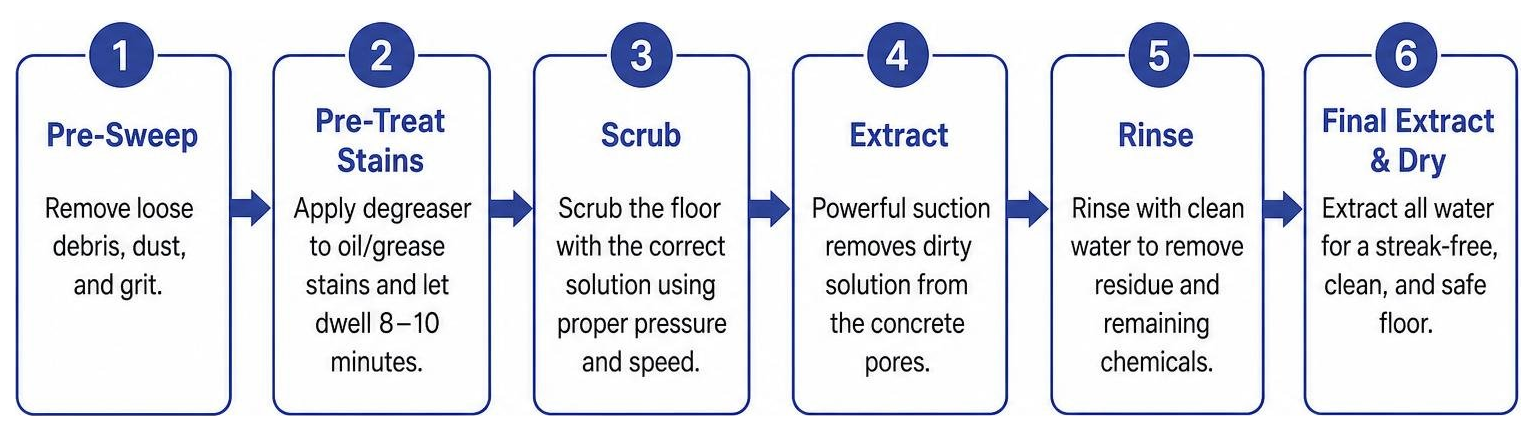
Achieving a flawless, streak-free finish on a commercial concrete floor requires a systematic approach. Skipping even a single step can result in dirty water drying back into the concrete’s pores, leaving behind hazy grey lines. Follow this professional process for pristine results:
Step 1: Pre-Sweep and Debris Removal
Never start scrubbing a floor that hasn’t been thoroughly swept. If you are using a disc scrubber, any loose pebbles, dust, or metal shavings trapped under the spinning pad will act like sandpaper, leaving swirl marks and scratches on the floor. Use a dedicated industrial sweeper or a high-quality push broom to clear the entire area.
Step 2: Pre-Treat Stubborn Oil and Grease Stains
Mechanical scrubbing alone is rarely enough to lift deeply set oil stains. Walk the floor before running the machine and apply a commercial-grade alkaline degreaser directly to any dark oil patches. Let the chemical sit (dwell) on the stain for 8 to 10 minutes. This gives the active ingredients time to break the chemical bond between the oil and the porous concrete. Do not let the chemical dry on the floor; mist it with a little water if it begins to evaporate.
Step 3: Configure Your Scrubber Settings
Fill your scrubber’s solution tank with clean water and the appropriate dilution of your chosen cleaning chemical. Set your brush down pressure and water flow rate. Because raw concrete is highly porous, you will need to set the water flow slightly higher than you would for a tiled floor to ensure the brushes stay adequately lubricated.
Step 4: Execute Overlapping, Methodical Passes
Begin scrubbing the floor, working in straight, methodical lines from the innermost part of the facility toward the exit. To prevent leaving uncleaned “strips” between passes, always overlap your previous path by 2 to 4 inches (5 to 10 cm). Maintain a steady, moderate walking or driving speed. Moving too quickly doesn’t give the brushes enough time to agitate the dirt, nor does it give the vacuum squeegee enough time to recover the water.
Step 5: Monitor Water Recovery and Tank Levels
Keep a close eye on the floor behind you. If you notice any water trails, wet spots, or streaks, stop immediately. This usually indicates that the recovery tank is full, the vacuum intake is clogged with debris, or the squeegee blade is worn or improperly adjusted. Empty the dirty water recovery tank and rinse it out every 15 to 20 minutes to prevent sludge buildup.
Step 6: Address Edges and Hard-to-Reach Corners
Scrubbing machines are fantastic for wide-open areas, but they cannot reach tight corners, columns, or the edges along walls. For these areas, employ professional power washing techniques or manual detail scrubbing with a stiff-bristled hand brush. Wash the grime out into the path of the scrubber so the machine can vacuum up the dirty water.
Step 7: Final Rinse and Complete Drying
If you used a heavy concentration of detergent or degreaser, perform a final “water-only” pass with the scrubber. This removes any lingering chemical residue that could dry into a sticky film, which would quickly attract new dirt. Keep all traffic off the floor until it is completely dry.
Safety Precautions and Operator Best Practices
Operating heavy commercial floor scrubbers requires strict adherence to safety protocols to protect both the operator and the public.
- Slip-and-Fall Prevention: Wet concrete is incredibly slippery. Always place highly visible “Wet Floor” warning signs at all entry points and around the perimeter of the cleaning zone. Ensure the scrubber’s squeegee is functioning perfectly so that the floor dries within minutes of the machine passing over it.
- Proper Ventilation: When operating fuel-powered scrubbers (LP or diesel) or using strong chemical degreasers in enclosed spaces like underground parking garages in Beverly Hills or Los Angeles, proper ventilation is critical. Ensure exhaust fans are running and doors are propped open to prevent the buildup of dangerous fumes.
- Machine Maintenance: At the end of every shift, perform basic preventative maintenance. Clean the squeegee blades, empty and rinse both the solution and recovery tanks, and clear any wrapped hair or debris from the brushes. Many modern machines feature yellow-colored “touchpoints” to guide operators through daily maintenance checks.
- Battery Safety: If using lead-acid battery-powered scrubbers, always charge them in a well-ventilated area to safely disperse hydrogen gas. Wear protective eyewear and gloves when checking battery water levels.
Frequently Asked Questions about Concrete Floor Scrubbing
How often should commercial parking structures and warehouses be scrubbed?
The frequency of concrete floor scrubbing depends entirely on your facility’s traffic volume and environmental exposure. High-traffic commercial parking structures in busy metropolitan areas like Los Angeles, Carson, and Pasadena typically require a deep mechanical scrub at least once or twice a year to remove built-in tire marks, oil spills, and heavy road grime.
For busy logistics warehouses operating multiple shifts daily, we recommend a weekly or bi-weekly scrubbing schedule. This prevents the accumulation of fine concrete dust and abrasive grit, protecting both your inventory and your forklifts.
Can a floor scrubber remove deep oil and grease stains from unsealed concrete?
Yes, but it requires a combination of the right chemical chemistry, adequate dwell time, and mechanical agitation. For deeply set oil stains, you must pre-treat the area with a concentrated alkaline degreaser and let it dwell for up to 10 minutes before running the scrubber over it. For incredibly stubborn, historic oil saturation, combining a hot-water pressure wash with mechanical scrubbing yields the best results.
What is the difference between a concrete scrubber and a power washer?
While both tools are used for deep cleaning, they function very differently:
- Power Washers: Use high-pressure water streams (often 3,000 PSI or more) to blast dirt and grime off surfaces. They are fantastic for outdoor concrete, vertical walls, and tight corners, but they use a massive volume of water and do not have built-in water recovery. This can lead to environmental runoff issues if not properly contained.
- Concrete Scrubbers: Rely on mechanical agitation (spinning brushes or pads) combined with chemical solutions and downward pressure. Crucially, scrubbers feature an integrated vacuum and squeegee system that immediately recovers 95%+ of the dirty water, leaving the floor nearly dry and completely safe for immediate use. This makes them the ideal choice for indoor warehouses, parking structures, and areas with strict environmental runoff regulations.
Conclusion
Achieving a clean, streak-free finish on commercial concrete requires the right machinery, proper chemical selection, and a careful, methodical technique. Cutting corners by skipping pre-sweeping, using worn-out squeegees, or rushing your passes will only result in unsightly streaks and leftover grime.
When maintaining commercial properties in Southern California—including Los Angeles, Torrance, Beverly Hills, Carson, Pasadena, and Brea—partnering with a professional service ensures the job is done safely, efficiently, and in compliance with local environmental regulations. Please note that we focus exclusively on commercial exterior maintenance and do not offer residential services.
Since 1969, Klean Sweep has been a trusted, family-owned leader in commercial property maintenance. We utilize state-of-the-art ride-on and walk-behind scrubbers, eco-friendly cleaning solutions, and highly trained crews to deliver pristine, streak-free results for parking structures, warehouses, and industrial facilities.
Let us handle the hard work. Contact us today to schedule your next professional concrete floor scrubbing service and keep your facility looking its absolute best!