

Is Acid Washing Your Basement Floor Worth It?
Acid washing a concrete basement floor is one of the most effective ways to clean, open, and prepare your slab for stain, epoxy, or sealer — but it’s not always the right move for every situation.
Here’s a quick summary of what you need to know:
| Question | Quick Answer |
|---|---|
| What does acid washing do? | Removes laitance, opens concrete pores, improves coating adhesion |
| Is it the same as acid staining? | No — washing preps the surface; staining adds permanent color |
| Best acid to use indoors? | Phosphoric acid (milder fumes) or diluted muriatic (1:10 ratio) |
| Do you need it for a 2-year-old floor? | Usually yes — curing compounds and laitance block stain penetration |
| Biggest safety risk? | Toxic fumes indoors — ventilation and PPE are non-negotiable |
| Safer alternative? | Mechanical grinding — more control, no chemicals |
Your basement floor has real potential. Whether you’re prepping for acid stain, epoxy, or a clear sealer, the prep work determines everything. Skip it, and coatings peel. Rush it, and stains won’t take. Do it right, and you get a durable, good-looking floor that can handle whatever a basement throws at it — including flooding.
This guide walks you through the full process: what acid washing actually does to concrete, when to use it (and when not to), how to do it safely indoors, and what to apply once the floor is ready.
I’m Jana Hanson, and through my work leading Klean Sweep’s exterior and concrete maintenance operations across greater Los Angeles, I’ve seen how proper surface prep — including knowing when and how to acid wash a concrete basement floor — makes the difference between a finish that lasts and one that fails within a year. That hands-on experience is exactly what this guide is built on.
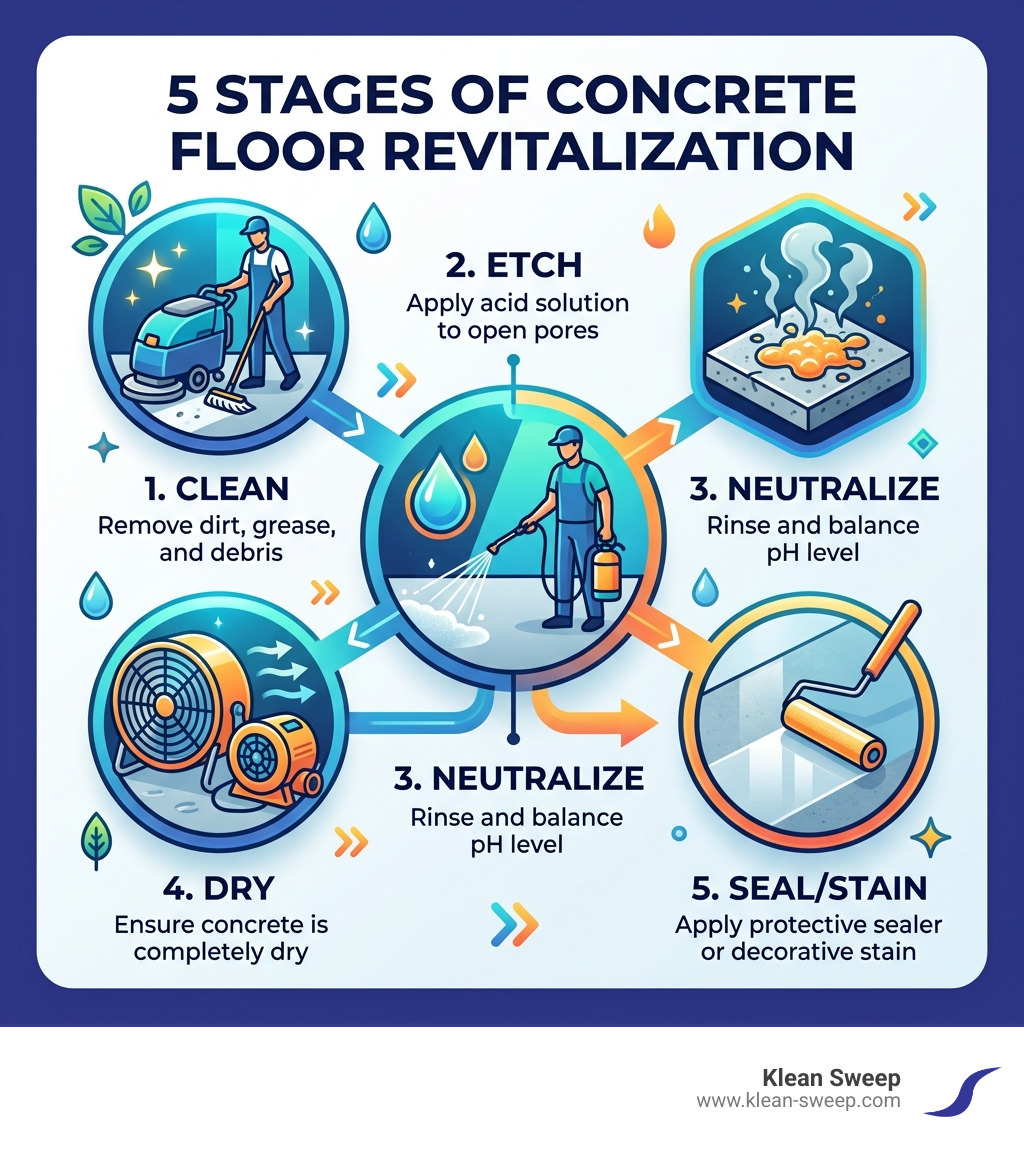
Understanding the Acid Wash Concrete Basement Floor Process
When we talk about an acid wash concrete basement floor, we are essentially discussing “chemical sanding.” Concrete might look solid, but it is actually a highly porous material—or at least it should be. Over time, a fine, powdery layer called laitance forms on the surface during the curing process. This layer, along with dirt, minerals, and old curing compounds, acts like a plastic wrap over your floor, preventing stains and sealers from getting inside.
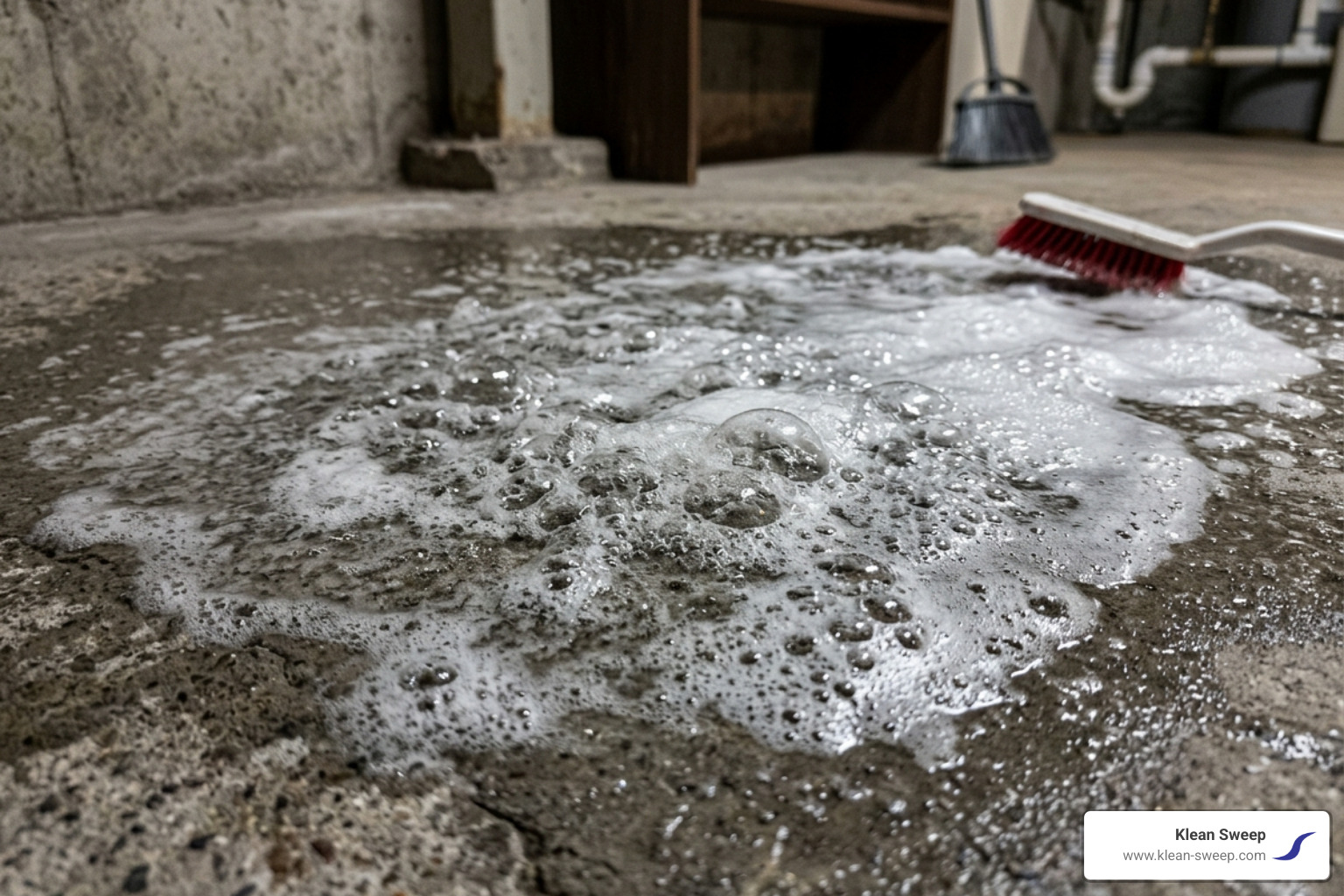
Acid washing, also known as etching, uses a mild acid solution to react with the calcium carbonate in the concrete. When the acid hits the floor, you’ll see it start to fizz and bubble. This reaction is the acid literally eating away that top “skin” of the concrete to expose the micro-pores underneath. By the time you’re done, the floor should feel slightly rough, similar to fine-grit sandpaper.
It is vital to distinguish between etching and staining. We often see homeowners get these confused! Etching is the preparation—it cleans and opens the pores. Staining is the decoration—it adds the color. If you try to stain a floor that hasn’t been properly etched, the color will just sit on top and eventually wash away or peel.
| Feature | Acid Washing (Etching) | Acid Staining (Coloring) |
|---|---|---|
| Primary Purpose | Surface preparation and pore opening | Aesthetic enhancement and permanent color |
| Chemical Action | Reacts with calcium to strip the top layer | Reacts with minerals to create marbled colors |
| Final Texture | Rough, like fine sandpaper | Smooth (depends on the sealer used) |
| Required Equipment | Plastic sprayers, stiff brushes, neutralizers | Sprayers, specialized stains, sealers |
Preparing Your Acid Wash Concrete Basement Floor
Before you even touch a bottle of acid, you need to know if your floor is ready to receive it. We recommend the “water-drop test.” Pour a small amount of water onto various sections of your basement floor. If the water beads up, there is a sealer or grease present that the acid cannot penetrate. If the water soaks in and darkens the concrete, you’re in business.
For those with a 2-year-old basement floor, don’t assume it’s “clean enough” just because it’s relatively new. Even at two years, concrete can still have residual curing compounds or a dense, machine-troweled finish that is too smooth for epoxy or stain to bond with. Proper Acid Washing a Basement Floor: Prep, Safety, and Coating Preparation – Flooring Scan ensures that the mechanical bond between the concrete and your new coating is as strong as possible.
Choosing the Right Acid Wash Concrete Basement Floor Sealer
Once the etching is complete, you have a “blank slate.” However, an etched floor is very thirsty and vulnerable to spills. You must protect it. In April 2026, the trend in Southern California basements is moving toward water-based acrylic sealers. These provide a beautiful satin finish without the heavy chemical odors associated with solvent-based products—a major plus for indoor air quality.
When selecting a sealer, consider “moisture vapor transmission.” Basements are notorious for dampness. You want a sealer that allows the concrete to “breathe” slightly so that moisture from the ground doesn’t build up under the sealer and cause it to cloud or flake. For more insights on choosing products that last, check out our More info about concrete floor durability.
Step-by-Step Guide to Etching and Staining
Ready to get to work? This is a project that requires patience and precision. For an 1800 sq ft basement, you’ll want to work in manageable 10×10 foot sections to ensure the acid doesn’t dry on the surface before you can rinse it.
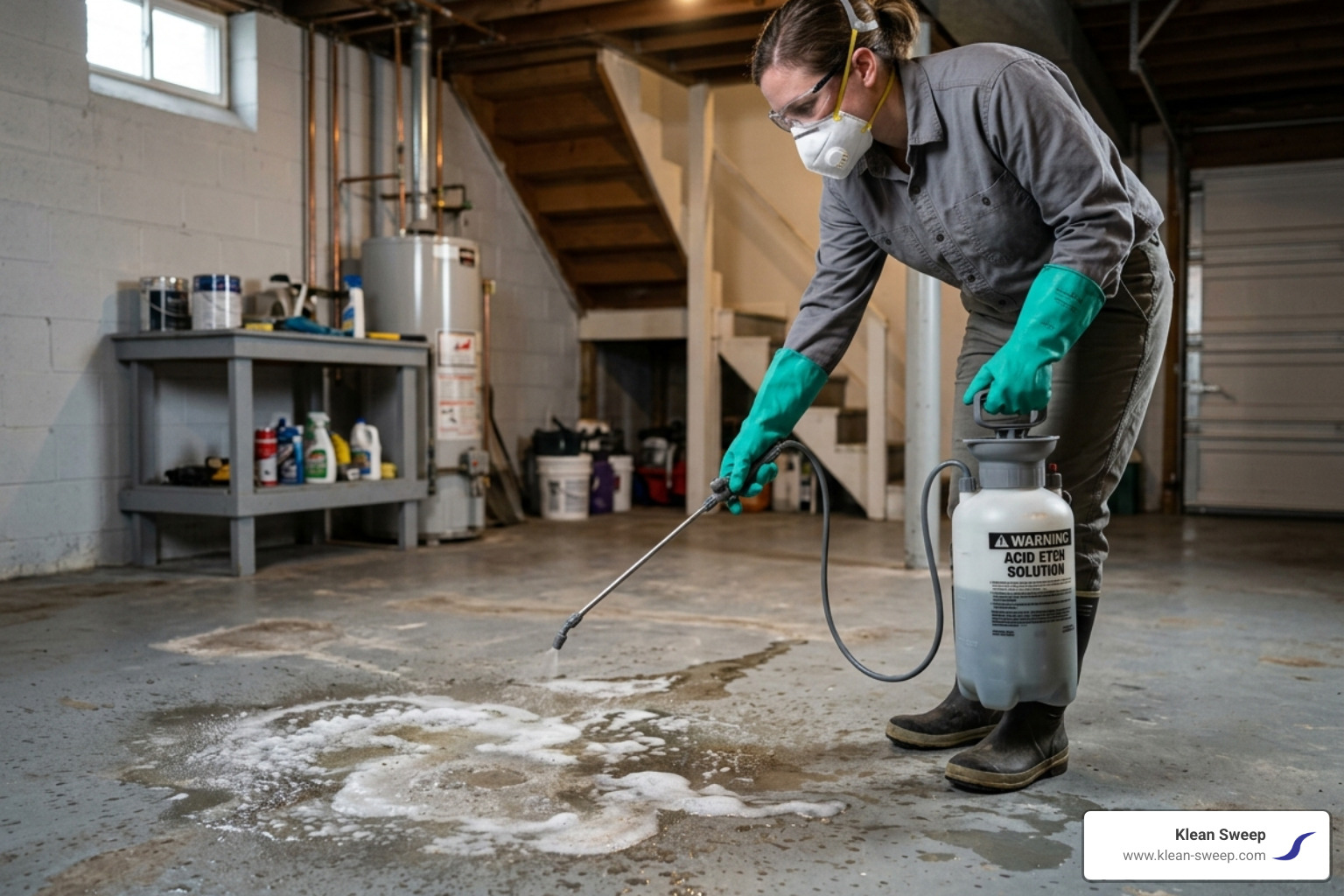
- The Deep Clean: Use a heavy-duty degreaser to remove any oil or grease. Acid will not react with oily spots, leaving you with an uneven etch.
- The Dilution: For muriatic acid, a standard ratio is 1 part acid to 10 parts water. If you are using phosphoric acid (which we often recommend for indoor use because it has fewer fumes), a 1:4 ratio is more common. Always pour acid into water, never water into acid.
- Application: Using an all-plastic pump sprayer, apply the solution evenly.
- Dwell and Scrub: Let the solution fizz for about 5 to 10 minutes. Use a stiff-bristle broom to scrub the solution into the pores.
- Rinse and Repeat: Do not let the acid dry! Rinse it immediately once the fizzing stops.
For a deep dive into professional-grade etching techniques, the How to Acid Wash Concrete (Concrete Etching) – Concrete Network offers excellent technical benchmarks.
Neutralizing and Rinsing Without a Floor Drain
The biggest challenge in a Los Angeles basement is often the lack of a floor drain. You cannot simply hose out the acid; you have to manage the wastewater. This is where neutralization becomes your best friend.
Once the etching is done, you must stop the chemical reaction. We use a mixture of 1 pound of baking soda to 5 gallons of water (or a specialized ammonia-based neutralizer). Pour this over the floor to bring the pH level back to neutral (around 7.0).
To remove the water, use a high-powered wet-dry vacuum or a commercial carpet cleaning machine. We often have to rinse the floor three or four times with clean water, vacuuming each time, until the water comes up perfectly clear. If you leave any white, chalky residue behind, your sealer will fail.
Drying Times and Stain Application
Don’t rush the dry time! Even if the surface looks dry, the deep pores of the concrete are still holding onto moisture. We recommend waiting at least 24 hours—and in humid conditions, up to 72 hours—before applying your stain or sealer.
If you’re applying an acid stain, the metallic salts in the stain will react with the lime in the concrete to create those beautiful, variegated colors. After the stain has sat for the manufacturer’s recommended time (usually 4 to 24 hours), you must neutralize it again before sealing. If you’re looking for professional help with the heavy lifting of cleanup, see our More info about professional pressure washing.
Safety, Equipment, and Indoor Precautions
We cannot stress this enough: safety is paramount. Muriatic acid is highly corrosive and produces intense fumes that can burn your respiratory tract and eyes.
- PPE: You need a respirator with acid gas cartridges, heavy-duty rubber gloves, safety goggles (not just glasses), and long sleeves/pants.
- Ventilation: Open every window and use high-volume fans to pull air out of the basement.
- Protection: Acid will eat through metal and damage wood. Mask off your baseboards with plastic sheeting and tape. Use only plastic buckets and sprayers; metal parts will corrode instantly.
- The Golden Rule: Always add acid to water (W.A.R. – Water Acid Ratio). Adding water to acid can cause a violent, heat-generating reaction that splashes acid back onto you.
Professional Alternatives: When to Skip the Acid
While a DIY acid wash concrete basement floor is possible, there are times when it’s better to go mechanical. At Klean Sweep, we often recommend mechanical grinding for indoor spaces in Torrance and Los Angeles.
Mechanical grinding uses diamond abrasives to “shave” the top layer of concrete.
- Pros: No toxic fumes, no hazardous wastewater to dispose of, and it provides a much more consistent “Concrete Surface Profile” (CSP).
- Dust Containment: Modern grinders are hooked up to HEPA vacuums, making the process virtually dust-free.
- Efficiency: It’s often faster for large 1800+ sq ft areas and eliminates the risk of “over-etching” which can weaken the concrete.
If you are concerned about the environmental impact of chemical runoff or have sensitive family members in the house, grinding is the superior choice. You can learn more about these mechanical standards at How to Acid Etch Concrete > Articles > Ghostshield®.
Frequently Asked Questions about Basement Concrete
Is acid washing necessary for a 2-year-old basement floor?
Yes, usually. Even though the concrete isn’t “old,” it likely has a layer of laitance or residual curing agents from the original construction. Without etching or grinding, your stain or epoxy will be trying to bond to a layer of dust rather than the solid concrete slab.
What are the most common mistakes to avoid?
The #1 mistake is skipping the neutralization step. If the floor remains acidic, the sealer will not cure properly and will eventually turn into a sticky, peeling mess. The #2 mistake is sealing while the concrete is still damp. Always use a moisture meter or the “plastic sheet test” (tape a square of plastic to the floor for 24 hours; if there’s condensation under it, it’s too wet to seal).
Will prior acid washing affect the ability of acid stain to bond?
It can. Acid stains rely on a chemical reaction with the lime in the concrete. Because acid washing removes some of that surface lime, a very heavy etch might result in a lighter stain color. We always recommend testing a small, inconspicuous patch—like in a closet or under where the water heater will sit—to see how the color develops.
Conclusion
Transforming your basement starts from the ground up. Whether you choose a DIY acid wash concrete basement floor or opt for professional mechanical prep, the goal is the same: a clean, porous, and neutralized surface ready for a stunning finish.
At Klean Sweep, we’ve been a family-owned staple in Torrance since 1969. We know Southern California concrete better than anyone. If the thought of handling muriatic acid in a confined basement feels a bit daunting, or if you want the precision that only state-of-the-art industrial grinders can provide, we are here to help. We provide environmentally friendly, professional concrete cleaning and prep services throughout the greater Los Angeles area to ensure your basement makeover lasts for decades.
Transform your basement with professional concrete floor cleaning in Torrance, CA