

Why Standard Mops Fail on Rough Concrete Floors
The best mop for rough concrete floors is one built to handle abrasive, textured surfaces without shredding apart after a few uses. Here’s a quick answer:
Best mops for rough concrete floors:
| Mop Type | Best For | Key Advantage |
|---|---|---|
| Knitted fleece cotton/polyester wet mop | Industrial & commercial concrete | 2X absorbency, lasts up to 75 washes |
| Looped-end microfiber wet mop | Non-slip, textured, terrazzo | Holds 7x its weight in water, anti-microbial |
| Large flat microfiber mop | Warehouses, large floor areas | Wide coverage, traps dust in pores |
Rough concrete is brutal on cleaning tools. The raised texture, grit, and non-slip coatings that make these floors safe to walk on are the exact same properties that shred standard cotton mop heads in just a few passes.
For property managers overseeing warehouses, parking structures, or industrial facilities in the Los Angeles area, a destroyed mop isn’t just an annoyance — it’s a recurring cost, a cleaning inefficiency, and a compliance risk.
The wrong mop leaves fibers behind, spreads dirt instead of lifting it, and falls apart before the floor is even clean.
I’m Jana Hanson, and after leading Klean Sweep through decades of exterior and industrial floor maintenance across Southern California, I’ve seen which tools hold up on abrasive surfaces — and which ones don’t. My experience on the front lines of commercial concrete cleaning shapes every recommendation in this guide to finding the best mop for rough concrete floors.
Introduction

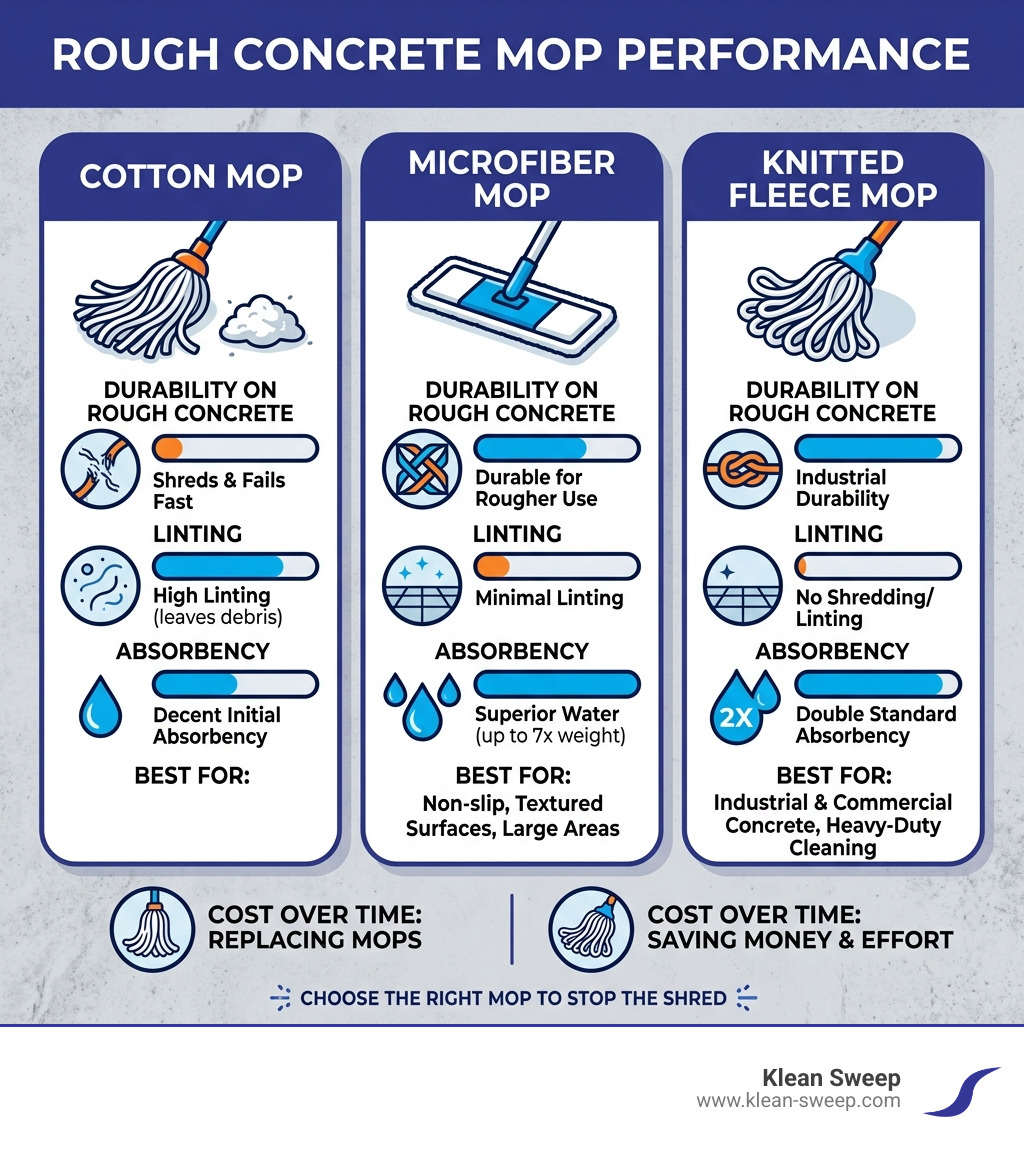
The challenge of cleaning abrasive surfaces lies in the physics of the floor itself. Whether you are dealing with non-slip surfaces, textured stone, or raw industrial concrete, these floors act like giant sheets of sandpaper. When you drag a standard “cut-end” cotton mop across them, the tiny hooks and pits in the concrete snag the individual fibers. Within minutes, your mop is “balding,” leaving behind white lint that is nearly impossible to remove once the floor dries.
This “mop shredding” isn’t just a nuisance; it’s a drain on your maintenance budget. If you are replacing mop heads every week because they’ve been chewed up by a warehouse floor, you are throwing money away. Furthermore, cleaning efficiency in industrial spaces depends on tools that can actually lift the heavy soils—like carbon, soot, and grease—that settle into concrete pores.
Maintaining the durability of your floor also requires the right touch. Rough surfaces trap more moisture and dirt than polished ones. Without the best mop for rough concrete floors, you’re often just moving dirty water around, which can lead to slippery residues or long-term staining. In the high-traffic environments of Torrance and Los Angeles, having a professional-grade approach to floor care is the only way to ensure your facility stays safe and presentable.
Key Features of the Best Mop for Rough Concrete Floors
When shopping for the best mop for rough concrete floors, you need to look past the generic options at the hardware store. Professional-grade mops for abrasive surfaces have specific engineering features that prevent them from falling apart.
Benefits of Looped Ends vs. Cut Ends
Traditional mops have “cut ends,” meaning the yarn ends are loose. On rough concrete, these loose ends are easily snagged and pulled out. The best mop for rough concrete floors features looped ends. These loops create a continuous strand that is much harder for the concrete to “grab” and tear away. Not only does this stop shredding, but it also allows the mop to cover more surface area with each pass.
Importance of Tail Bands
A tail band is a piece of fabric sewn across the bottom of the mop strands. This keeps the loops spread out evenly. Without a tail band, mop strands bunch up, leading to “skipping” on textured floors. A banded mop ensures consistent contact with the floor, which is vital for deep cleaning the low spots in a textured surface.
The Science of Knitted Fleece and Polyester Blends
Modern material science has given us the knitted fleece cotton/polyester blend. This isn’t your grandma’s cotton mop. This blend offers 2X the absorbency of traditional cotton, which is crucial for porous concrete that tends to “drink” cleaning solutions. The polyester provides the “scrubbing” strength and durability to resist abrasion, while the knitted fleece provides the thirst needed to pick up heavy liquid spills.
Secure Attachment: 5-Inch Headbands
For industrial use, we always recommend a 5-inch headband. This larger headband is designed to be used with heavy-duty clamp-style handles. On a high-friction rough floor, a flimsy mop handle will snap or the mop head will slip out. A 5-inch headband provides the surface area needed for a “Gripper” style handle to hold the mop head securely, even when the floor is pulling back.
Proper tool selection is the first step in Concrete Floor Cleaning for Long-Lasting Durability.
Mop Performance Comparison Table
| Feature | Standard Cotton | Microfiber | Knitted Fleece Blend |
|---|---|---|---|
| Durability on Grit | Low (Shreds) | Medium | High |
| Absorbency | 1X | 7X | 2X |
| Launderability | Poor | High | Premium (75+ washes) |
| Best Surface | Smooth Tile | Indoor Concrete | Rough/Abrasive Concrete |
Top Mop Types for Abrasive and Textured Surfaces
Selecting tools for abrasive floors requires an understanding of the specific “grit” of your surface. A non-slip kitchen floor in a Torrance restaurant has different needs than a broom-finished concrete loading dock in Los Angeles.
For non-slip surfaces, the goal is to find a mop that glides. Specialized mops like the Rubbermaid Rough-Floor Wet Mop or the Triple S models are specifically designed for these environments. These mops often use a unique “knitted” yarn that creates a smoother glide over aggressive textures.
When dealing with stone and terrazzo, you need a mop that is soft enough not to scratch the finish but durable enough to handle the grout lines. Industrial-grade standards for warehouses and auto shops usually point toward high-capacity wet mops that can handle heavy degreasers like Zep Extra Industrial Concrete and Masonry Floor Cleaner – Fast Acting – Zep Inc. .
Why Microfiber is the Best Mop for Rough Concrete Floors
Microfiber has revolutionized the way we clean indoor concrete. Unlike natural fibers, microfiber is a synthetic material that can be split into strands thinner than a human hair.
- 7x Weight Capacity: Microfiber can hold up to seven times its weight in water. This is essential for wet mopping indoor concrete where you want to apply enough solution to loosen dirt but don’t want to leave puddles.
- Superior Dirt Trapping: The tiny “hooks” in microfiber reach into the microscopic pores of the concrete to pull out dust and allergens that a cotton mop would simply skip over.
- Hygiene & Resistance: Microfiber is naturally anti-microbial and mildew resistant. This is a huge plus for facilities in Southern California where humidity can sometimes lead to musty mop odors.
If your concrete floor has deep-set stains or years of grime, sometimes a mop isn’t enough. In those cases, you may need to look into Steam Cleaning & Pressure Washing Services Near You to restore the surface before starting a regular mopping maintenance routine.
Heavy-Duty Wet Mops: The Best Mop for Rough Concrete Floors in Industrial Settings
In a warehouse or manufacturing plant, you need a “workhorse.” This is where the 24 oz heavy-duty wet mop shines. These are often sold in case packs of 12 because they are the standard for professional crews.
The key to the value of these mops is launderability. A high-quality rough-floor wet mop can withstand up to 75 commercial launderings. While the initial cost might be higher than a cheap cotton mop from a big-box store, the fact that you can wash and reuse it 75 times makes it significantly cheaper in the long run. Synthetic blends (polyester/cotton) are the champions of longevity in high-friction environments because they don’t become brittle after multiple wash cycles.
Essential Cleaning Techniques and Chemicals
Even the best mop for rough concrete floors won’t work if your technique is off. Cleaning rough concrete is more about “lifting” than “wiping.”
The Figure-8 Pattern
The most effective way to mop a large concrete area is the Figure-8 pattern. By moving the mop in an overlapping “8” shape and working backward, you keep the leading edge of the mop in contact with the dirt. This prevents you from simply pushing the dirty water back into the pores you just cleaned.
Using the Right Chemicals
For industrial concrete, a generic floor cleaner often won’t cut through the oils and carbon. We recommend professional-grade degreasers like Zep Extra Industrial Concrete and Masonry Floor Cleaner – Fast Acting – Zep Inc. .
- Proper Dilution: Always follow the manufacturer’s instructions. For light cleaning, a high dilution is fine. For heavy oil removal in an auto shop, you’ll need a more concentrated mix.
- Dwell Time: On rough concrete, let the cleaner sit (dwell) for a few minutes before mopping. This allows the chemical to break the bond between the oil and the abrasive surface.
- Rinsing: Concrete is porous. If you don’t rinse thoroughly, the soap residue will dry in the pores and actually attract more dirt, making the floor look dingy faster.
For the toughest jobs, including carbon and deep oil removal, our team often utilizes Our Services / Steam Cleaning and Pressure Washing in Torrance, CA to get the floor back to a “like-new” state.
Maintenance and Longevity of Your Cleaning Tools
To get those 75 washes out of your mop head, you have to treat it right.
- Rinse After Use: Never leave a mop sitting in dirty cleaning solution. The chemicals (especially heavy degreasers) can break down the polyester fibers over time.
- Machine Washing: Use a mesh laundry bag to prevent the long mop strands from tangling in the washing machine’s agitator. Use a mild detergent and avoid high-heat drying, which can shrink the synthetic fibers.
- Hardware Check: Ensure your handle is compatible. A 5-inch headband requires a clamp-style handle (like the Rubbermaid Gripper). Using the wrong handle puts uneven stress on the fibers, leading to premature failure.
- Replacement Cycles: Even the best mop for rough concrete floors has a lifespan. Establish a replacement cycle. If you notice the “loops” are starting to fray or the mop head feels significantly lighter (meaning it’s lost fiber mass), it’s time to swap it out.
Frequently Asked Questions about Concrete Mops
How often should I replace a mop used on rough concrete?
For a high-quality knitted fleece mop, the benchmark is 75 washes. However, on extremely abrasive surfaces, you may need to replace it sooner. Look for “thinning” strands or a loss of absorbency. If the mop is no longer picking up water like it used to, the internal fleece fibers have likely worn down.
Can I use a steam mop on unsealed concrete?
You can, but with caution. Steam mops are great for eliminating bacteria through heat without using harsh chemicals. However, unsealed concrete is very porous. The “vapor” can penetrate deep into the slab. If you use a steam mop, ensure the area has good ventilation so the moisture can evaporate quickly. For long-term ease of maintenance, we always recommend sealing your concrete floors.
What is the best way to prevent mop shredding?
The absolute necessity is looped-end construction. Beyond that, using a synthetic blend (like polyester) provides the “slickness” needed to glide over grit. Another pro tip: Keep the mop sufficiently damp. A dry mop on rough concrete is a recipe for instant shredding. The water acts as a lubricant between the fiber and the floor.
Conclusion
Finding the best mop for rough concrete floors is about matching the durability of your tool to the aggression of your floor. By choosing looped-end, knitted fleece, or high-grade microfiber options, you can stop the “mop shred” cycle and start seeing real results in your facility’s cleanliness.
At Klean Sweep, we’ve been the Southern California experts in commercial property maintenance since 1969. As a family-owned business, we pride ourselves on using state-of-the-art equipment—from high-capacity mops to industrial-grade scrubbers like the Mopit Mid Floor Scrubber | Industrial Mop | Mopit | Mopit —to keep your property in top shape.
Whether you need a one-time deep clean or a recurring maintenance schedule in Torrance, Los Angeles, or the surrounding areas, we are here to help. Don’t struggle with the wrong tools and wasted man-hours. Let us bring the professional advantage to your facility.
Explore Our Services / Concrete Floor Cleaning in Torrance, CA to see how we can transform your rough concrete floors today.